V.C. Summer update: MOU signed with Brookfield

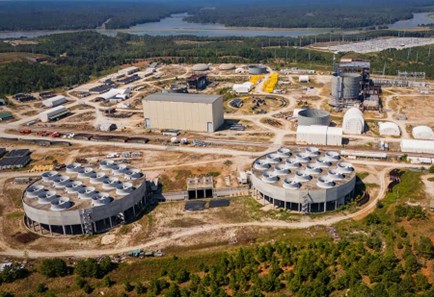
Santee Cooper, South Carolina’s state-owned electric and water utility, recently announced that it has signed a memorandum of understanding with Brookfield Asset Management.
HSB Global Inspection and Engineering Services – We provide specialized inspection and certification services for boilers, pressure vessels, nuclear components, and power plants worldwide. Wherever your business takes you, we’re at your side. Global reach. Local presence.

Santee Cooper, South Carolina’s state-owned electric and water utility, recently announced that it has signed a memorandum of understanding with Brookfield Asset Management.
Four public electric utilities—three based in Nebraska and one in Oklahoma—recently signed a memorandum of understanding to form the Great Plains New Nuclear Consortium. The first goal of that new consortium is to explore the feasibility of deploying 1–2 GW of new nuclear (potentially in the form of small modular reactors) within Nebraska.

Hash Hashemian
president@ans.org
At the time of this writing, it is only a few days before the American Nuclear Society’s 2025 Winter Conference & Expo in Washington, D.C., which is set to be an unmissable gathering of key nuclear leaders from across the United States and the world. Over the past three weeks, I have been working doggedly to obtain nearly $500,000 in sponsorships and recruit speakers for the conference.
I am thankful for the many generous donors—such as the Tennessee Valley Authority and Constellation—who continue to enable ANS to serve its members, in part by putting on the best conferences we possibly can.
I conducted much of my fundraising and recruitment while I was traveling to represent ANS at various universities, laboratories, and conferences. As I’ve mentioned before, I am focused on developing criteria around where ANS presidents travel to ensure that our resources are spent wisely; I am working with ANS past president Gail Marcus (2001–2002) to develop those criteria now, and in the meantime, I have been judicious in deciding which invitations to accept.
Here is a recap of recent industry happenings:

Agreement signed on advanced nuclear technology in space
Texas-based space technology and orbital logistics developer Space Ocean Corporation and New Mexico–based space nuclear power systems developer Space Nuclear Power Corporation (SpaceNukes) have signed a letter of intent to explore the integration of advanced nuclear reactor technology into future space missions. Space Ocean agreed to test SpaceNukes’ 10-kilowatt microreactor aboard its ALV-N satellite and, if performance criteria are met, to use SpaceNukes as a core supplier of reactors for future Space Ocean lunar and planetary missions. The companies also agreed to examine the integration of fluid delivery systems with reactor modules, to collect operational data to support technology readiness certification, and to form a joint working group to pursue additional space infrastructure and commercial opportunities.

Utah Gov. Spencer Cox joined Brigham City Mayor D. J. Bott this week to announce a new partnership among the state, city, Hi Tech Solutions, and Holtec International. The partnership plans to develop a “full-scale nuclear energy ecosystem” based in Brigham City that will feature advanced manufacturing, workforce development, and Holtec’s SMR-300.

Craig Piercy
cpiercy@ans.org
As 2025 winds down, it seems nuclear energy in the U.S. is now well on its way toward a renaissance, or resurgence, or whatever optimistic term you may use in your daily conversations.
New reactor designs, projects, and partnerships are being announced on a near-weekly basis; valuations of publicly traded nuclear companies are hovering near all-time highs; and AI’s thirst for reliable, clean electricity remains largely unquenched. The overall investment climate for nuclear energy has thawed dramatically. These days, it seems everyone from big Wall Street banks to individual investors is trying to get a piece of the nuclear action.
It’s the perfect time to talk about failure.
Yes, I know “nuclear failure” is not a topic on which we in the nuclear community like to dwell. For those of a certain age, it brings back bad memories of events beyond our control that shifted the trajectory of companies, careers, and lives for decades.
Here is a recap of recent industry happenings:
TerraPower’s Natrium plans for Wyoming, Utah move forward
TerraPower has reported a number of developments related to its Natrium sodium fast reactor project. In the project’s fifth round of procurement awards, the company awarded three supplier contracts to support the Natrium plant’s construction, which is underway in Kemmerer, Wyo., and is expected to be completed in 2030. AvanTech will design advanced sodium processing system modules and supporting skids for the Natrium plant, as well as fabricate and deliver the test and fill facility cold trap skid. Structural Integrity Associates will design and fabricate the sodium cover gas gamma spectroscopy analysis cabinet, a radiation monitoring system. PAR Systems will design and fabricate the pool handling machine, a specialized crane system for spent fuel pool operations.

The Department of Energy’s Office of Environmental Management has issued a request for offer (RFO) seeking proposals from U.S. companies to build and power AI data centers on the DOE’s Paducah Site in Kentucky. Companies are being sought to potentially enter into one or more long-term leasing agreements at the site that would be solely funded by the applicants.
The Department of Energy, Argonne National Laboratory, NVIDIA, and Oracle have agreed to a public-private partnership to deliver the DOE’s largest AI supercomputers, named Solstice and Equinox.

The U.S. government has signed an $80 billion deal with Westinghouse Electric Company to build large-scale nuclear reactors to support growing electricity demand from artificial intelligence.

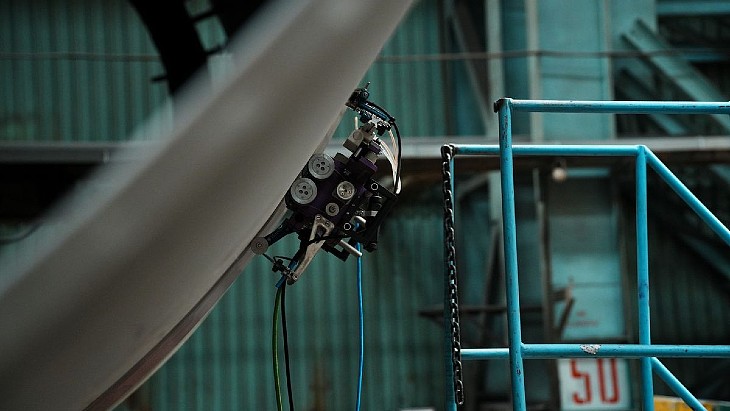
“Nuclear Spider” sounds like the title of a 1950s-era science-fiction movie, but it’s actually a fairly accurate description of a new robotic system deployed by Atommash, the mechanical engineering division of Rosatom, Russia’s state-owned nuclear utility.
The Canadian provinces of Alberta and Saskatchewan were the subject of two different announcements yesterday about new nuclear developments.
Google DeepMind—Google’s artificial intelligence development subsidiary—recently announced a new partnership with fusion start-up Commonwealth Fusion Systems. The goal of this collaboration is to leverage AI to both advance plasma simulation and discover novel control strategies, ultimately accelerating CFS’s timeline to deliver commercial fusion to the grid.
Here is a recap of recent industry happenings:
New international partnership to speed Xe-100 SMR deployment
X-energy, Amazon, Korea Hydro & Nuclear Power, and Doosan Enerbility have formed a strategic partnership to accelerate the deployment of X-energy’s Xe-100 small modular reactors and TRISO fuel in the United States to meet the power demands from data centers and AI. The partners will collaborate in reactor engineering design, supply-chain development, construction planning, investment strategies, long-term operations, and global opportunities for joint AI-nuclear deployment. The companies also plan to jointly mobilize as much as $50 billion in public and private investment to support advanced nuclear energy in the U.S.
The Department of Energy’s Office of Environmental Management and Office of Science and the National Nuclear Security Administration issued requests for proposals last month, seeking plans from companies to build AI data centers at the Oak Ridge Reservation, the Savannah River Site, and Idaho National Laboratory.

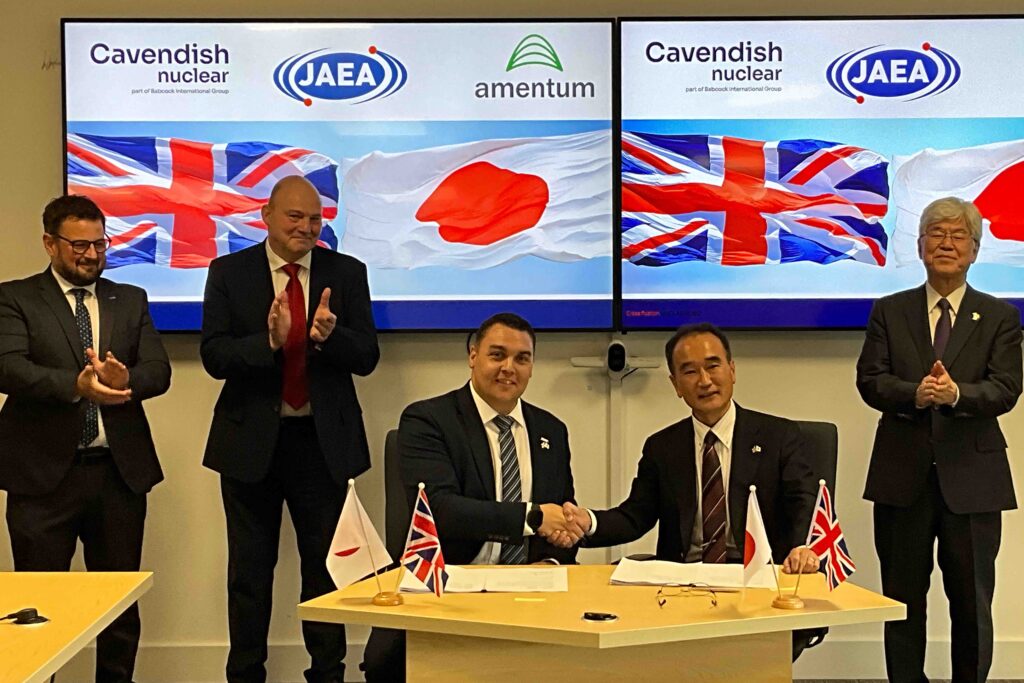
U.K.-based Cavendish Nuclear, a subsidiary of Babcock International, will work with Amentum on the next phase of work supporting the decommissioning of Japan’s Monju prototype fast reactor under a contract awarded by the Japan Atomic Energy Agency.

Over the past several weeks, there has been a lot of activity on the nuclear front in Kansas, ranging from new nuclear sitings to investments.
At a glance: TerraPower signed a memorandum of understanding with Evergy and the Kansas government on small modular reactors; Deep Fission announced investments in Kansas, Utah, and Texas; and the Kansas Board of Regents will invest $15 million in energy projects. Read on to get more information on these items.

After making waves last week at Idaho National Laboratory by breaking ground on its first Aurora Powerhouse reactor, Oklo has again made headlines this week by partnering with Stockholm, Sweden–based advanced reactor developer Blykalla.

Atlanta-based radiation equipment provider Mirion announced that it has entered into a definitive agreement to acquire Paragon Energy Solutions, a leading provider of engineering technology for the nuclear power industry. Mirion purchased Paragon, based in Fort Worth, Texas, from Windjammer Capital Investors for approximately $585 million.

The International Atomic Energy Agency presented its 2025 Global ISOP Innovation Award for AI to Blue Wave AI Labs, Constellation, and the Southern Company subsidiary Southern Nuclear for the companies’ collaborative work on Blue Wave's ThermalLimits.ai. The technology is an AI application that provides accuracy in online thermal limit forecasting for boiling water reactors.