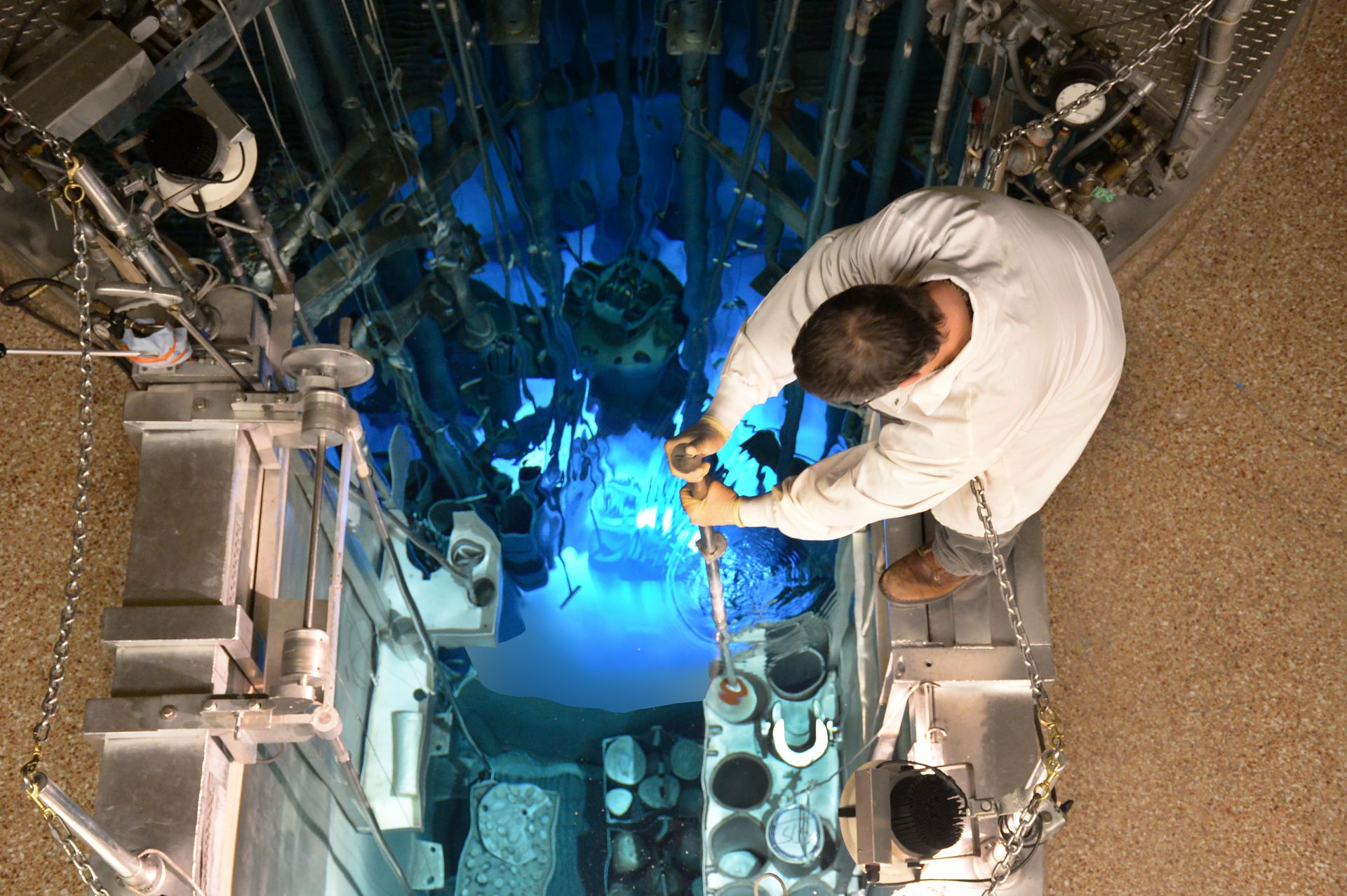
A reactor operator at MURR works with a sample can from the reactor pool. (Photo: University of Missouri)
On April 10, the University of Missouri (MU) took its first formal step toward building NextGen MURR when school officials issued the request for qualifications for the project. The RFQ is a solicitation for interested companies to offer the design, engineering, licensing, environmental, and developmental services that are needed for NextGen MURR, planned to be larger and more capable than the school’s existing University of Missouri Research Reactor (MURR)—which itself has been the most powerful research reactor and most intense neutron source on any U.S. campus since it began operating in 1966.
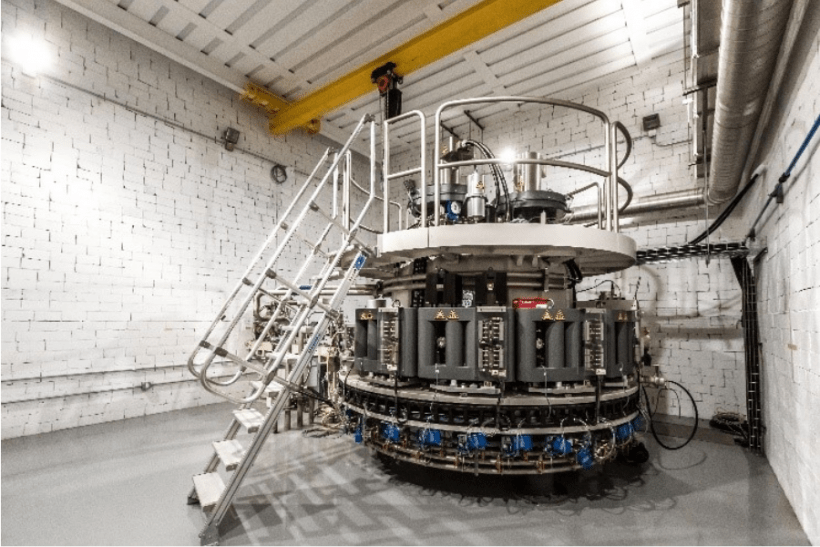
The electron accelerator that will be used for Mo-99 production at NorthStar’s newly completed facility in Wisconsin. (Photo: NNSA)
NorthStar Medical Radioisotopes has completed construction and all equipment installation at its new facility in Beloit, Wis., to produce the medical radioisotope molybdenum-99 without the use of high-enriched uranium, the Department of Energy’s National Nuclear Security Administration announced last week.
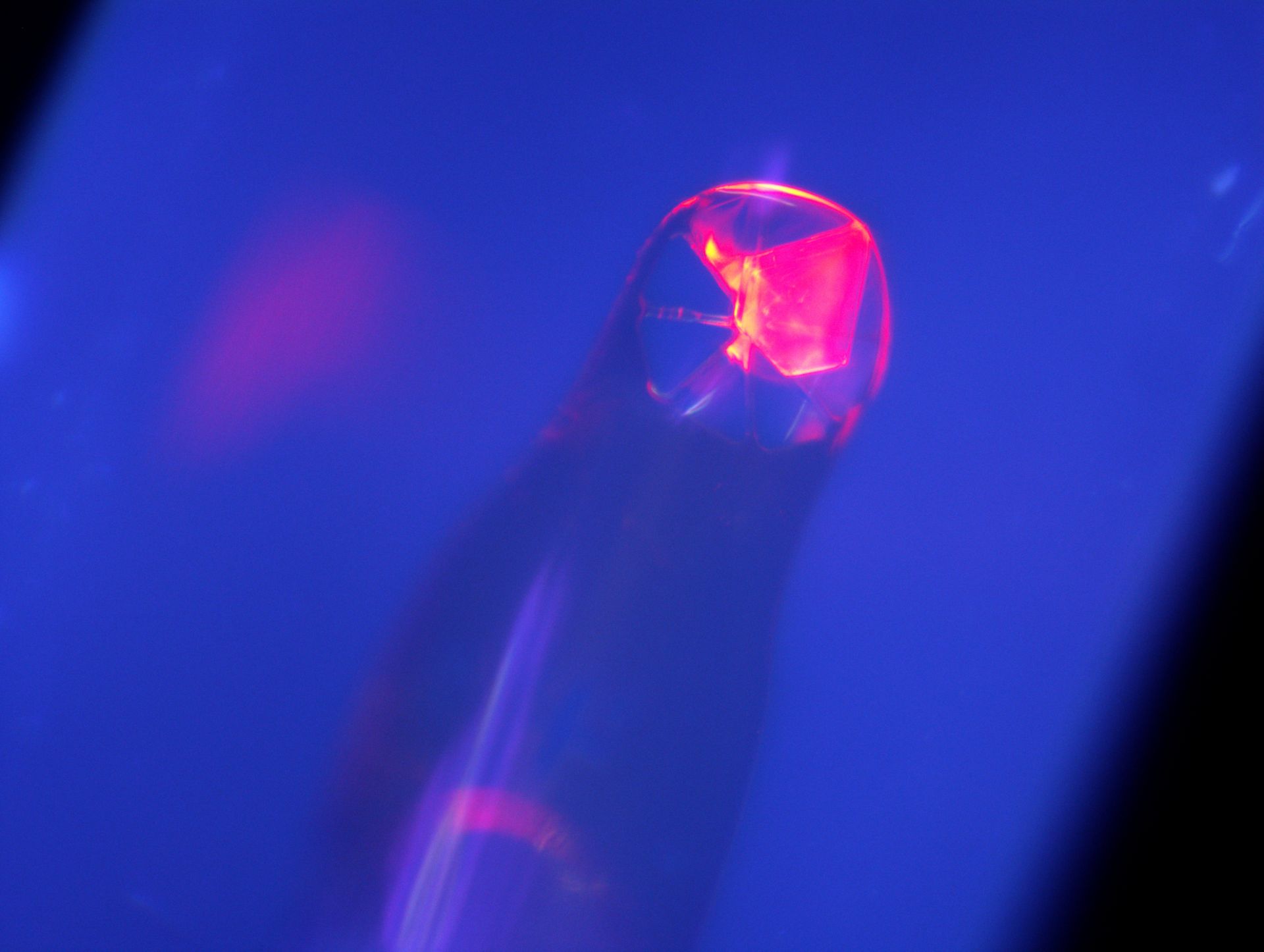
A new compound of curium photographed at LLNL during crystallography experiments. Crystals of this curium compound are uncolored under ambient light but glow an intense pink-red when exposed to ultraviolet light. (Image: LLNL/Deblonde)
Scientists at Lawrence Livermore National Laboratory and Oregon State University (OSU) have developed a promising new method to isolate and study some of the rarest elements on Earth. Focused first on curium, they have identified three new complexes containing curium ions and revealed the molecules’ 3D structures, as well as previously unknown features.
This landscape speckled with glittering stars is the edge of a nearby, young, star-forming region called NGC 3324 in the Carina Nebula. Captured in infrared light by NASA’s new James Webb Space Telescope, this image reveals for the first time previously invisible areas of star birth. (Photo: NASA)
ANS’s August 4 online event “The New Space Race is Going Nuclear” featured several expert panelists who discussed the growing importance of nuclear technologies in space commercialization and exploration. Although nuclear energy has long played a role in space missions, participants discussed the latest exciting developments in the space nuclear field and presented their views on how increased application of nuclear technologies could fundamentally transform the ways in which both crewed and uncrewed space missions are carried out.
Artist’s rendering of USNC spacecraft using EmberCore. (Image: DIU)
The Defense Innovation Unit (DIU), a Department of Defense organization focused on swiftly putting commercial technology to use in the U.S. military, has awarded contracts for two nuclear technologies—compact fusion and radioisotope heat—for spacecraft that could carry a high-power payload and freely maneuver in cislunar space. The objective is to accelerate ground and flight testing and launch a successful orbital prototype demonstration of each approach in 2027.
In 2021, the Fusarium wilt disease continued to spread in banana plantations across South America. (Photo: M.Dita/Biodiversity International, Colombia)
A lethal banana disease, known as the Fusarium wilt or Panama wilt, is spreading rapidly in South America and threatening global supplies of the Cavendish banana, the world’s most popular export variety. Working with experts in the Andean countries of Bolivia, Colombia, Ecuador, and Peru, the IAEA and the Food and Agriculture Organization of the United Nations (FAO) are using irradiation and nuclear-derived techniques to combat, manage, and prevent the spread of the disease. The IAEA describes the work in a December 24 news article.
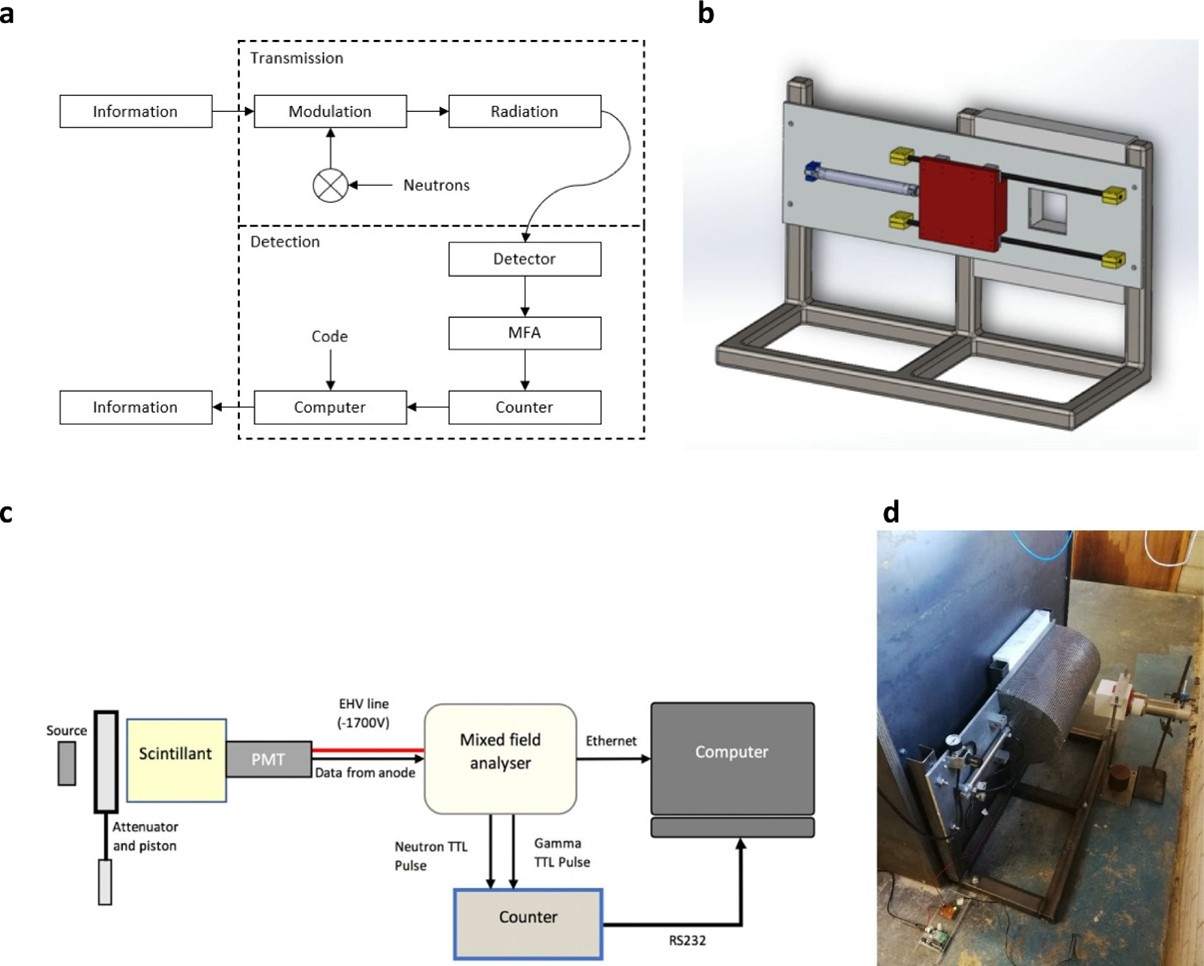
(CLICK IMAGE TO ENLARGE) The researchers’ experimental layout is depicted here. In (b), the neutron chopper is depicted without the mesh guard shown in (d), a photograph of the experimental layout that includes the Cf-252 source tank at left. (Composite image: Joyce, et al., “Wireless information transfer with fast neutrons,” doi.org/10.1016/j.nima.2021.165946)
Swapping conventional electromagnetic radiation for fast neutrons, a team of research engineers at Lancaster University in the United Kingdom, working with the Jozef Stefan Institute of Slovenia, report that they have successfully transmitted digital information wirelessly using nuclear radiation. The researchers’ attempts to transmit words and numbers using standard ASCII code “were 100 percent successful,” according to a November 10 press release from Lancaster University. Their research will be published in an upcoming issue of Nuclear Instruments and Methods in Physics Research and is now available online.
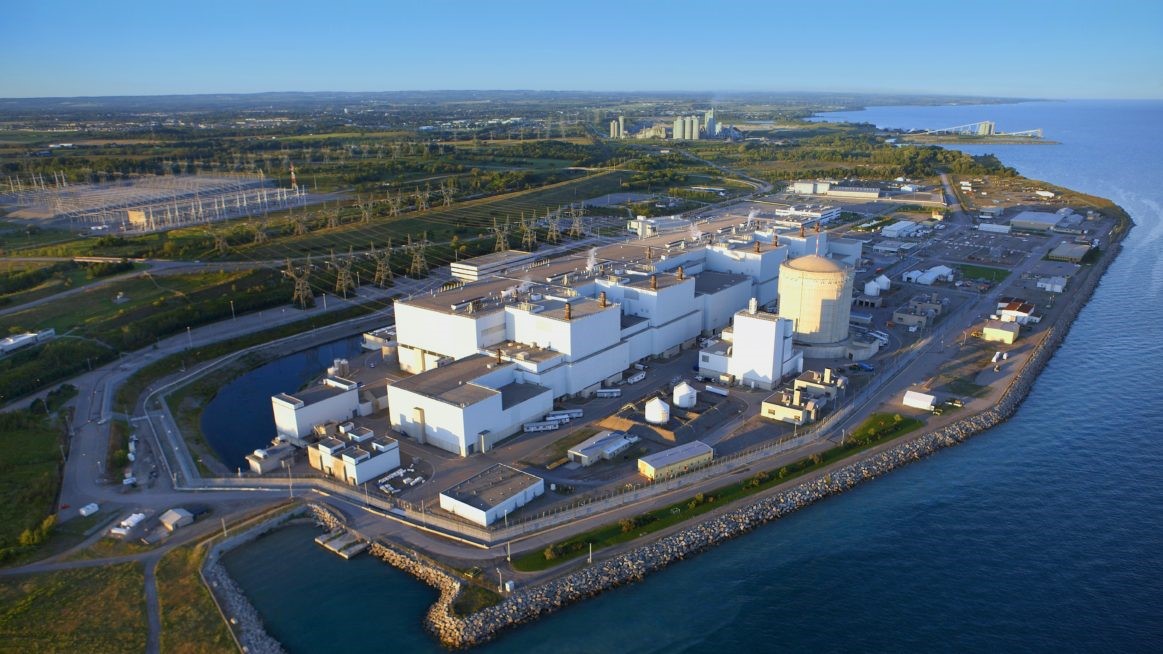
Darlington nuclear power plant. (Photo: OPG)
The Canadian Nuclear Safety Commission (CNSC) has amended Ontario Power Generation’s (OPG) operating license for its Darlington nuclear power station near Clarington, Ontario, allowing the company to produce the medical radioisotope molybdenum-99 using Darlington’s Unit 2 CANDU reactor. OPG subsidiary Laurentis Energy Partners, in conjunction with BWXT Medical, is leading the program to produce Mo-99 at Darlington.
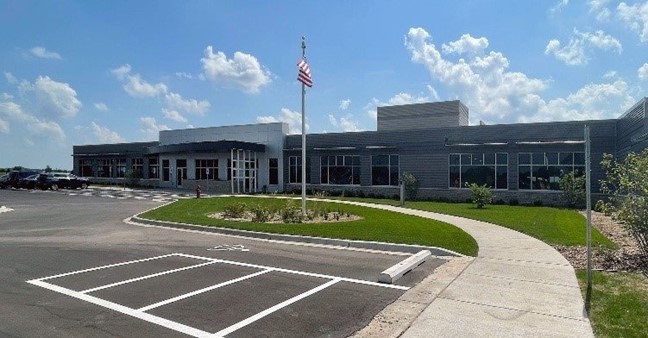
SHINE Technologies’ headquarters building in Janesville, Wis. (Photo: SHINE)
The Department of Energy’s National Nuclear Security Administration has issued a cooperative agreement worth $35 million to SHINE Technologies, based in Janesville, Wis., to support the commercial production of molybdenum-99, a critical isotope used in more than 40,000 medical procedures in the United States each day, including the diagnosis of heart disease and cancer.
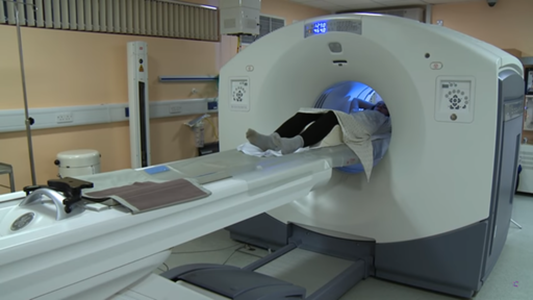
A PET imaging machine. (Photo: Wikimedia Commons)
ARTMS, a Canadian producer of medical isotopes, announced that it has registered the cyclotron production of gallium-68 with the government of Canada, filing a Type 1 Master File with the Health Products & Food Branch of Health Canada. The Ga-68 radioisotope is used in nuclear medicine diagnostic procedures utilizing positron emission tomography (PET) imaging.
NorthStar’s RadioGenix system produces the medical radioisope Mo-99 without the use of uranium. (Photo: NorthStar)
NorthStar Medical Technologies of Beloit, Wis., will receive $37 million under two cooperative agreements with the National Nuclear Security Administration for the production of molybdenum-99 without the use of high-enriched uranium. Considered a critical medical radioisotope, Mo-99 is used in more than 40,000 medical procedures in the United States each day, including the diagnosis of heart disease and cancer.
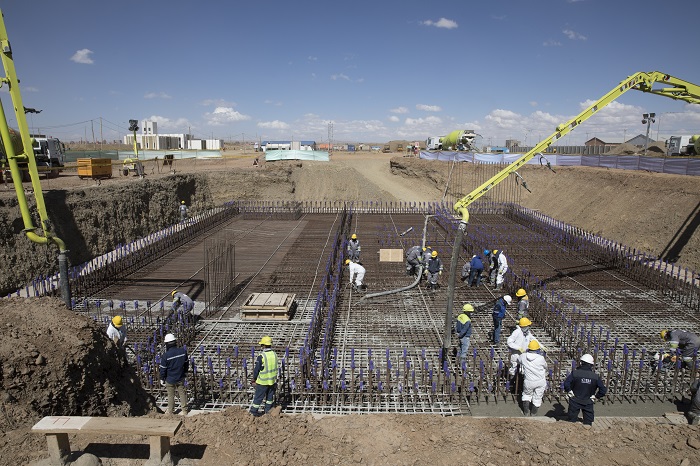
First concrete pour for research reactor begins at Bolivian nuclear research center. (Photo: Rosatom)
Key facilities at a multipurpose nuclear research center in the high plains of Bolivia are nearing operation, and a ceremonial first concrete pour for the nuclear research reactor that will serve as the centerpiece of the project was held on July 26. Bolivian president Luis Arce attended the ceremony at the Center for Nuclear Technology Research and Development (CNTRD). Also attending were Kirill Komarov, first deputy director general for corporate development and international business at Rosatom (Russia’s state atomic energy agency), and authorities from the Ministry of Hydrocarbons and Energies and the Bolivian Nuclear Energy Agency (ABEN).

-3 2x1.jpg)


.png)