-3 2x1.jpg)
New model stretches the limits of fusion torus control
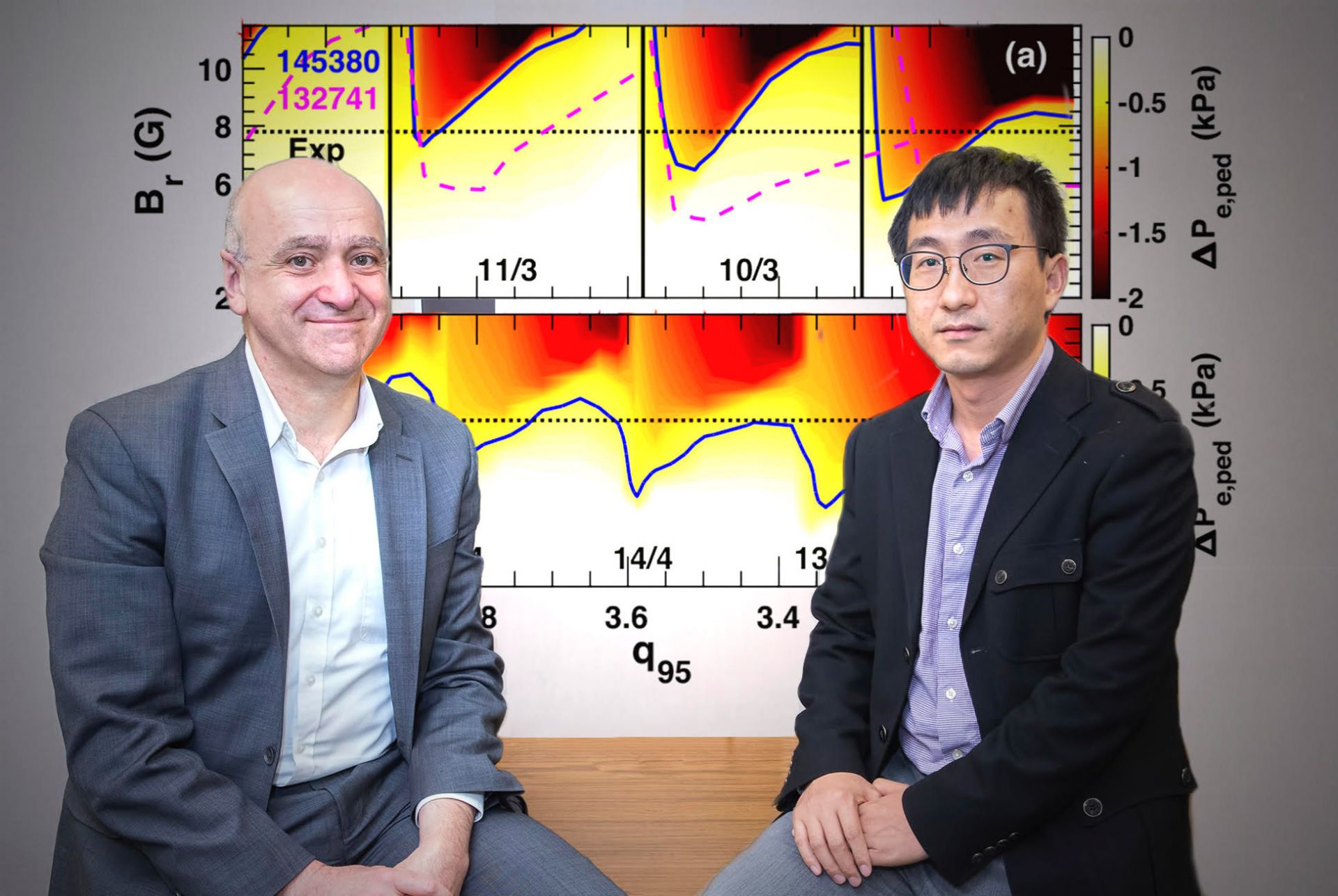
PPPL physicists Raffi Nazikian (left) and Qiming Hu, with a figure from their research. Photo: PPPL/Elle Starkman
Stars contain their plasma with the force of gravity, but here on earth, plasma in fusion tokamaks must be magnetically confined. That confinement is tenuous, because tokamaks are subject to edge localized modes (ELM)—intense bursts of heat and particles that must be controlled to prevent instabilities and damage to the fusion reactor.
Researchers at the Department of Energy’s Princeton Plasma Physics Laboratory (PPPL) and at General Atomics (GA) recently published a paper in Physical Review Letters explaining this tokamak restriction and a potential path to overcome it. They have developed a new model for ELM suppression in the DIII-D National Fusion Facility, which is operated by GA for the DOE. PPPL physicists Qiming Hu and Raffi Nazikian are the lead authors of the paper, which was announced on August 10 by PPPL.


 There’s a new mythbuster out in the Idaho desert by the name of Don Miley, separating nuclear fact from fiction in the service of science and the Idaho National Laboratory. An article released by INL’s Communications and Outreach staff on August 3—“