Senior leaders from Nordion, PSEG, and Westinghouse attended the signing ceremony. (Photo: Westinghouse)
Westinghouse Electric Company, Nordion, and PSEG Nuclear announced on Tuesday the signing of long-term agreements to establish the first commercial-scale production of cobalt-60 in a U.S. nuclear reactor. Under the agreements, the companies are to apply newly developed production technology for pressurized water reactors to produce Co-60 at PSEG’s Salem nuclear power plant in New Jersey.
Research team members at PNNL pose with their UGES prototype, including (from left) James Ely, Riane Stene, Nikhil Deshmukh, Mital Zalavadia, Benjamin McDonald, Grey Batie, and Rodrigo Guerrero. (Photo: Andrea Starr/PNNL)
A uranium enrichment monitor developed by a team at Pacific Northwest National Laboratory will soon be undergoing testing for nonproliferation applications at the International Atomic Energy Agency Centre of Excellence for Safeguards and Non-Proliferation in the United Kingdom. A recent PNNL news article describes how the research team, led by nuclear physicist James Ely, who works within the lab’s National Security Directorate, developed the UF6 gas enrichment sensor (UGES) prototype for treaty verification and other purposes.
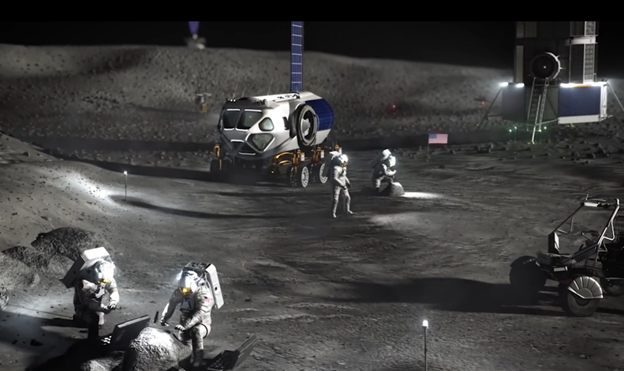
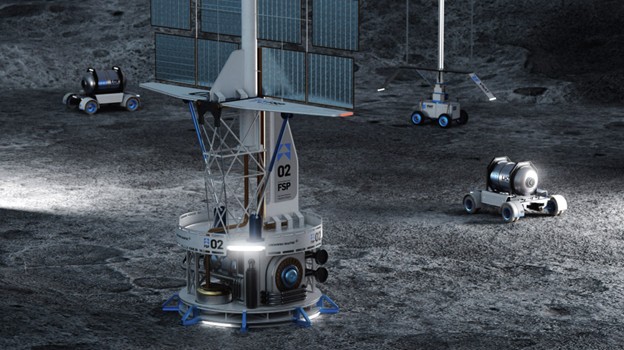
Concept art of a fission surface power system on the surface of the moon. (Image: Lockheed Martin)
The “space race” is once again making headlines, with technology worthy of the 21st century. Like the Cold War–era competition, this race too is about showcasing power—but this time it's nuclear power.
A new article in Power Technology examines the competing efforts of the United States, Russia, and China as they strive to be the first to put a nuclear reactor on the moon to power a lunar base, detailing the technical challenges and international rivalries.
Orano USA CEO Jean-Luc Palayer (middle) shakes hands with Zeno Power’s cofounder and CEO Tyler Bernstein (left) and Chief Commercialization Officer Harsh Desai. (Photo: Orano USA)
Zeno Power, a developer of nuclear batteries, is to receive americium-241 recovered from Orano’s La Hague nuclear fuel recycling site in Normandy, France, under a strategic agreement announced by the companies on September 24.
A still image from a NASA video illustrating power needs on the lunar surface. (Image: NASA)
After the Trump administration’s new push to get a nuclear reactor on the moon by 2030 was first reported by Politico last month, media played up the shock value for people new to the concept. Few focused on the technical details of the new plan for lunar fission surface power (FSP), which halts and replaces a program that began under the first Trump administration with an early hope of getting a reactor on the moon by the end of 2026. Now, the focus is on streamlining NASA’s internal processes to support commercial space companies that can build a reactor with more than twice the power and mass and have it ready for launch by 2030.
Rendering of a floating nuclear power plant concept, in foreground. (Image: American Bureau of Shipping/Herbert)
On April 22, 1959, Rear Admiral George J. King, superintendent of the Maine Maritime Academy, announced that following the completion of the 1960 training cruise, cadets would begin the study of nuclear engineering. Courses at that time included radiation physics, reactor control and instrumentation, reactor theory and engineering, thermodynamics, shielding, core design, reactor maintenance, and nuclear aspects.
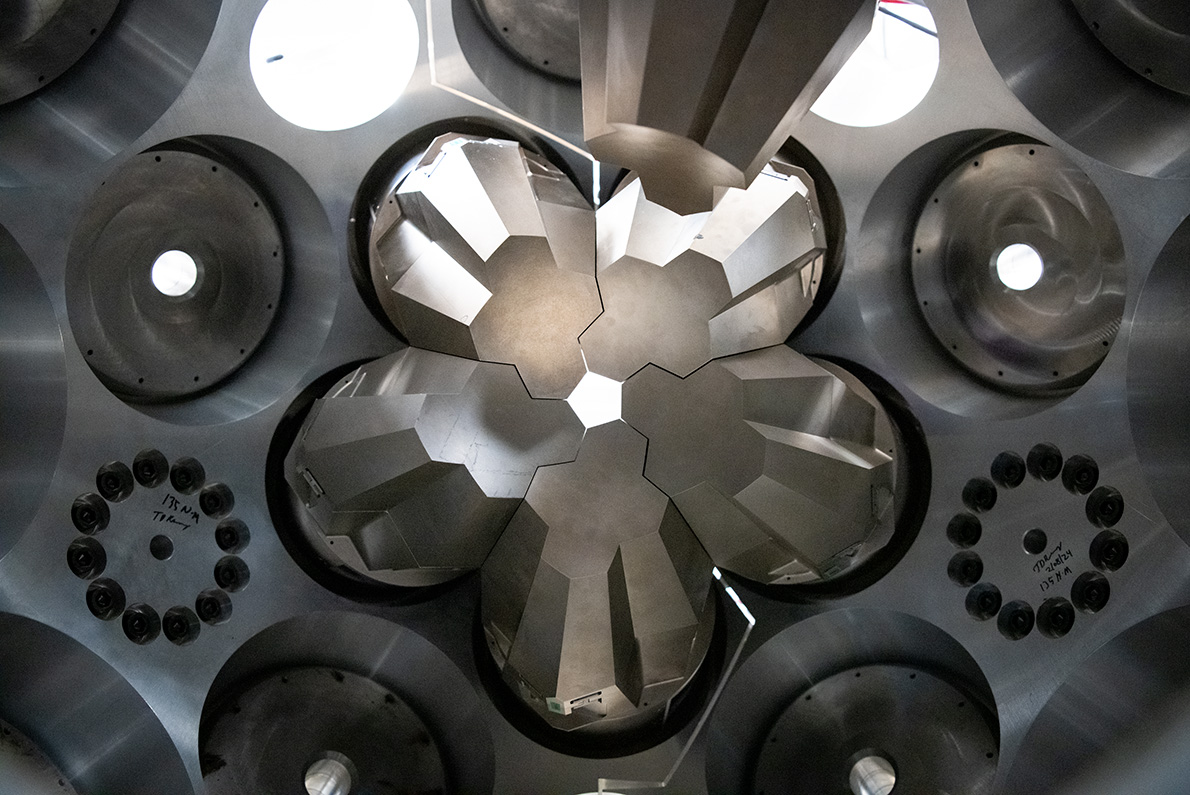
GRETA will use multiple germanium crystals to track gamma rays emitted from nuclear decays. Pictured here are 24 of the 120 crystals in 6 modules. (Credit: Robinson Kuntz/Berkeley Lab)
Researchers announced earlier this month that they have completed major construction of the Gamma-Ray Energy Tracking Array (GRETA), a precision tool for gamma ray spectroscopy that, according to Paul Fallon, a researcher at University of California–Berkeley and GRETA’s project director, will be 10 to 100 times more sensitive than previous nuclear science experiments. Fallon was quoted in an August 8 article published by Lawrence Berkeley National Laboratory (Berkeley Lab)—where GRETA’s project leaders are based and GRETA was assembled.






 The Department of Energy announced on Wednesday that it has awarded $134 million in funding for two programs designed to secure U.S. leadership in emerging fusion technologies and innovation. The funding was awarded through the DOE’s Fusion Energy Sciences (FES) program in the Office of Science and will support the next round of Fusion Innovation Research Engine (FIRE) collaboratives and the Innovation Network for Fusion Energy (INFUSE) awards.