Art meets technology in photos from The Nuclear Sublime

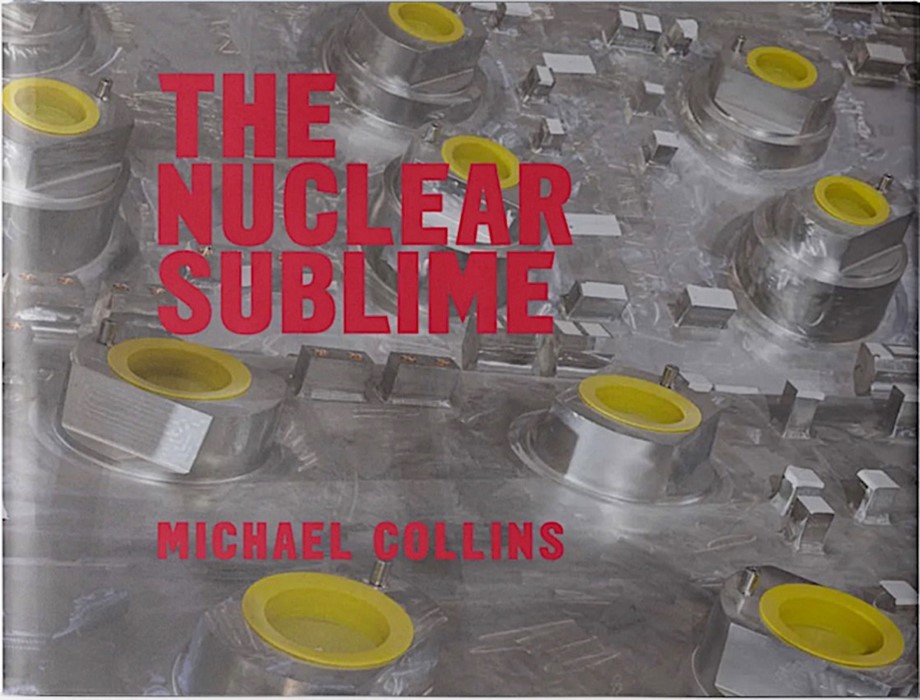
The Nuclear Sublime is a new large-format photobook that features fascinating and unusual photographs of the interiors of nuclear reactors and power plants across the United Kingdom.
-3 2x1.jpg)
A message from Curtiss-Wright
High-Temperature neutron flux detectors for Generation IV reactors and SMRs

The Nuclear Sublime is a new large-format photobook that features fascinating and unusual photographs of the interiors of nuclear reactors and power plants across the United Kingdom.

The effort to build the Hinkley Point C nuclear power plant in Somerset, England, has been “prodigious, lengthy, and increasingly costly.” So says London-based energy, business, and environment writer Stanley Reed in his recent New York Times article, “Why Britain Is Struggling with Nuclear Power.”
Leaders of five nations that collectively represent 50 percent of the world’s uranium conversion and enrichment capacity—the United States, Canada, Japan, France, and the United Kingdom—are making a habit of meeting on the sidelines of global climate talks to pledge their commitment to securing the nuclear fuel supply chain. On December 7 at the Net Zero Nuclear Summit—an event held in Dubai, United Arab Emirates, during the UN Climate Change Conference, or COP28—representatives of those nations announced plans to “mobilize at least $4.2 billion” in government and private investment in enrichment and conversion capacity. The commitment expands on an initial civil nuclear fuel security agreement that the so-called Sapporo 5 reached in April 2023, when they met (as now, on the sidelines) during a G7 Ministers’ Meeting on Climate, Energy, and Environment in Sapporo, Japan.

Bowie

Turk
Two top energy officials—U.S. deputy secretary of energy David M. Turk and U.K. minister for nuclear and networks Andrew Bowie—met on November 8 in Washington, D.C., to talk about a “coordinated, strategic approach” to advance fusion energy demonstration and commercialization and “maximize value” for both nations.

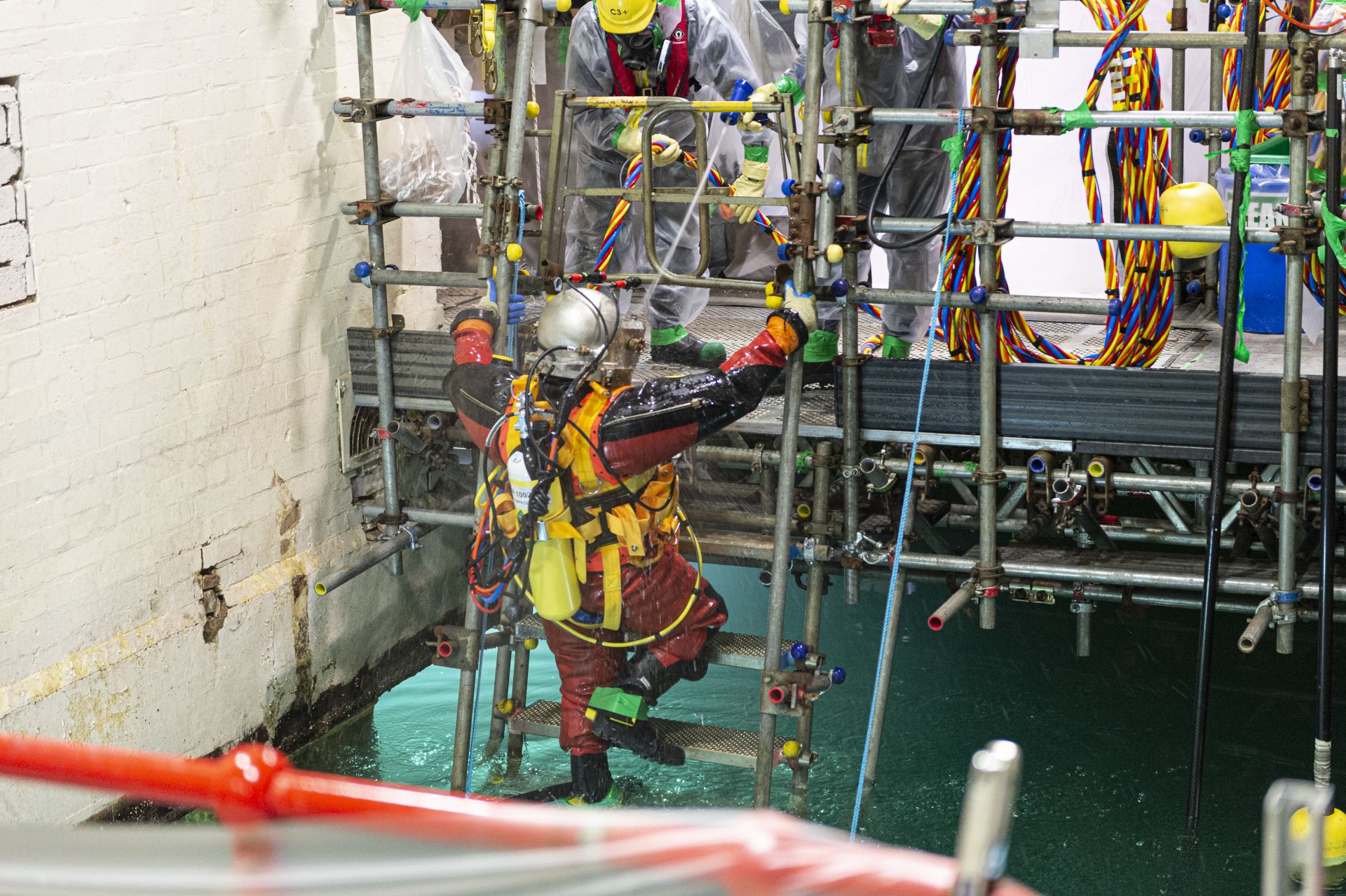
The last time a human entered the Pile Fuel Storage Pond at the Sellafield nuclear site in Cumbria, England, was in 1958, when records show a maintenance operator and health physics monitor carried out a dive into the newly constructed pond to repair a broken winch. At least that was true until December 2022, when Josh Everett, a diver from the U.K. specialist nuclear diving team Underwater Construction Corporation (UCC) UK Ltd., became the first person in more than 60 years to work in one of the most unique workplaces in the world.
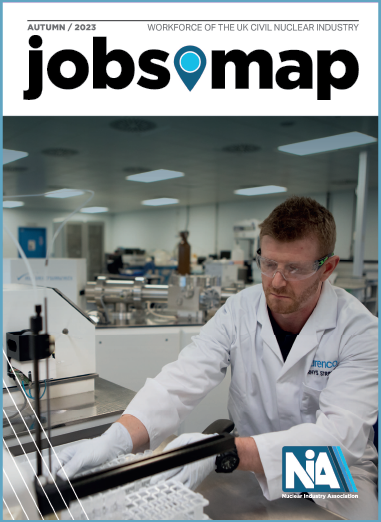
The present size of the civil nuclear workforce in the United Kingdom is the largest it has been in the past 20 years. So reports the Nuclear Industry Association (NIA), the main trade association for the U.K. civil nuclear industry, in its recently released Jobs Map 2023. The London-based organization has released this report annually for more than a decade with the objective of giving the government the most up-to-date, accurate statistics on which to base economic and energy decisions. The NIA reports that the latest job growth has been fueled partly by projects on advanced and emerging nuclear technologies.
The Nuclear Decommissioning Authority, the governmental organization responsible for the cleanup and decommissioning of the United Kingdom’s 17 nuclear sites, has released its business plan for the fiscal years running from April 1, 2023, through March 31, 2026. The plan provides a summary of the activities and progress the NDA expects to make at its nuclear sites over the next three years.
In introducing the report, NDA group chief executive officer David Peattie wrote, “This business plan sets out a challenging program of work, reducing hazards while contributing to a globally significant sustainability agenda, developing our people, and supporting our communities.”
The full report Nuclear Decommissioning Authority Business Plan: 1 April 2023 to 31 March 2026 can be found here.
As part of the run-up to the G7 Ministers’ Meeting on Climate, Energy, and Environment in Japan on April 15–16, U.K. energy security secretary Grant Shapps met in Seoul yesterday with South Korean trade, industry, and energy minister Chang-yang Lee to discuss closer collaboration on clean energy development and energy security.

The United Kingdom’s nuclear industry is expanding, with the U.K. government committed to supporting the build of more civil nuclear power plants (deployments up to 24 GW by 2050)1 while also undertaking large-scale decommissioning work in parallel.2 The defense sector is experiencing growth with the decommissioning, operation, and new build of submarines, plus managing the U.K.’s deterrent.3 Although the civil and defense programs are separate, they draw on the same group of skills and people.
The discovery of a small amount of uranium inside a package of scrap metal bars at Heathrow Airport in London has raised a number of puzzling questions that are being investigated by Scotland Yard, headquarters of the London Metropolitan Police (the Met). Investigators said that the uranium, which was found by Border Force staff during routine screening at the airport on December 29, originated in Pakistan, though it arrived at Heathrow on a passenger flight from Oman and, according to a January 11 report in the Guardian, was bound for an Iranian-owned business with offices in the United Kingdom.

Small modular reactor developers Holtec International and GE Hitachi Nuclear Energy (GEH) are both looking to the United Kingdom as a prime location for deployment of their units—the SMR-160 and BWRX-300, respectively.
On December 19, Holtec Britain announced that it is poised to enter the United Kingdom’s generic design assessment (GDA) process for the SMR-160 early in 2023, enabling the start of construction of the first U.K. unit as soon as 2028. (The GDA, developed by the Office for Nuclear Regulation and the Environment Agency, gauges the safety, security, and environmental protection aspects of a nuclear plant design. Successfully completing the assessment culminates in a design acceptance confirmation from ONR and a statement of design acceptability from the Environment Agency.)

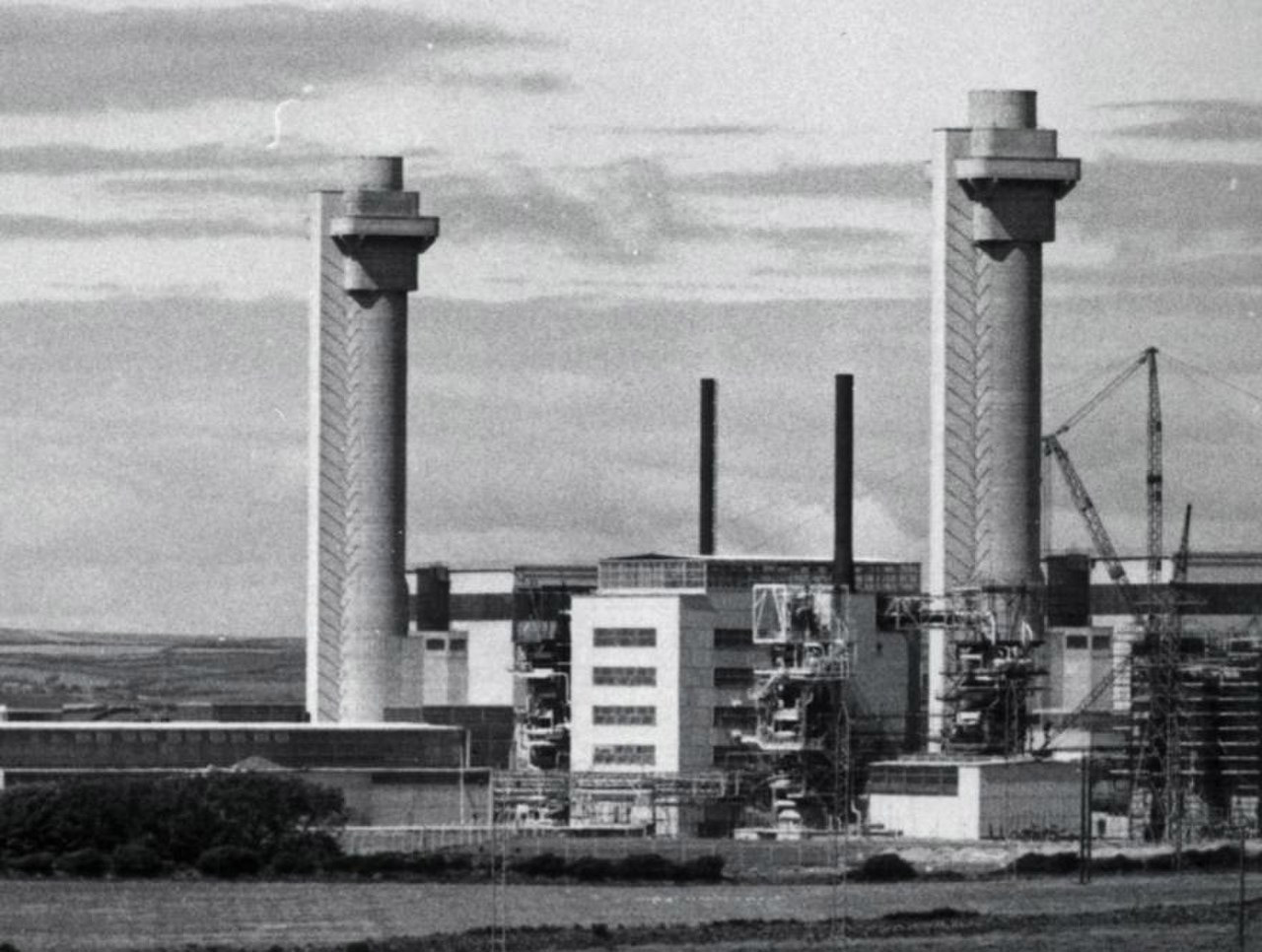
The Windscale Piles, circa 1956. (Photo: DOE)
After the Atomic Energy Act of 1946 ended collaboration between the United States and its World War II allies (specifically, the United Kingdom and Canada), the British government felt it necessary to go down its own path in developing nuclear technology. As a result, the Windscale Piles, in Seascale, Cumberland, England, were planned and built with the aim of producing plutonium for the U.K.’s defense purposes. Windscale Pile No. 1 became operational in 1950, and Windscale Pile No. 2 followed shortly after in 1951.
Early in the design process, the U.K. government came to realize that it did not have an adequately expansive piece of land that could provide a safety barrier in case of an issue at a water-cooled reactor. If the flow of water coolant were to be interrupted, an evacuation and exclusion zone could require a large land area that Britain simply did not have. The government, therefore, decided to construct both reactors with a natural draft air convection core cooling system. A massive cooling chimney at each reactor would soar nearly 400 feet into the air.

Craig Piercy
cpiercy@ans.org
The Cheshire countryside in late summer has a lot to offer an American visitor besides cool, insect-free air; bacon sandwiches; and warm ales. It also provides the perfect vantage point to consider the fundamental shifts in energy availability and security we have witnessed over the last 12 months.
Residential energy prices here in the United Kingdom have increased by roughly 80 percent over the last year, prompting the government to advise Britons to turn their water heaters off at night and boil their kettles with only as much water as needed to make their tea.
While I was here, outgoing British prime minister Boris Johnson visited the Sizewell site to announce a £700 million investment in Sizewell C, two 1,600-MW EPR reactors soon to be under construction. His remarks had the wistful, poignant tone of a leader facing the end of his tenure in office:

As citizens of the United Kingdom and others around the world mourn the death of Queen Elizabeth II, many have reflected on how the world has changed during the seven decades of the queen’s reign—the same decades that saw the rise of civilian nuclear power.
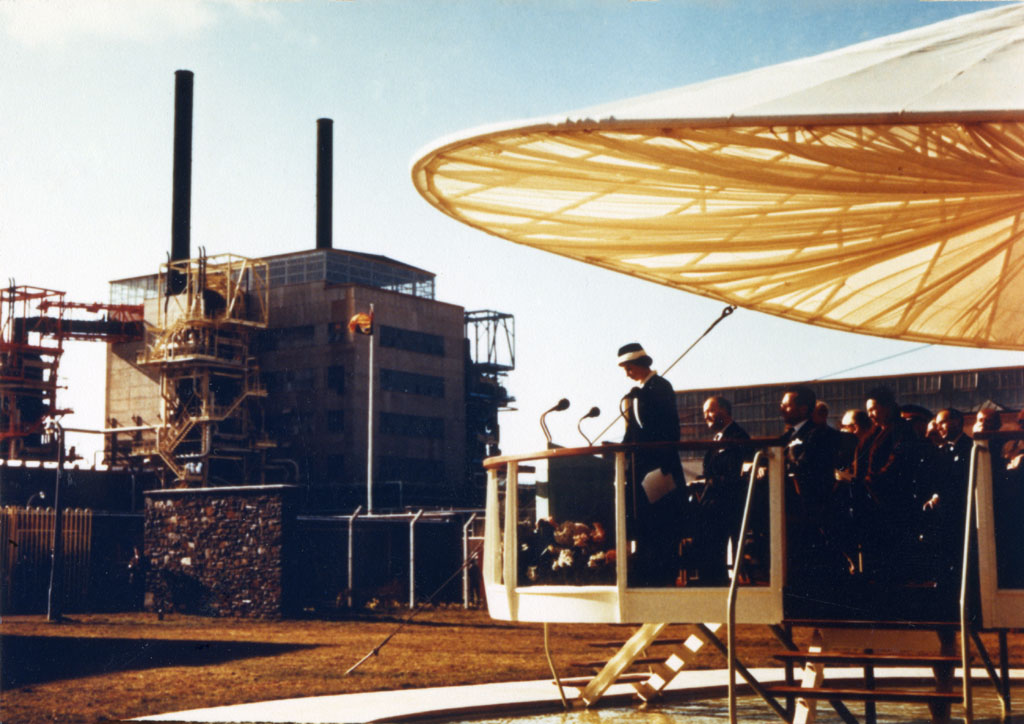
Calder Hall was already under construction at the Sellafield site in West Cumbria when Princess Elizabeth became queen in 1953. Queen Elizabeth traveled to the site in October 1956 and declared, in a televised ceremony, that “It is with pride that I now open Calder Hall, Britain’s first atomic power station.” Watch the fanfare in a historical clip uploaded to YouTube by Sellafield Ltd below.

The LongOps project will develop innovative robotic technologies. Photo: UKAEA
Britain and Japan have signed a research and technology deployment collaboration to help automate nuclear decommissioning and aspects of fusion energy production. According to the U.K. government, which announced the deal on January 20, the £12 million (about $16.5 million) U.K.–Japanese robotics project, called LongOps, will support the delivery of faster and safer decommissioning at the Fukushima Daiichi reactors in Japan and at Sellafield in the United Kingdom, using long-reach robotic arms.
The four-year collaboration on new robotics and automation techniques will also be applied to fusion energy research in the two countries.
Funded equally by U.K. Research and Innovation, the U.K.’s Nuclear Decommissioning Authority, and Japan’s Tokyo Electric Power Company, the LongOps project will be led by the U.K. Atomic Energy Authority’s (UKAEA) Remote Applications in Challenging Environments (RACE) facility.
A new research contract between the U.K. Space Agency and Rolls-Royce will see planetary scientists working together to explore nuclear power as an energy source for deep space missions in the decades to come. The effort is similar to one that the United States is undertaking through NASA.
"Space nuclear power and propulsion is a game-changing concept that could unlock future deep-space missions that take us to Mars and beyond," said Graham Turnock, chief executive of the U.K Space Agency, on January 12. "This study will help us understand the exciting potential of atomic-powered spacecraft, and whether this nascent technology could help us travel further and faster through space than ever before."
Along with the wider Trade and Cooperation Agreement it signed late last month with the European Union to address post-Brexit realities, the U.K. government concluded a stand-alone Nuclear Cooperation Agreement with the European Atomic Energy Community, better known as Euratom. The NCA went into effect January 1.
A 170-page energy white paper, Powering Our Net Zero Future, issued by the United Kingdom government on December 14 sets big goals for cleaning up the U.K.’s energy system. According to the U.K. government, the plan would create and support green energy jobs across England, Scotland, Wales and Northern Ireland and would keep electricity bills affordable as the U.K. transitions to net zero emissions by 2050.
The white paper notes that the U.K. will generate emission-free electricity by 2050 with a trajectory that will see "overwhelmingly decarbonized power in the 2030s. Low carbon electricity will be a key enabler of our transition to a net zero economy with demand expected to double due to transport and low carbon heat."
The white paper builds upon the U.K. prime minister’s 38-page Ten Point Plan for a Green Industrial Revolution, which was issued on November 18.
The United Kingdom’s Department for Business, Energy and Industrial Strategy has asked local governments to submit bids to host the Spherical Tokamak for Energy Production project, or STEP, according to an article published by Bloomberg on December 1.
The STEP plant will be developed by the U.K. Atomic Energy Authority, which says that construction could begin as soon as 2032, with operations by 2040, and “will prove that fusion is not a far-off dream.”

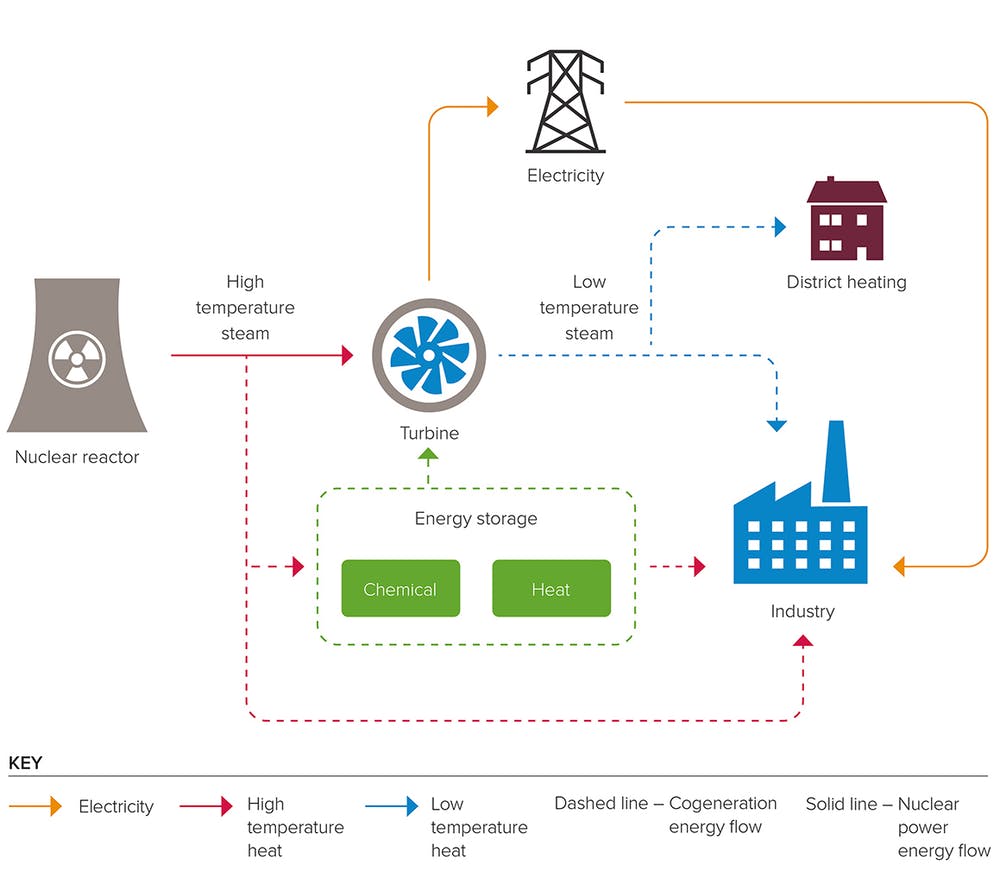
Nuclear reactors have evolved to achieve more than just electricity generation and should be part of the U.K.’s plan to reach net-zero emissions by 2050. Photo: Royal Society, authors provided
The United Kingdom needs to start rebuilding its capacity to generate nuclear power, according to an opinion article published Wednesday on The Conversation by two members of the U.K.-based Bangor University faculty.
Bill Lee, a professor of materials in extreme environments, and Michael Rushton, a senior lecturer in nuclear energy, argue that the plan by the Committee on Climate Change, which advises the U.K. government on the effort to reach net-zero emissions by 2050, is “strangely silent on nuclear power.”