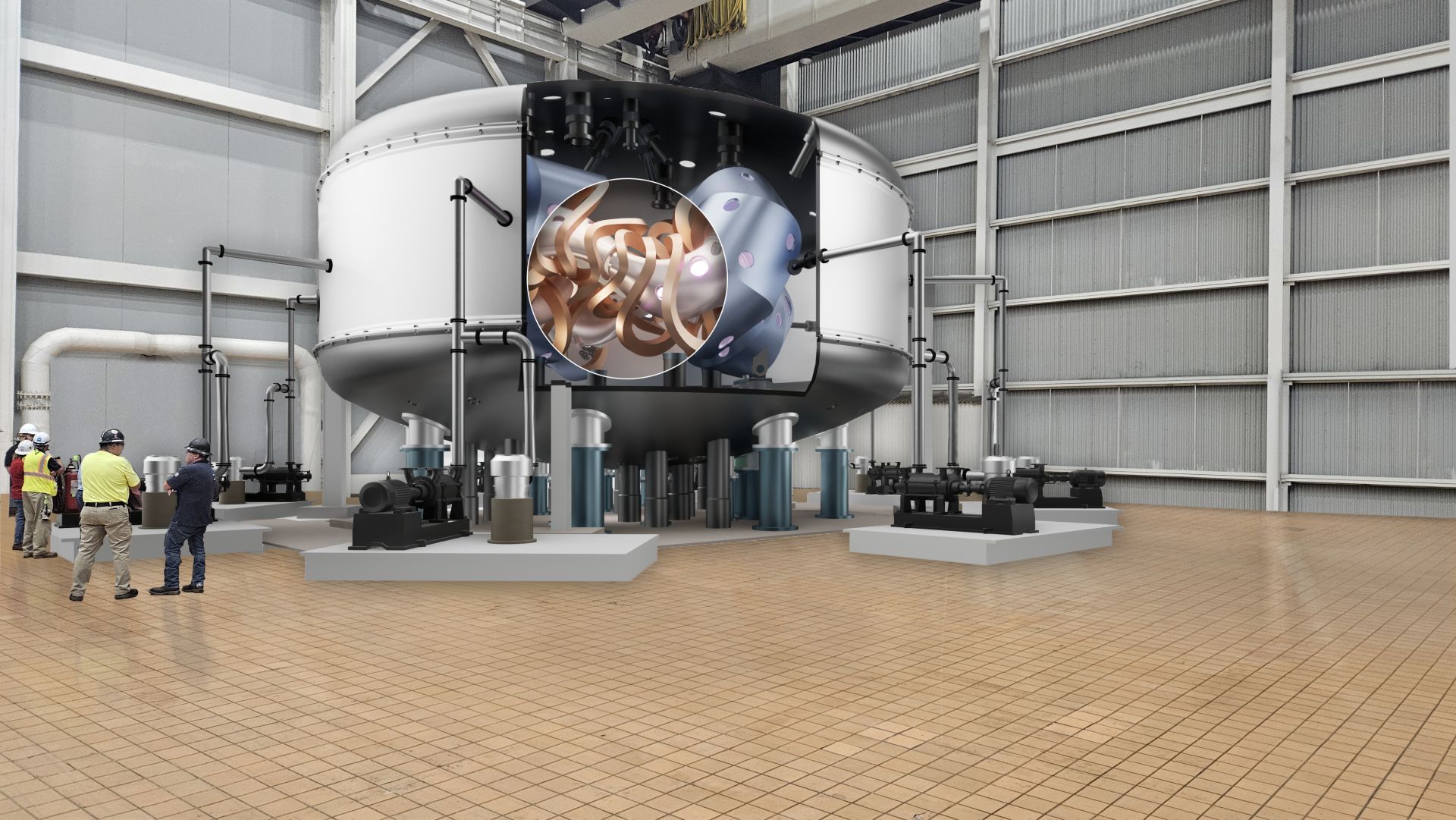
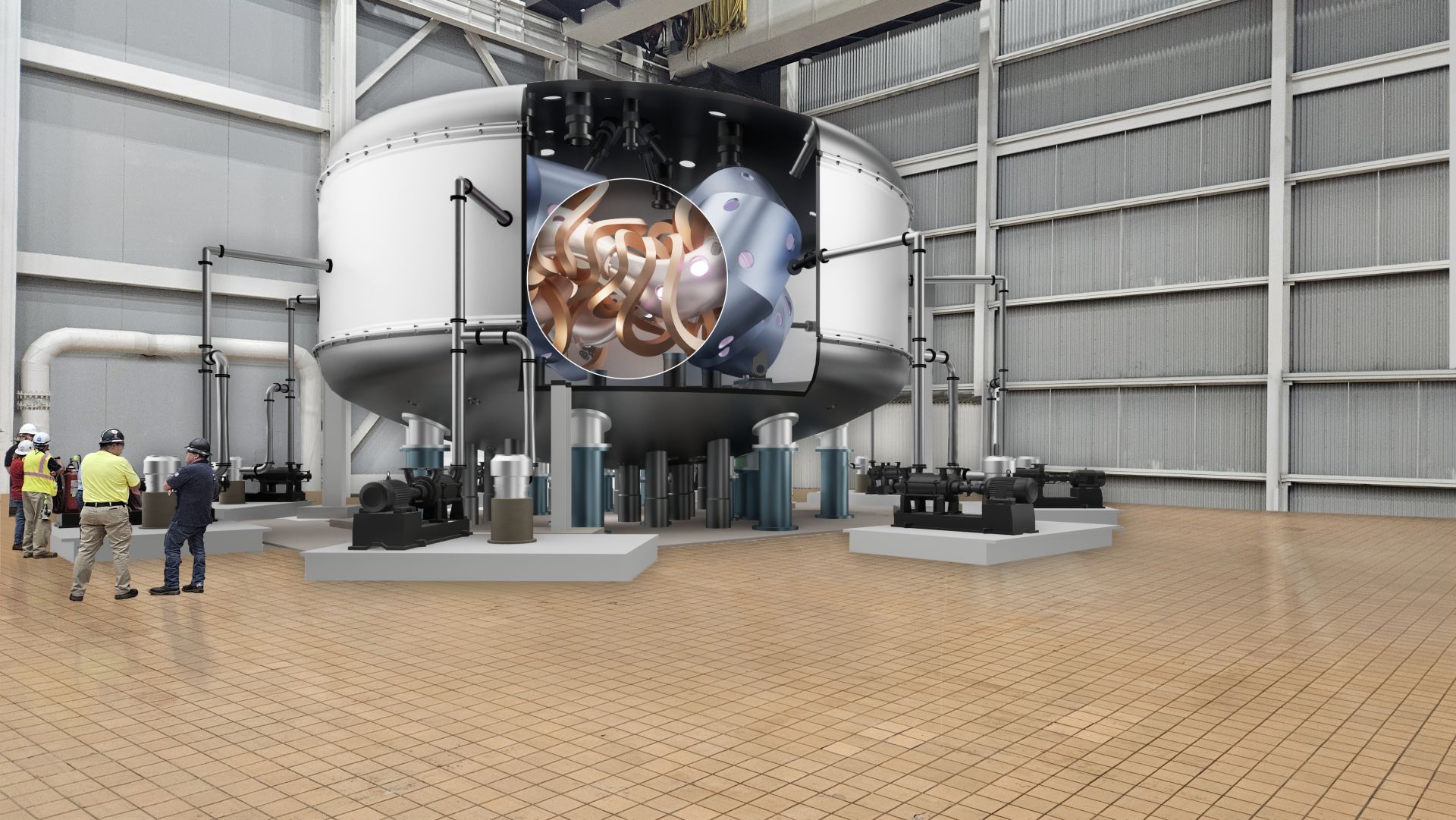
Concept art showing Type One Energy’s Infinity One prototype stellarator inside TVA’s Bull Run fossil plant. (Photo/Image: Business Wire)
Fusion startup Type One Energy has announced the publication of a baseline physics design basis for its proposed Infinity Two stellarator fusion pilot power plant. The design basis was published in a series of seven papers in a special issue of the Journal of Plasma Physics. According to the company, the design basis realistically considers for the first time the relationship between competing requirements for plasma performance, power plant startup, construction logistics, reliability, and economics utilizing actual power plant operating experience.
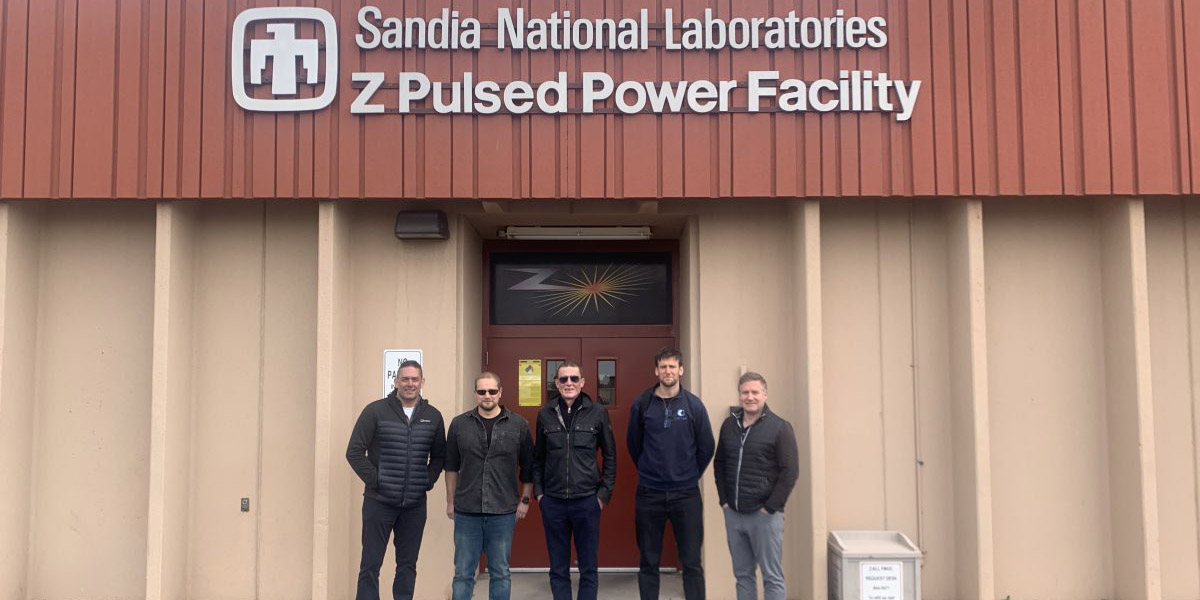
Representatives of First Light Fusion stand outside Sandia’s Z Pulsed Power Facility. (Photo: First Light Fusion)
First Light Fusion announced last week that it has set a new record for the highest quartz pressure achieved on Sandia National Laboratories’ Z machine using its amplifier technology to achieve an output pressure of 3.67 terapascal (TPa)—roughly doubling the pressure the company reached in its first experiment on the machine one year ago.
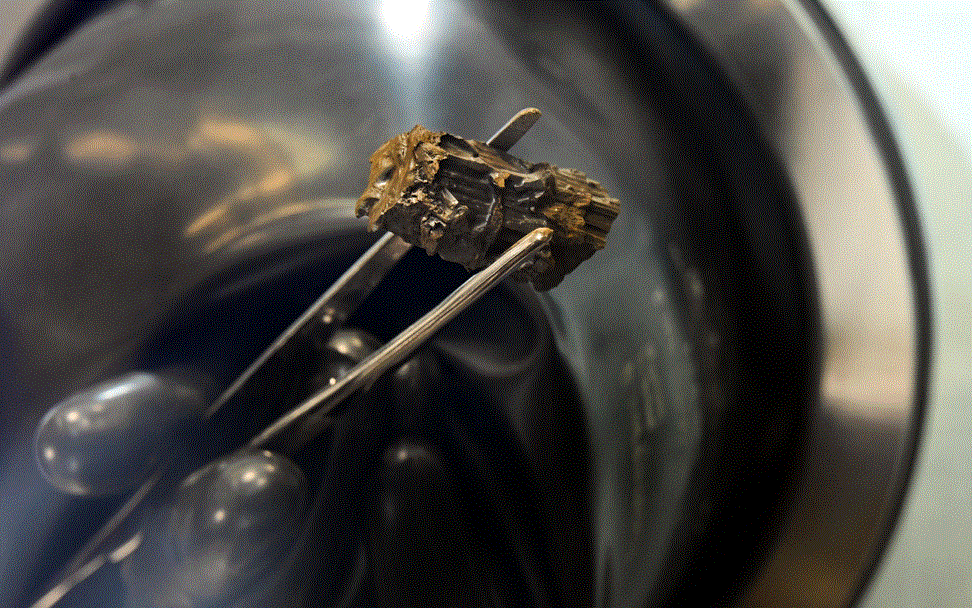
Uranium chloride fuel salt. (Photo: INL)
Scientists at Idaho National Laboratory continue to make progress on the Molten Chloride Reactor Experiment (MCRE), which entails research and development for the first operational advanced nuclear reactor to use a mixture of molten chloride salt and uranium as fuel and coolant. The experiment is evaluating the safety and physics of the molten chloride fast reactor that Southern Company and TerraPower are planning to build.
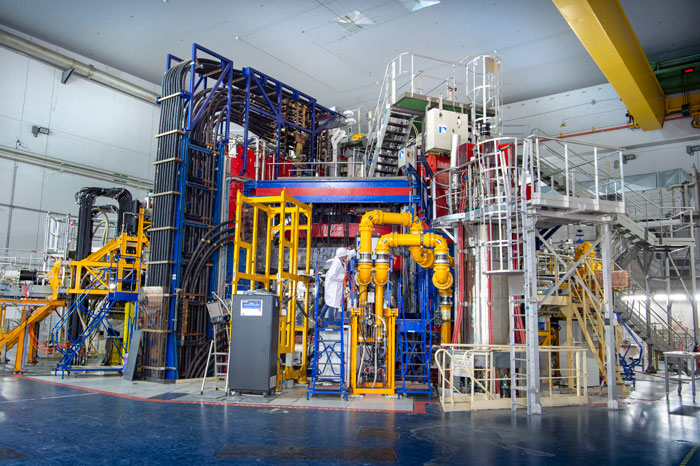
The WEST tokamak. (Photo: L. Godart/CEA)
The French magnetic confinement fusion tokamak known as WEST maintained a plasma in February for more than 22 minutes—1,337 seconds, to be precise—and “smashed” the previous record plasma duration for a tokamak with a 25 percent improvement, according to the CEA, which operates the machine. The previous 1,006-second record was set by China’s EAST just a few weeks prior. Records are made to be broken, but this rapid progress illustrates a collective, global increase in plasma confinement expertise, aided by tungsten in key components.
Korea’s KSTAR tokamak. (Photo: Korea Institute of Fusion Energy)
Concept art showing Type One Energy’s Infinity One prototype stellarator inside TVA’s Bull Run fossil plant. (Photo: Business Wire)
Type One Energy said it has entered into a cooperative agreement with the Tennessee Valley Authority to jointly develop plans for a potential TVA fusion power plant project in the Tennessee Valley region using Type One Energy stellarator fusion power technology. The company said its 350-MWe fusion pilot power plant, named Infinity Two, could provide a complementary source of baseload electrical generation for the region as early as the mid-2030s.
An experimental chamber that will be used by UC San Diego as part of the TINEX project. (Photo: David Baillot/UC San Diego Jacobs School of Engineering)
The University of California–San Diego has joined a new research collaborative focused on overcoming critical obstacles in developing and scaling up inertial fusion power plants. Led by San Diego-based General Atomics, the group was one of six research teams that were collectively awarded $107 million in January by the Department of Energy as part of the Fusion Innovative Research Engine (FIRE) Collaboratives.
The University of Tennessee-Knoxville's Alyssa Hayes. (Photo: UTK
University of Tennessee–Knoxville’s Department of Nuclear Engineering highlighted the Computational Research Access Network (CRANE) program in a recent article on its website. CRANE is a free online program “that teaches computational methods in nuclear fusion to students from underrepresented backgrounds,” said Alyssa Hayes, a nuclear engineering Ph.D. candidate at UTK. Hayes is the first chair of the board of directors of the CRANE nonprofit organization.
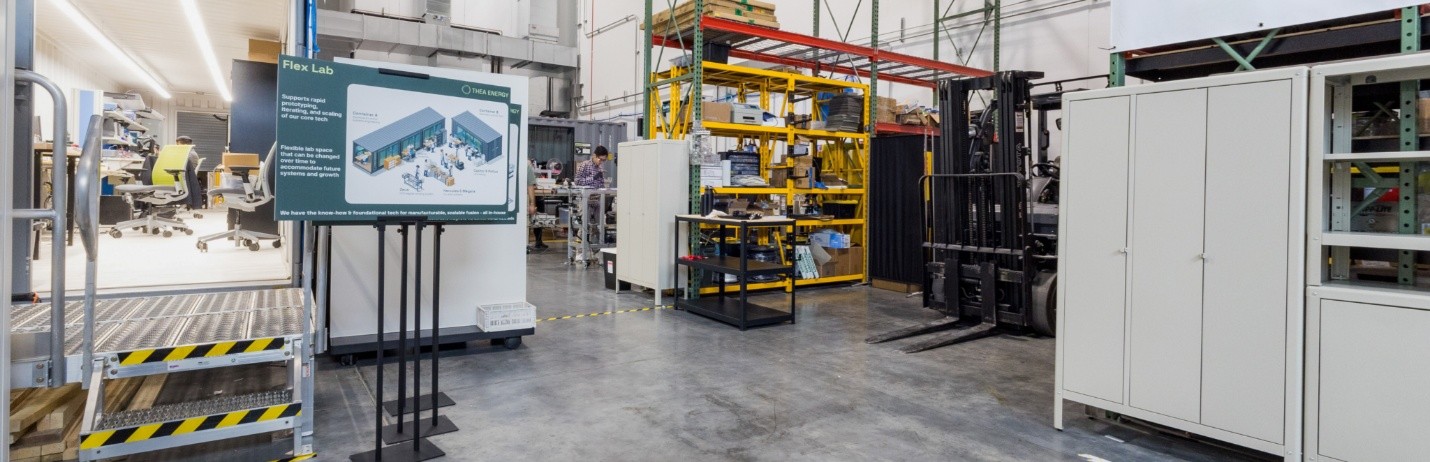
Thea Energy, one of three fusion companies that have met early milestones in the design of a fusion pilot plant has opened a new headquarters facility in Kearny, N.J. (Photo: Thea Energy)
The Department of Energy announced six Fusion Innovative Research Engine (FIRE) collaboratives set to receive funding of $107 million on January 16. The six selected teams represent a first round of awards from a funding opportunity announcement released in May 2023 as part of the DOE Office of Fusion Energy Sciences’ (FES) goal of creating a “fusion innovation ecosystem.”
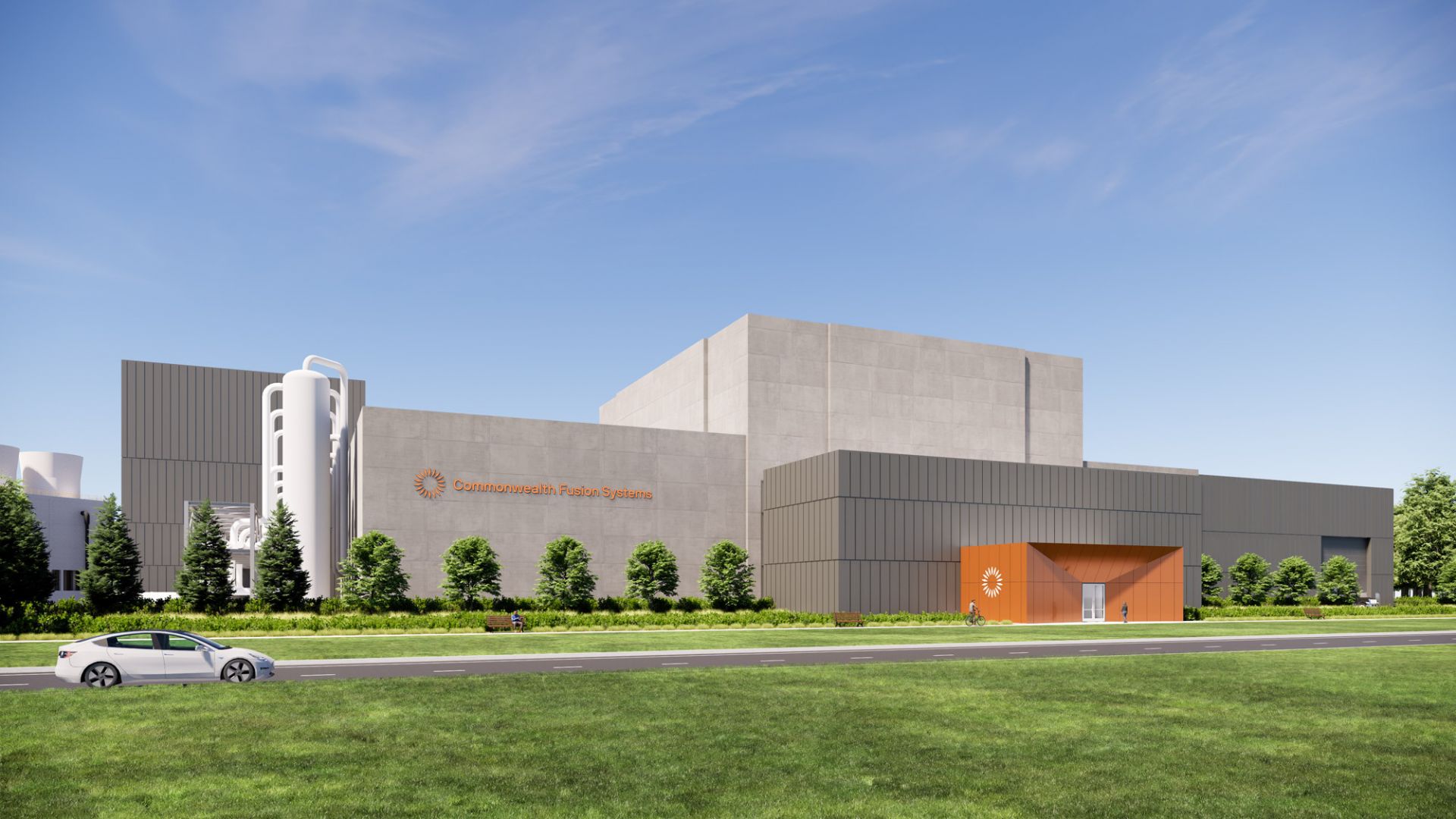
A rendering of Commonwealth Fusion Systems planned ARC power plant. (Image: CFS)
Commonwealth Fusion Systems (CFS) has announced that it plans to build a fusion power plant, named ARC, at the James River Industrial Park in Chesterfield County, Va.—and that it expects to be the first company to make fusion power available at grid scale.
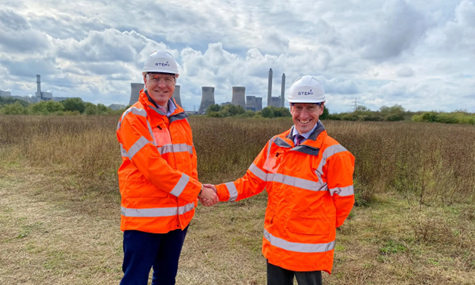
Chapman (left) and Methven at the West Burton power station. (Photo: UKIFS)
Leadership of the United Kingdom’s STEP (Spherical Tokamak for Energy Production) fusion program has transitioned to U.K. Industrial Fusion Solutions Ltd. (UKIFS), a wholly owned subsidiary of the U.K. Atomic Energy Authority (UKAEA). UKIFS was established in February 2023 to lead a public-private partnership that will design, build, and operate the STEP prototype fusion energy plant in Nottinghamshire in England’s East Midlands region.
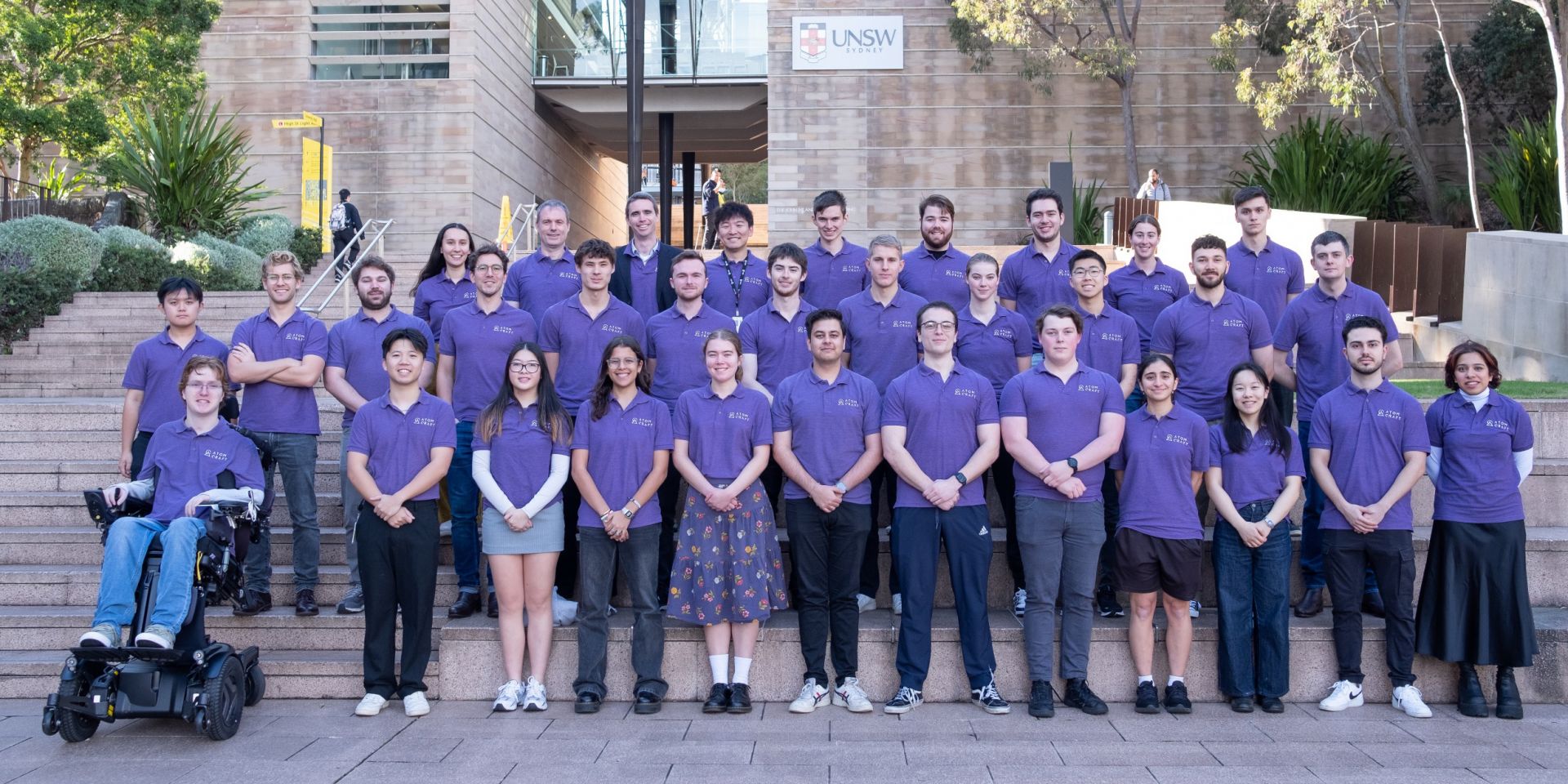
The cross-disciplinary AtomCraft team. (Photo: University of New South Wales)
Commercial nuclear power is illegal in Australia, and it has been since the 1990s. This past June, however, the country’s main opposition party announced plans to build seven commercial nuclear reactors in the 2030s and 2040s on sites presently occupied by aging coal-fired plants—should the party’s Liberal–National Coalition win power in federal elections next year. This statement has reignited a public debate regarding the potential role of nuclear energy in Australia.
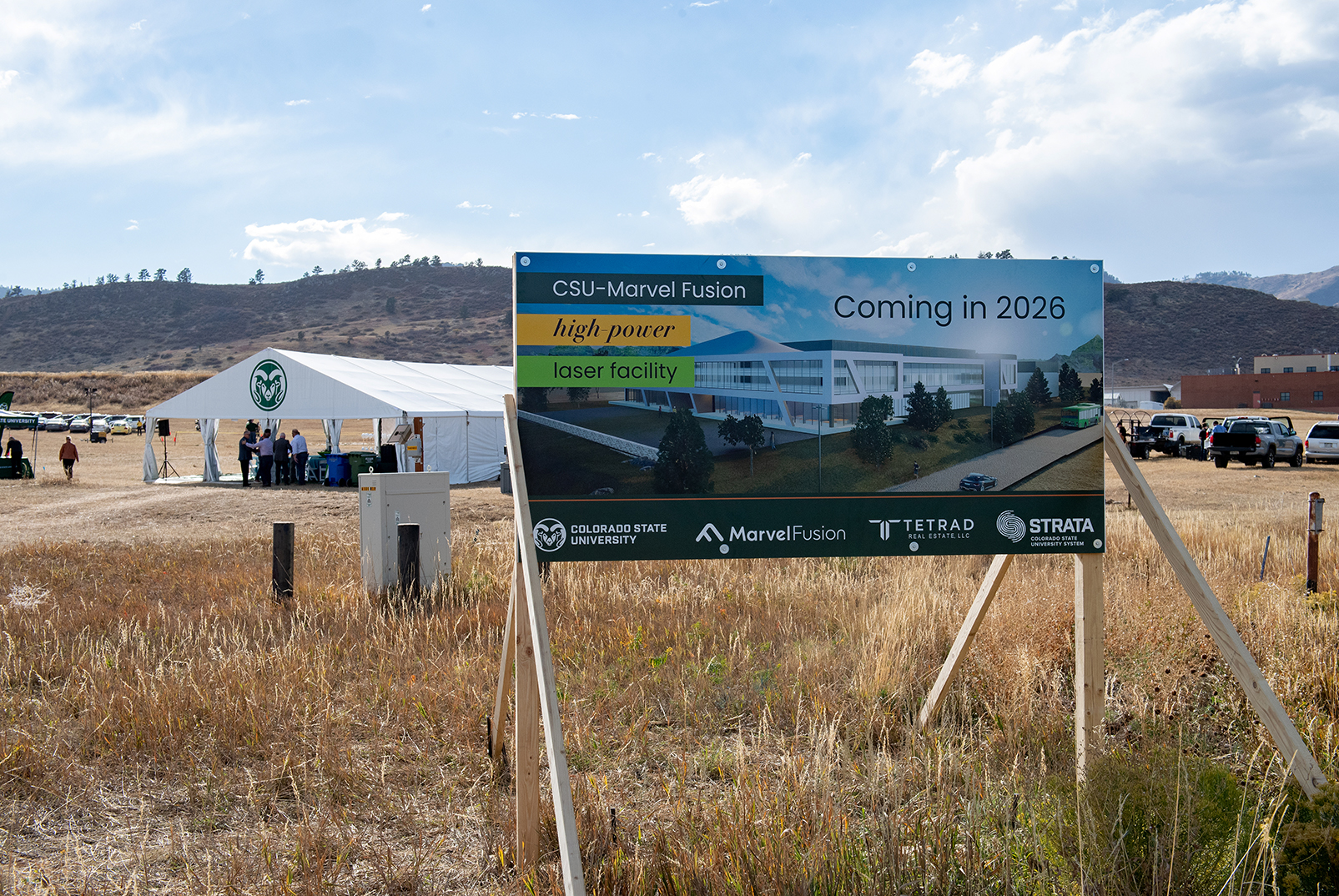
Colorado State University hosted a ground-breaking event for a new laser research facility being built in partnership with Marvel Fusion at the university’s Foothills Campus. (Image: CSU)
In the foothills of the Rocky Mountains on the outskirts of Fort Collins, Colo.—home to Colorado State University—work began this month on a new laser facility funded by a public-private partnership. The private portion is $150 million from Marvel Fusion, announced in August 2023, while $12.5 million—the latest funding for CSU from the Department of Energy’s Office of Fusion Energy Sciences (FES)—will support the new facility as part of LaserNetUS, a laser research network operated by DOE-FES to provide access to laser facilities for multidisciplinary researchers from the United States and abroad.

.svg.png)