
A Technical Blueprint for EPU Equipment Upgrades: Increasing Reliability and Reducing Total Cost of Ownership
To meet current and future power capacity needs, nearly all utilities with nuclear generation assets are looking at the feasibility of extended power uprates (EPU) for their facilities. Much of the engineering efforts of the plants and their engineering partners is focused to how the affected systems need to be modified to accommodate increases in steam and water flow.
The change in pump hydraulics required to meet the EPU flow and pressure provides a tremendous opportunity for improvement in pump design and performance. Since the pumps in the feed pump train act in series, there is considerable flexibility in establishing the pressure developed by each pump service to achieve the necessary system head for the EPU flow. Turbine-driven feed pumps provide greater flexibility since most of the incremental pressure required can be obtained in the feed pump alone.
By including a comprehensive pump design review as part of the EPU process, end users can achieve the lowest total cost of equipment ownership by:
Reducing long-term costs
Minimizing initial investment
Mitigating potential risks
When navigating an extended power uprate, the default strategy typically involves contracting an engineering, procurement, and construction (EPC) firm. The EPC determines what equipment modifications are needed to produce the new required flow and pressure, usually favoring a wholesale replacement of the feedwater pump train to accommodate the additional flow and pressure required. However, this approach can be very expensive and often fails to incorporate new technologies and operating experience that would eliminate known mechanical vulnerabilities.
By reframing the standard EPU approach to an equipment-centric model, end users can take advantage of the experience and specialized engineering capabilities of subject matter experts. Instead of a total replacement, hydraulic modifications can often be executed that reuse the existing equipment- both pumps and motors. Where this is not feasible, custom drop-in replacements can be designed. This methodology preserves the original footprint while also significantly enhancing equipment availability.
Hydro’s recent partnership with a US nuclear generating station and their EPC partner highlights the value of this approach, providing a technical blueprint for meeting uprate requirements while also maximizing equipment efficiency and reliability through targeted design improvements. As an independent pump service provider, Hydro has the experience to understand and improve the design but is also able to provide an unbiased viewpoint.
Assessment of Current and Future Operation
The first step the EPU team (Hydro, the end user, and their EPU partner) undertook was to complete an engineering analysis of the feedwater system. The study began with an overview of how the equipment was operating at the existing system demand. This overview helped Hydro understand how head was currently distributed between the applications and what additional head was required to meet the new system flow.
Weibull Reliability Curve
The subject nuclear plant’s reactor feed system has three pumps operating in series- a condensate pump, condensate booster pump, and reactor feed pump. The existing alignment of the feed system pump train is three (3) condensate pumps operating in parallel, feeding three (3) booster pumps operating in parallel, discharging to two (2) reactor feed pumps operating in parallel. The approved EPU requires a 16.3% increase in flow and 4.3-5.8% increase in total developed head (TDH) from the three (3) applications acting in series.
The initial investigation uncovered that all pumps were being operating back on their curve, away from the best efficiency point (BEP). This discovery underscored a high potential for improvement not only in operating efficiency but also in equipment reliability. The study also identified the main constraints on the system, which included horsepower limitations, net positive suction head required (NPSHr) margin, turbine drive speed limitations, and pressure limitations of ancillary equipment, such as demineralizers, installed at various points within the system.
Hydraulic Design-flow Streamline
Predicted Efficiency Improvements
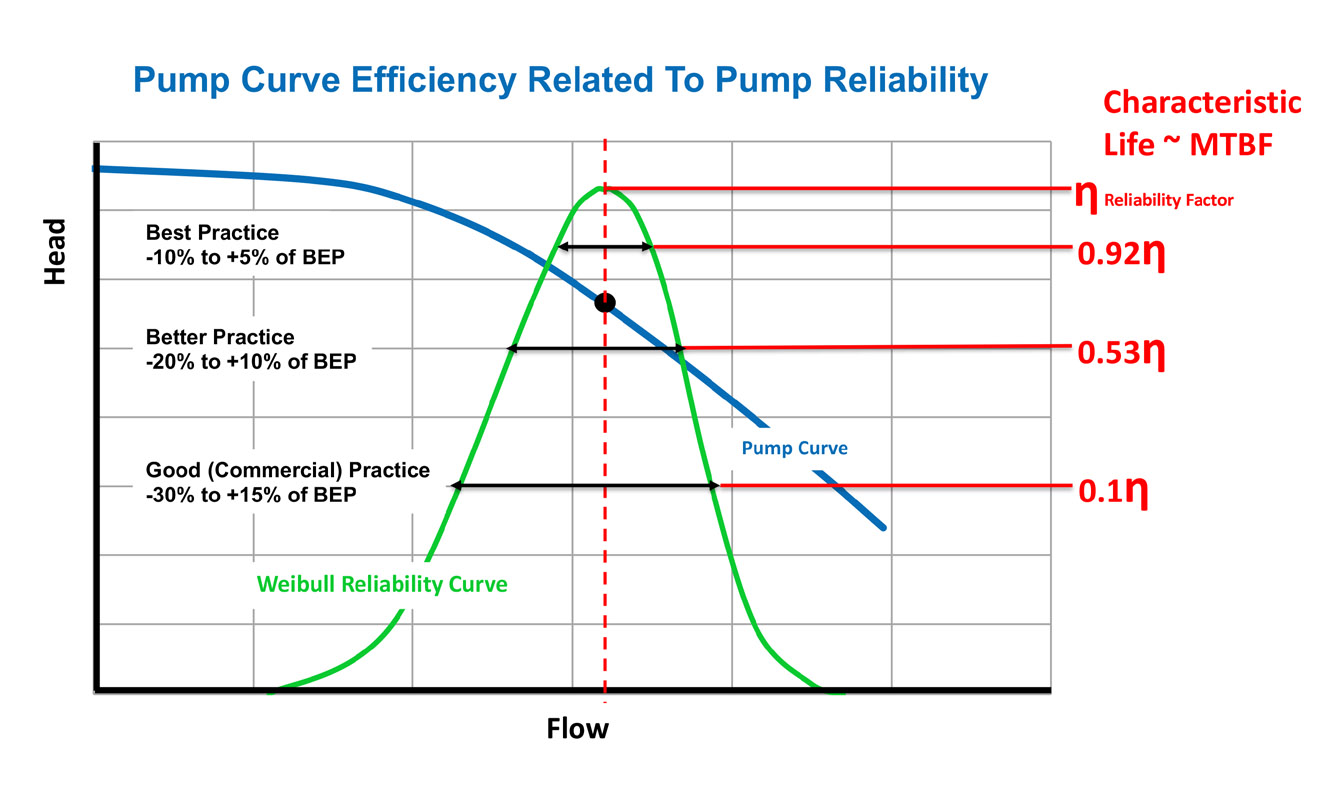
Operational excellence of pumps is achieved by mitigating hydraulic instability at both the impeller inlet and exit. This is accomplished by operating each pump within -10%/+5% of its best efficiency flow (BEP). A study conducted by Waloddi Weibull demonstrates the impact on pump reliability when not operating at BEP. Another critical consideration is providing acceptable net positive suction head available (NPSHa) to net positive suction head required (NPSHr) margin for all steady-state and transient operating modes.
Hydro’s study initially concluded that it is probable that all reliability parameters could be met for all applications for EPU and EPU +5% if the booster and reactor feed pump impellers were redesigned to have their BEP at the EPU flow condition. In this scenario, it was determined that the condensate pump system could remain as installed, which was important given the electrical constraints precluding additional motor sizing.
The redesigned impellers would fit into the existing casings, requiring no modifications to the existing foundations and structures. It was recommended that computational fluid dynamics (CFD) be employed to validate that the interaction between the new impeller and existing casing will not cause flow separation and subsequent loss of performance.
Exploring Different Scenarios
While strongly recommending that the site choose to modify the hydraulics of the existing booster pump and reactor feed pump so that they would meet the stated reliability parameters, the aftermarket service provider also analyzed two other operating scenarios and provided an unbiased opinion on the risks associated with each option. The options considered included:
Option 1: Restoring the pumps to the original design with no modifications
Option 2: Adding an additional stage to the condensate pump (from 3 stages to 4 stages) to provide more head while maintaining the original design of the condensate booster and reactor feed pumps. This modification will require a larger electric motor and shafting/bearing system for the condensate pumps.
Option 3: Designing new custom impellers for the booster and feed pumps to be installed in existing casings. The new design would have its BEP at the EPU flow and redistribute head between the two pumps to put more head into the booster pump, allowing the reactor feed pump’s turbine drive to operate at a reduced speed and horsepower.
Each option took into consideration sensitivity cases reflecting eight filter/demineralizers; one case assumed that the demineralizers were clean (10.5 psid loss at EPU flow), and the other assumed that the demineralizers had maximum allowable debris loading (24.0 psid loss at EPU flow).
The study showed that the pumps would be operable, but not optimal, for the EPU flow rates under both options 1 & 2. The greatest concerns for normal operation were the NPSHa margin and operation relative to BEP for both the condensate booster pump and reactor feed pump.
Another Scenario Emerges
While evaluating the recommendations that were proposed by Hydro, site management imposed an accident scenario wherein the plant was to remain functional with a loss of one of the two 50% turbine driven feed pumps. This requires a minimum 68% of the EPU mass flow to the reactor to avoid shutting down the unit.
This new scenario made the recommendations previously supplied untenable. In this new condition, the single operating feed pump would increase speed significantly, and analysis showed that both the turbine overspeed limit and design turbine horsepower rating would be exceeded. API 612 limits steam turbine overspeed limits to ~27% above the rated speed; the required speed in this scenario was ~39% of the design speed.
The new solution was to provide additional head to either the condensate or booster pump to reduce the head generation required by the single feed pump. This placed the turbine back to within its design parameters for both speed and horsepower thus obviating the need to purchase two new expensive steam turbines.
Given the limitations of the current electrical supply to the condensate pump, the site decided to place the additional head in the booster pump.
Design Improvements
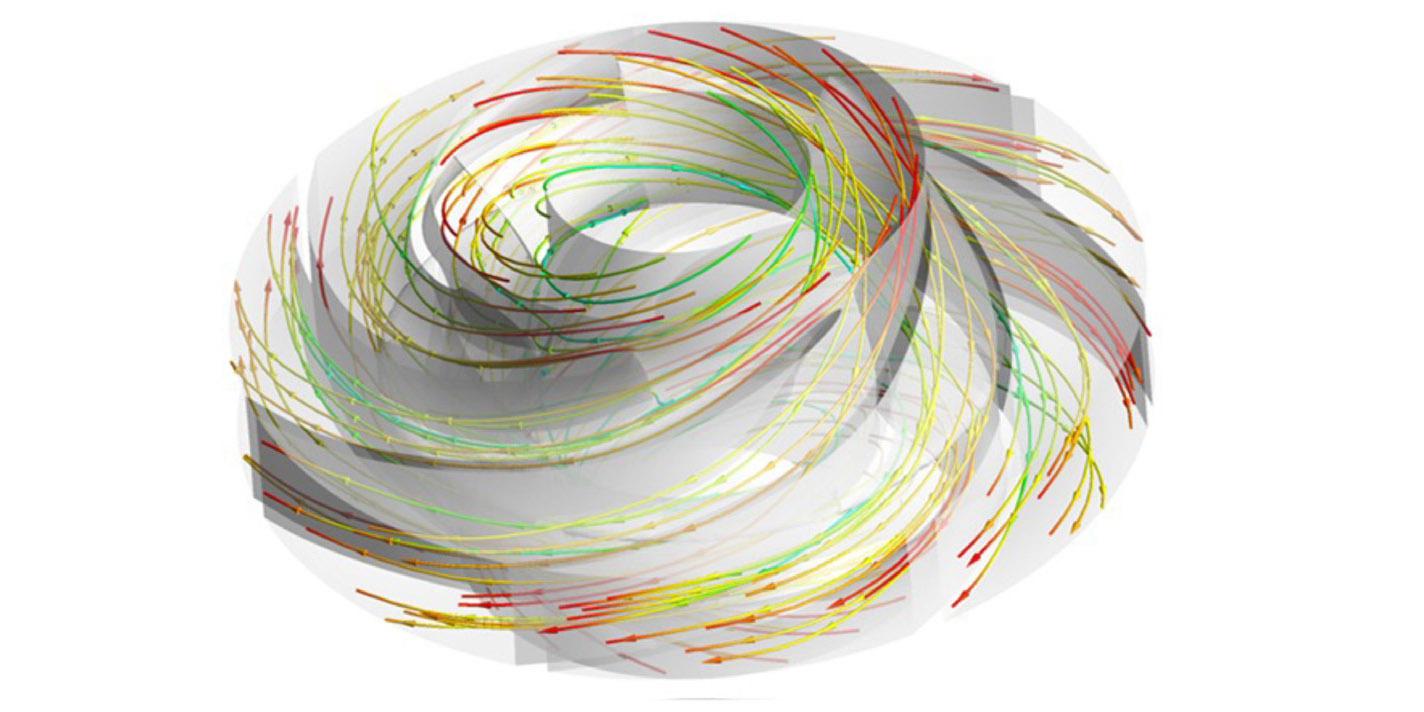
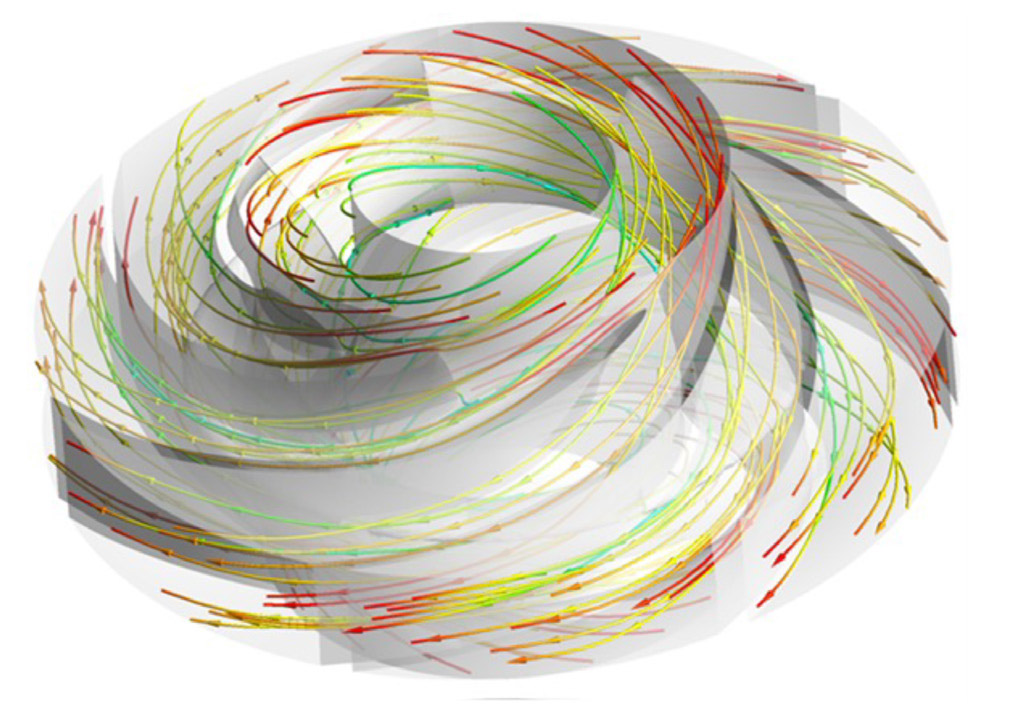
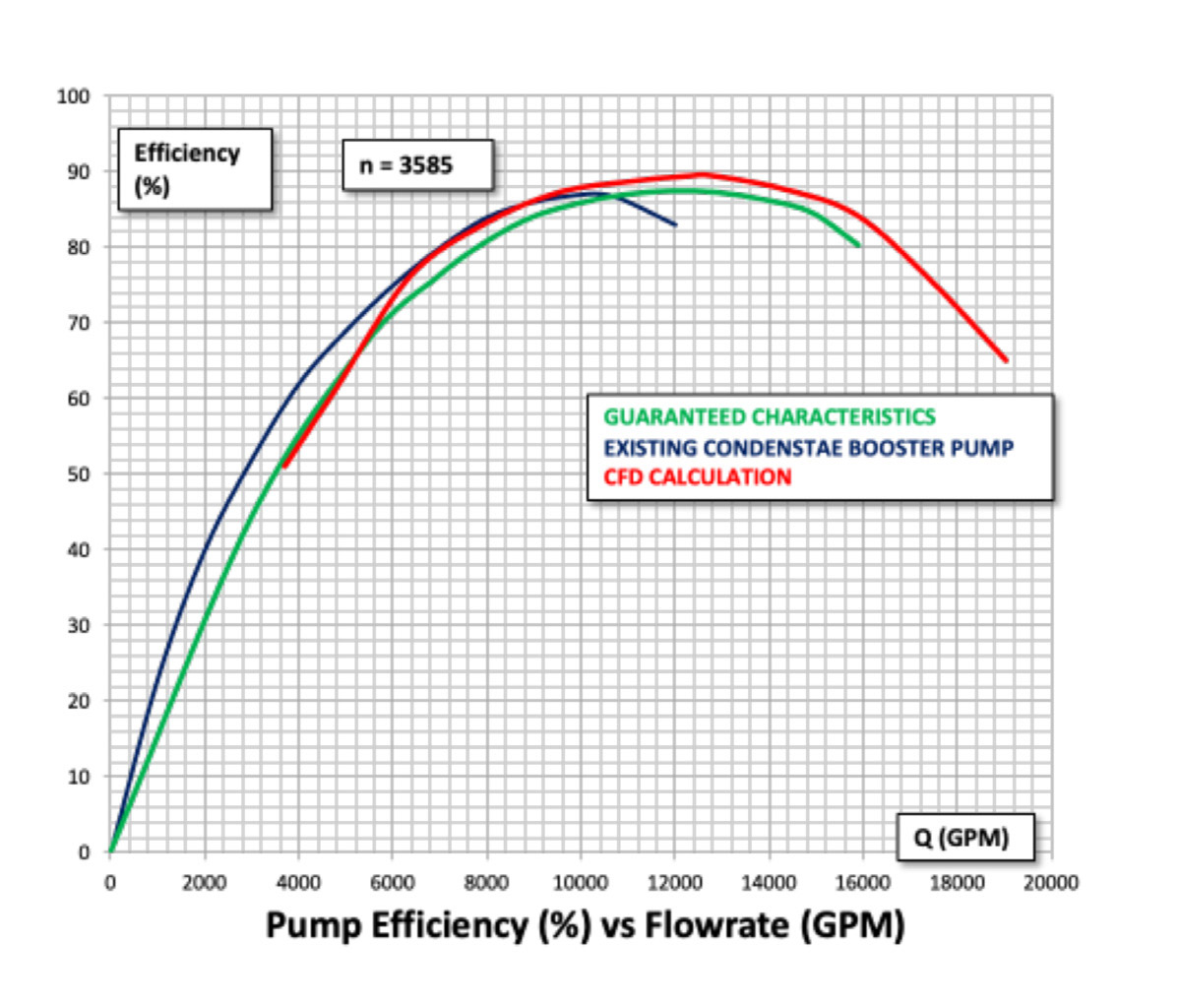
New hydraulic components were designed to meet the EPU requirements within the defined system constraints. As a custom design, Hydro was able to meet these requirements close to the best efficiency point instead of having to choose a “best fit” from existing designs. Computational fluid dynamics (CFD) was used during the design to predict performance and identify any problematic flow conditions. The predicted performance of the new hydraulic design improved peak efficiency from ~87.5% to ~90%, further reducing the long-term costs of equipment ownership.
In addition to the hydraulic modifications undertaken for the condensate booster and feedwater pumps, a design analysis was completed to identify common failure modes for those pump configurations and ensure that the new design included measures to counteract these known weaknesses.
Some examples of design improvements included in the new pumps are:
Biased wear ring diameters to ensure unidirectional thrust and eliminate risk of axial shuttling for single-stage double suction condensate booster pump
5-pad tilting pad journal bearings for increased stiffness
Diamond-faced mechanical seals for longer life
Conclusion
Having done their due diligence to understand how the reactor feed system pumps would react under different operating conditions, the nuclear plant was able to choose a path forward that reduced risk and best suited their reliability goals and project budget. In lieu of supplying redesigned impellers within the existing casing, as had been originally planned, they opted to work with Hydro to custom-design new booster pumps and feed pumps to operate at their BEP and to deliver the required pressures.
Hydro is now undertaking the new hydraulic design, which will be validated through CFD and tested in their performance test lab, and providing sole-source responsibility for all other required design analyses and equipment supply, including new motors for the condensate booster pump.
This project demonstrates the importance of a rigorous system analysis when approaching an anticipated change in system demand, as with an EPU.
 Mike Mancini, Hydro Total Solutions, Hydro, Inc.
Mike started his career in 1974 at Ingersoll-Rand designing pumps for the US Navy SSN 688 and Trident submarine program. He progressed to Vice President of Worldwide Aftermarket Services for Ingersoll-Dresser Pump
Mike went into business as an independent pump consultant in 2003. He worked with many customers in varied markets in the training of personnel, specification development, root cause analysis, and strategic planning and process improvement. He is now President of Hydro Total Solutions for Hydro, Inc. His job responsibilities mirror his consulting work, supporting customers in reducing their total cost of pump operation.
 Dibu Chowhury, Hydro, Inc. Vice President, Nuclear Division
Dibu Chowdhury has been an integral part of Hydro’s engineering team since joining the organization in 2007. He demonstrates exceptional technical expertise, specializing in finite element analysis and pump design. In his current role, he responsible for overseeing all activities within Hydro’s Nuclear Division.
Dibu has also been Chairman of the ASME Working Group on Pumps since 2019.