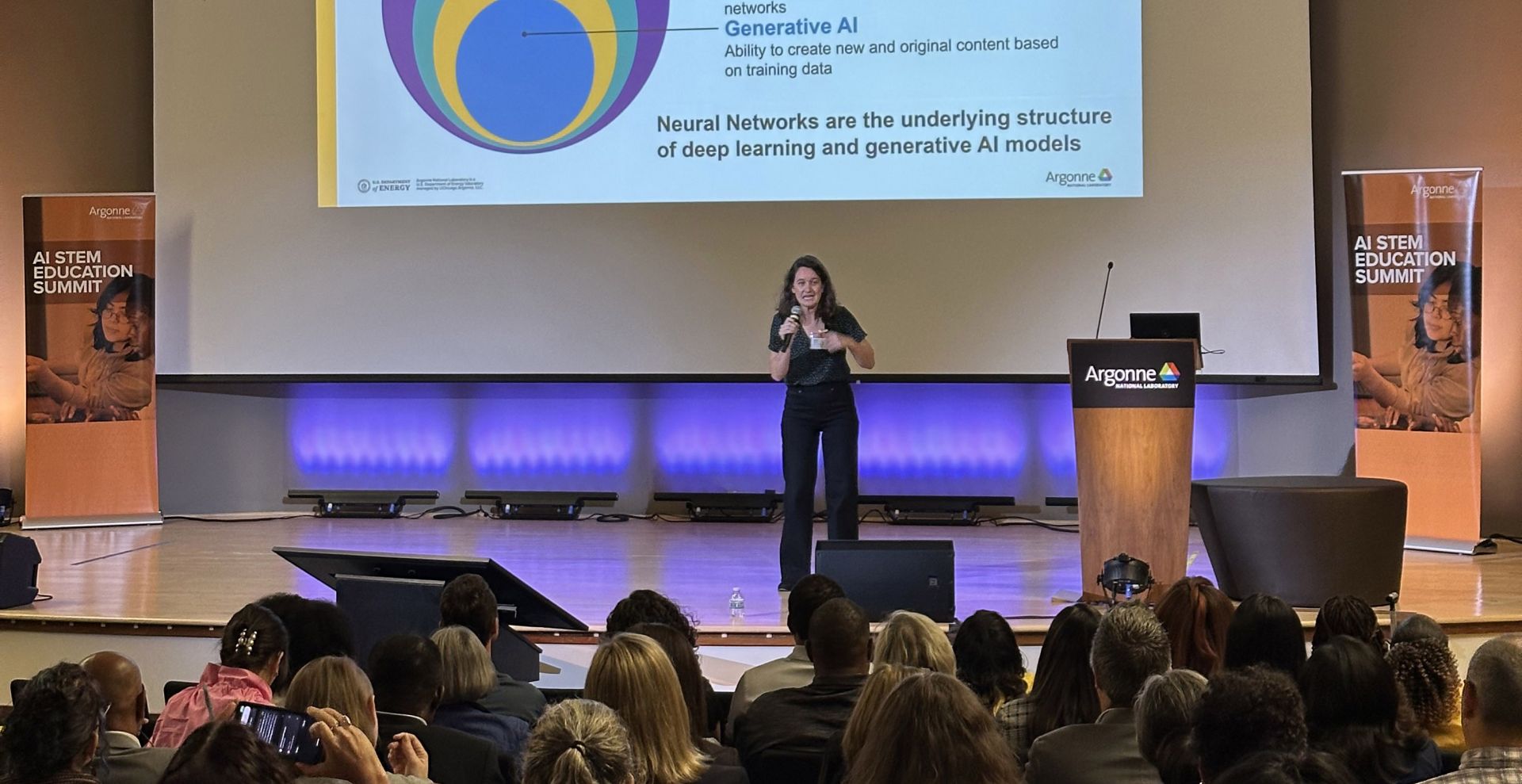
Argonne’s Paige Kingsley presents “Inside the Neural Network: An Interactive AI Experience” at the AI STEM Education Summit. (Photo: Argonne)
Last September, in the Chicago suburb of Lemont, Ill., Argonne National Laboratory hosted its first AI STEM Education Summit. More than 180 educators from high schools, community colleges, and universities; STEM administrators; and experts in various disciplines convened at “One Ecosystem, Many Pathways–Building an AI-Ready STEM Workforce” to discuss how artificial intelligence is reshaping STEM-related industries, including the implications for the nuclear engineering classroom and workforce.
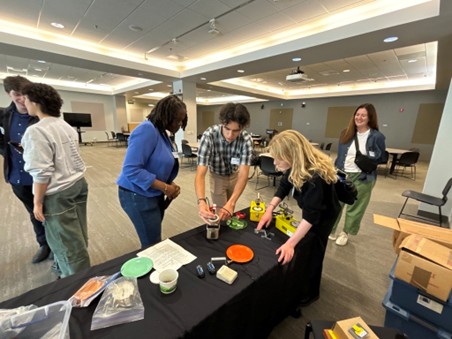
ANS immediate past president Lisa Marshall (blue sweater) tests the radioactivity of various materials at this year’s Radfest with Rex Reidel and Lillian Merrill, two chairs of the ANS Accelerators. (Photo: ANS)
The day before the 2025 ANS Annual Conference officially began in Chicago, the air was abuzz with the crackle of Geiger counters at Argonne National Laboratory in neighboring Lemont, Ill., where about 100 visitors from across the country attended an outreach and education event hosted by the American Nuclear Society.
AI-powered imaging from Argonne reveals hidden flaws in stainless steel and could boost safety in critical industries
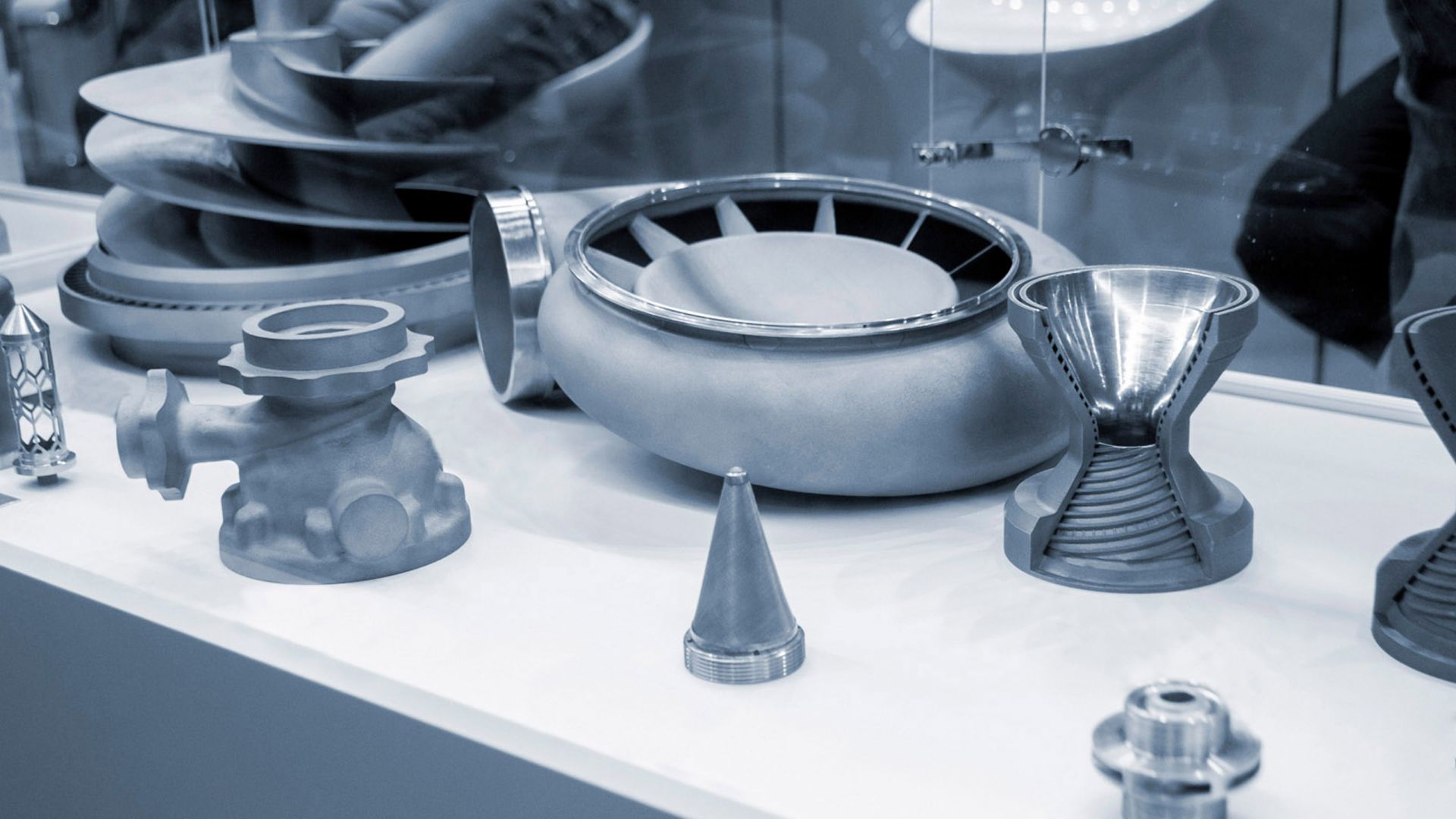
Advanced metal components produced through additive manufacturing can highlight the potential for cutting-edge technologies like AI-enhanced defect detection to ensure their reliability. (Photo: Shutterstock/MarinaGrigorivna)
Imagine you’re constructing a bridge or designing an airplane, and everything appears flawless on the outside. However, microscopic flaws beneath the surface could weaken the entire structure over time.
These hidden defects can be difficult to detect with traditional inspection methods, but a new technology developed by scientists at the U.S. Department of Energy’s Argonne National Laboratory is changing that. Using artificial intelligence and advanced imaging techniques, researchers have developed a method to reveal these tiny flaws before they become critical problems.
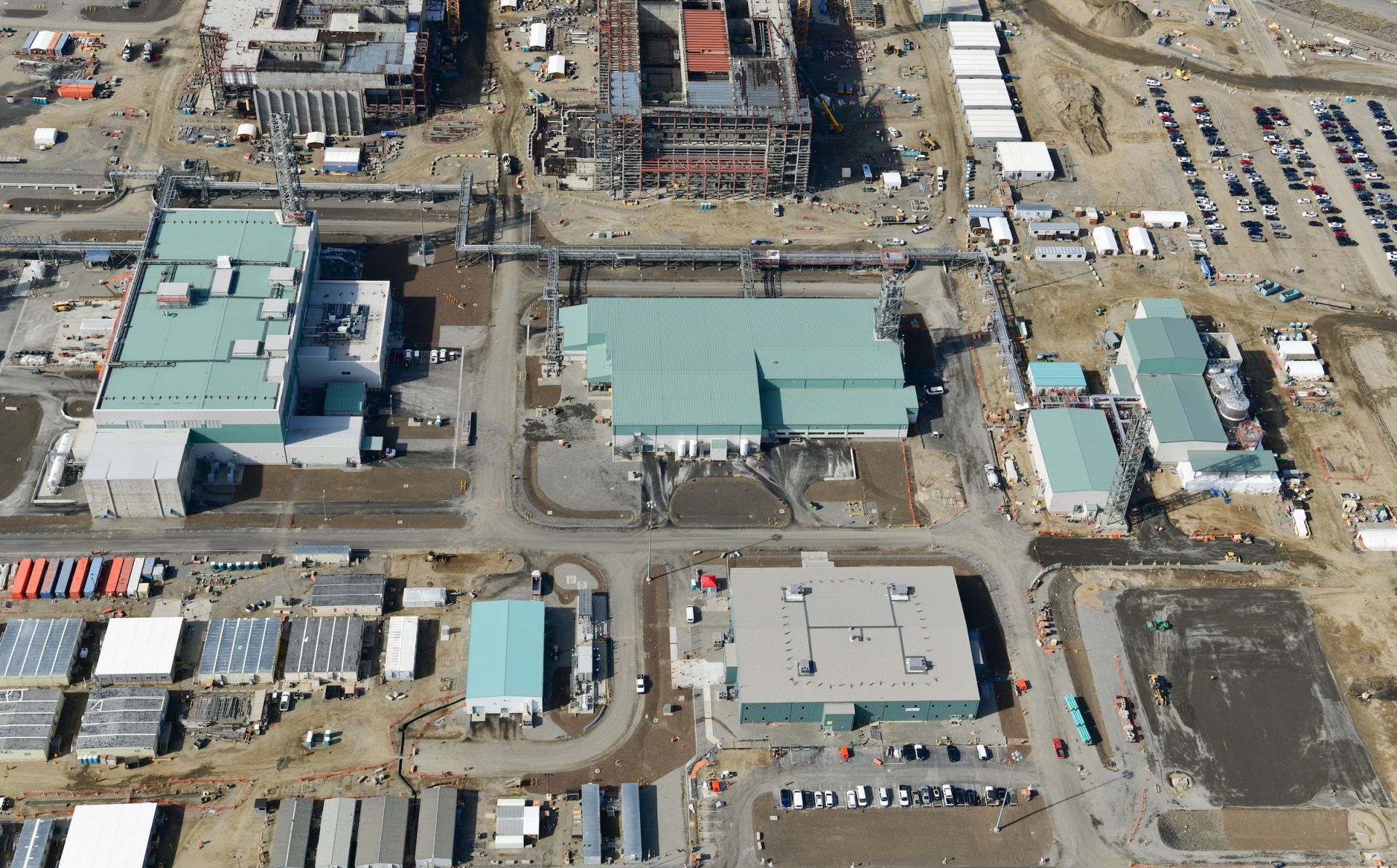
Hanford’s Waste Treatment and Immobilization Plant, also known as the Vit Plant. (Photo: Bechtel National)
Researchers at the Department of Energy’s Argonne National Laboratory are investigating the details of plutonium chemistry with the goal of aiding the cleanup of the Hanford Site in Washington state. For more than 40 years, reactors located at Hanford produced plutonium for America’s defense program, resulting in millions of gallons of liquid radioactive and chemical waste.
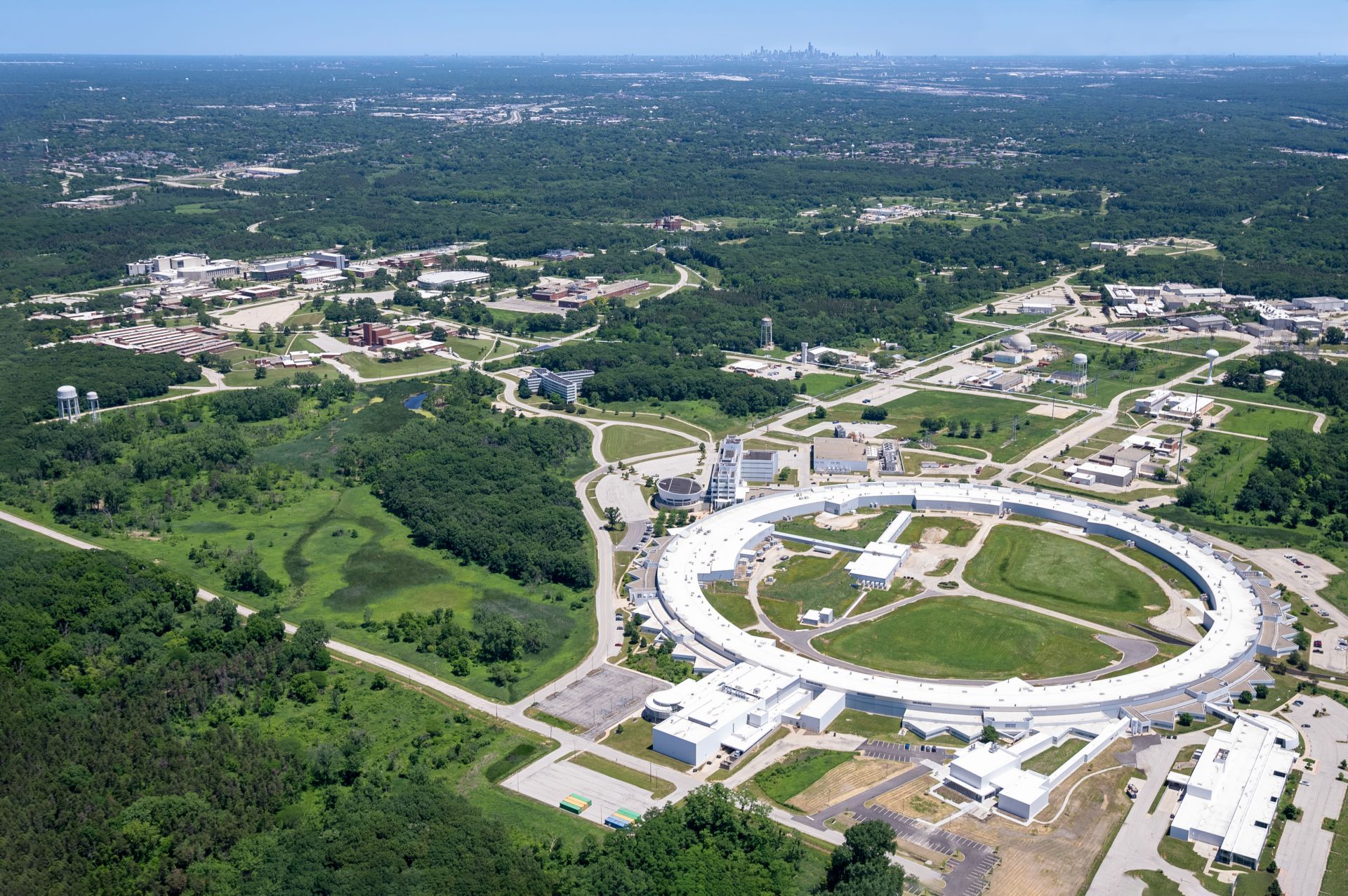
The DOE’s Argonne National Laboratory in Lemont, Ill. (Photo: DOE)
Researchers at the Department of Energy’s Argonne National Laboratory are developing and deploying ARG-US (from the Greek Argus, meaning “Watchful Guardian”) remote monitoring systems technologies to enhance the safety, security, and safeguards (3S) of packages of nuclear and other radioactive material during storage, transportation, and disposal.
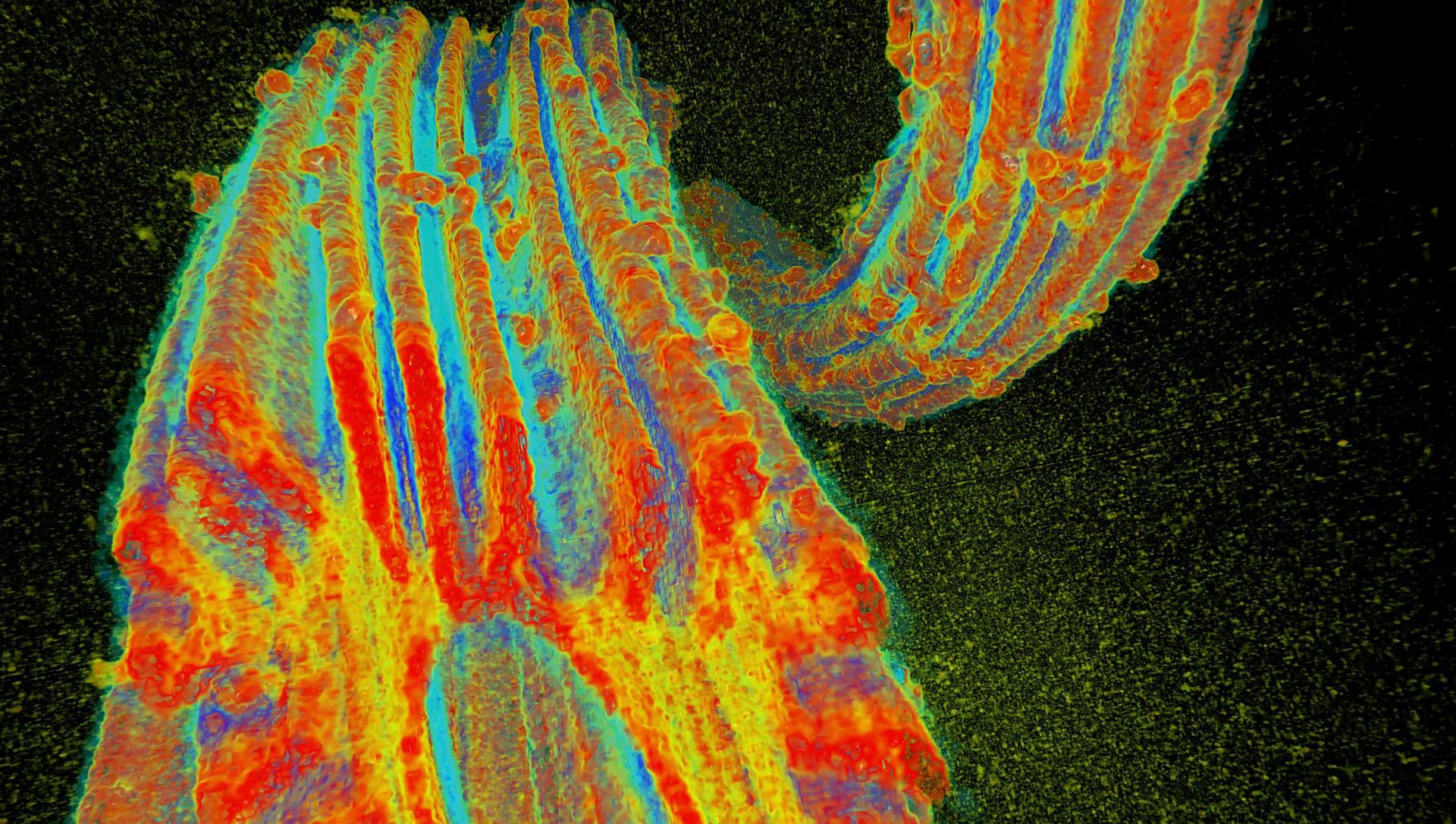
Researchers have been working frantically to develop an array of materials and fibers to economically extract uranium from seawater—and they have succeeded. PNNL scientists exposed this special uranium-sorbing fiber developed at ORNL to Pseudomonas fluorescens and used the Advanced Photon Source at Argonne National Laboratory to create a 3-D X-ray microtomograph to determine microstructure and the effects of interactions with organisms and seawater. (Image: PNNL)
America, Japan, and China are racing to be the first nation to make nuclear energy completely renewable. The hurdle is making it economical to extract uranium from seawater, because the amount of uranium in seawater is truly inexhaustible.
While America had been in the lead with technological breakthroughs from the Department of Energy’s Pacific Northwest and Oak Ridge National Laboratories, researchers at Northeast Normal University in China have sprung ahead. But these breakthroughs from both countries have brought the removal of uranium from seawater within economic reach. The only question is when will the source of uranium for our nuclear power plants change from mined ore to seawater extraction?
Joint efforts of Argonne and private industry further nuclear reactor developments
Partnerships between the nuclear industry and national laboratories are making overall codes more robust and capable. (Photo: Argonne)
The development of modern nuclear reactor technologies relies heavily on complex software codes and computer simulations to support the design, construction, and testing of physical hardware systems. These tools allow for rigorous testing of theory and thorough verification of design under various use or transient power scenarios.
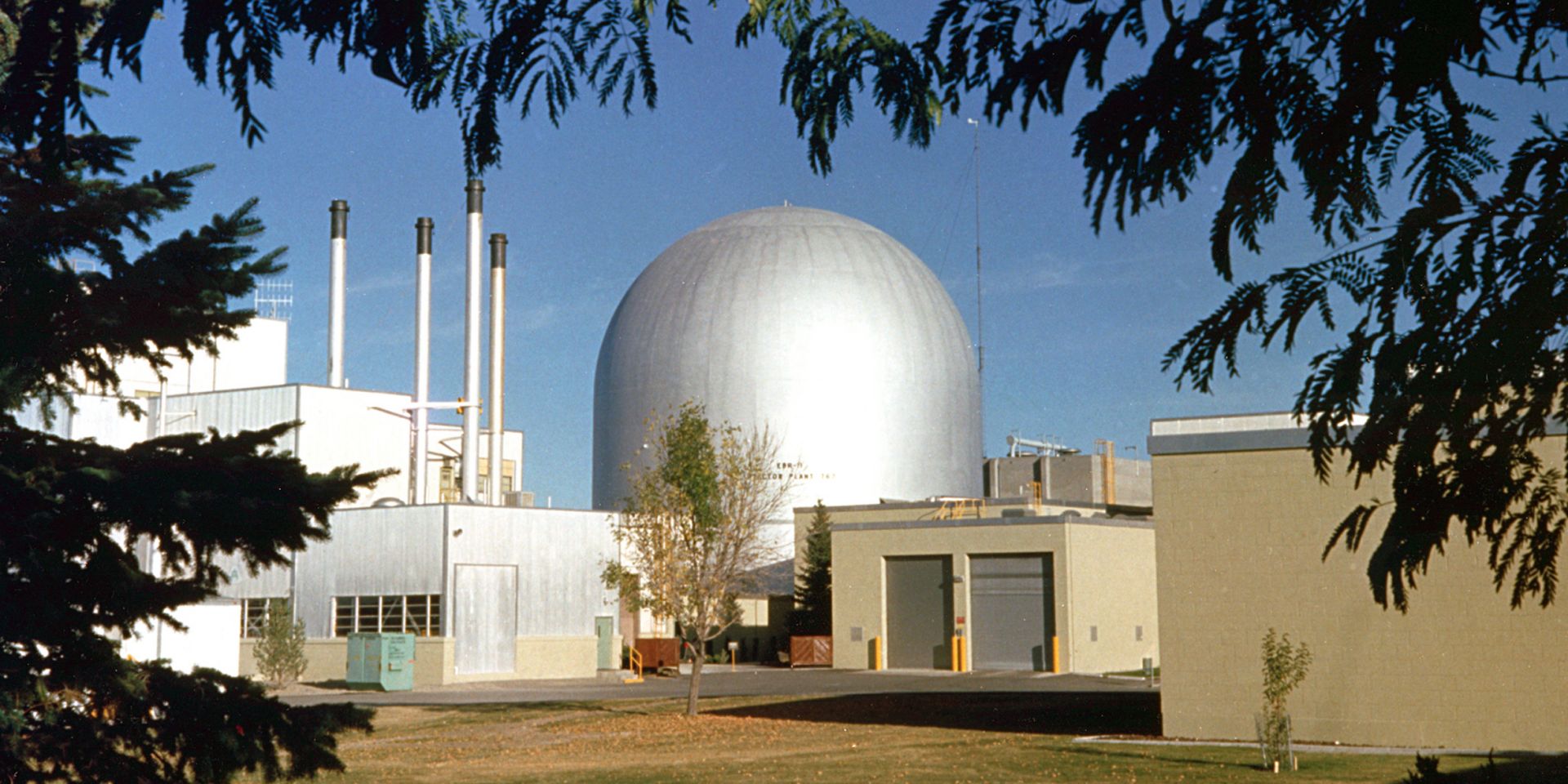
Experimental Breeder Reactor-II (Photo: ANL)
If you head west out of Idaho Falls on U.S. Highway 20 and make your way across the Snake River Plain, it won’t be long before you’ll notice a silver dome in the distance to the north. One of the most recognizable structures in the history of nuclear energy, Experimental Breeder Reactor-II stands out from the desert landscape. The 890-square-mile site on which EBR-II is located is the former National Reactor Testing Station, now known as Idaho National Laboratory.