
DOE steps up plutonium production for future space exploration

This high-resolution still image is from a video taken by several cameras as NASA’s Perseverance rover touched down on Mars on February 18. Credits: NASA/JPL-Caltech
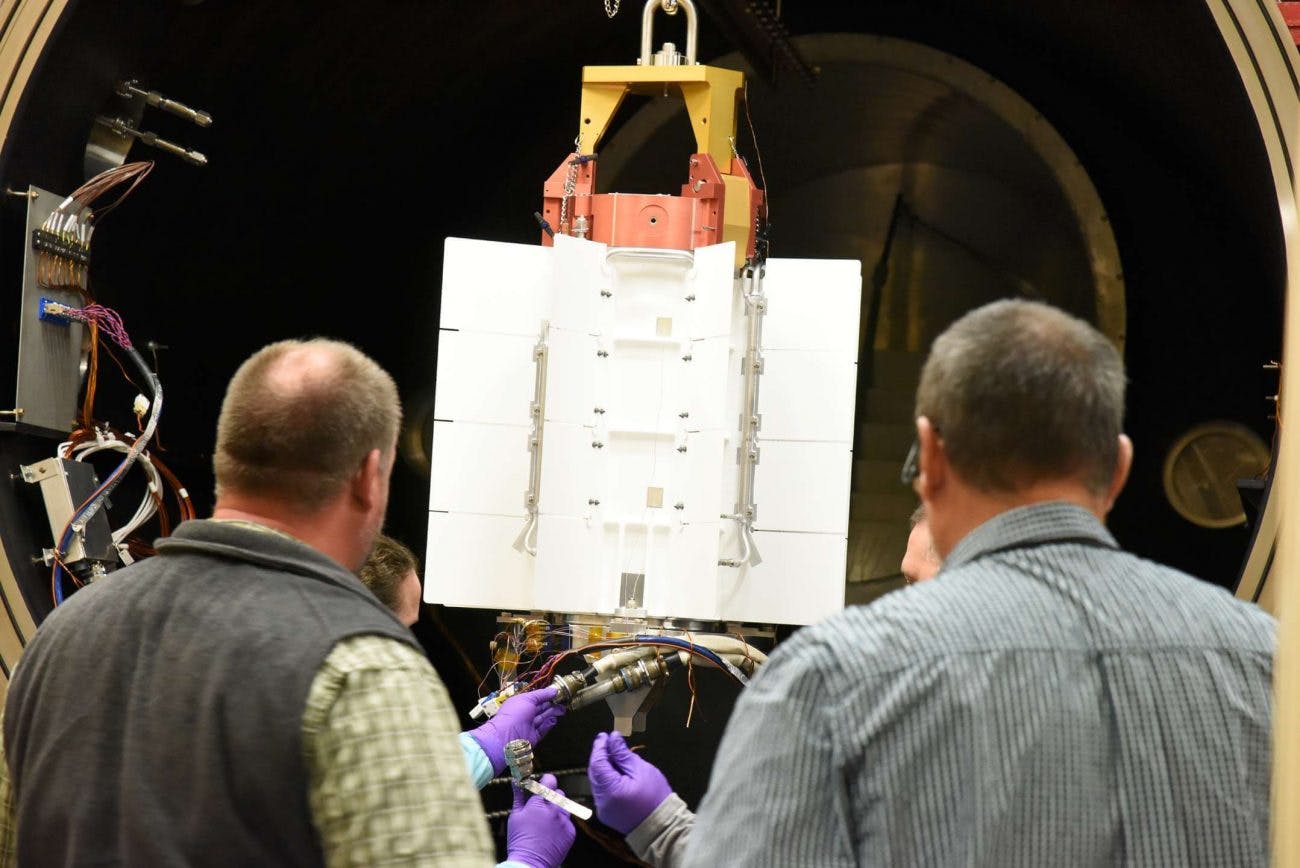
NASA’s Perseverance rover, which successfully landed on Mars on February 18, is powered in part by the first plutonium produced at Department of Energy laboratories in more than 30 years. The radioactive decay of Pu-238 provides heat to radioisotope thermoelectric generators (RTGs) like the one onboard Perseverance and would also be used by the Dynamic Radioisotope Power System, currently under development, which is expected to provide three times the power of RTGs.
Idaho National Laboratory is scaling up the production of Pu-238 to help meet NASA’s production goal of 1.5 kg per year by 2026, the DOE announced on February 17.



 Maybe everything really is bigger in Texas, but that’s not necessarily a good thing. The brutal winter storm that hit much of the country earlier this week struck the Lone Star State with particular severity, leaving the power grid in shambles and millions of Texas residents without power, in many instances for days. On Tuesday, at the height of the power crisis, more than 4.4 million utility customers were without access to electricity, according to
  Coordinated federal and private industry investments made now could yield an operational fusion pilot plant in the 2035–2040 time frame, according to



 ANSI/ASME/ANS RA-S-1.4-2021, “Probabilistic Risk Assessment Standard for Advanced Non-Light Water Reactor Nuclear Power Plants,” has just been issued. Approved by the American National Standards Institute (ANSI) on January 28, 2021, this joint American Society of Mechanical Engineers (ASME)/American Nuclear Society (ANS) standard sets forth requirements for probabilistic risk assessments (PRAs) used to support risk-informed decisions for commercial nuclear power plants and prescribes a method for applying these requirements for specific applications.