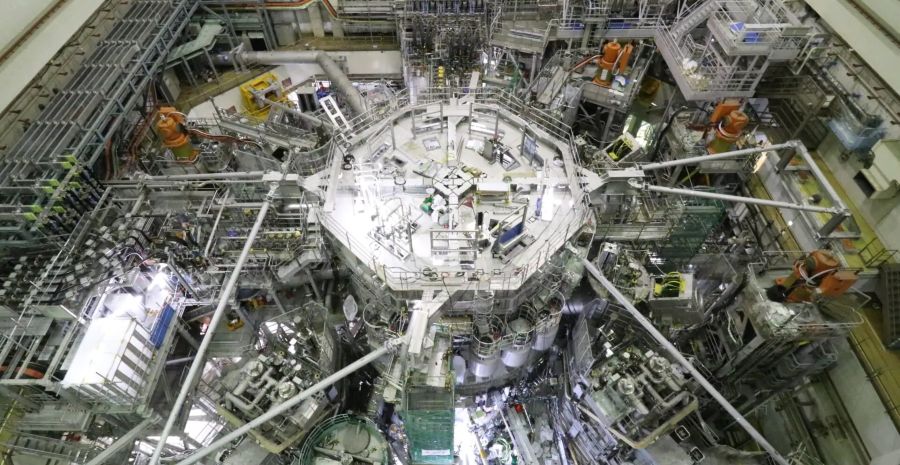
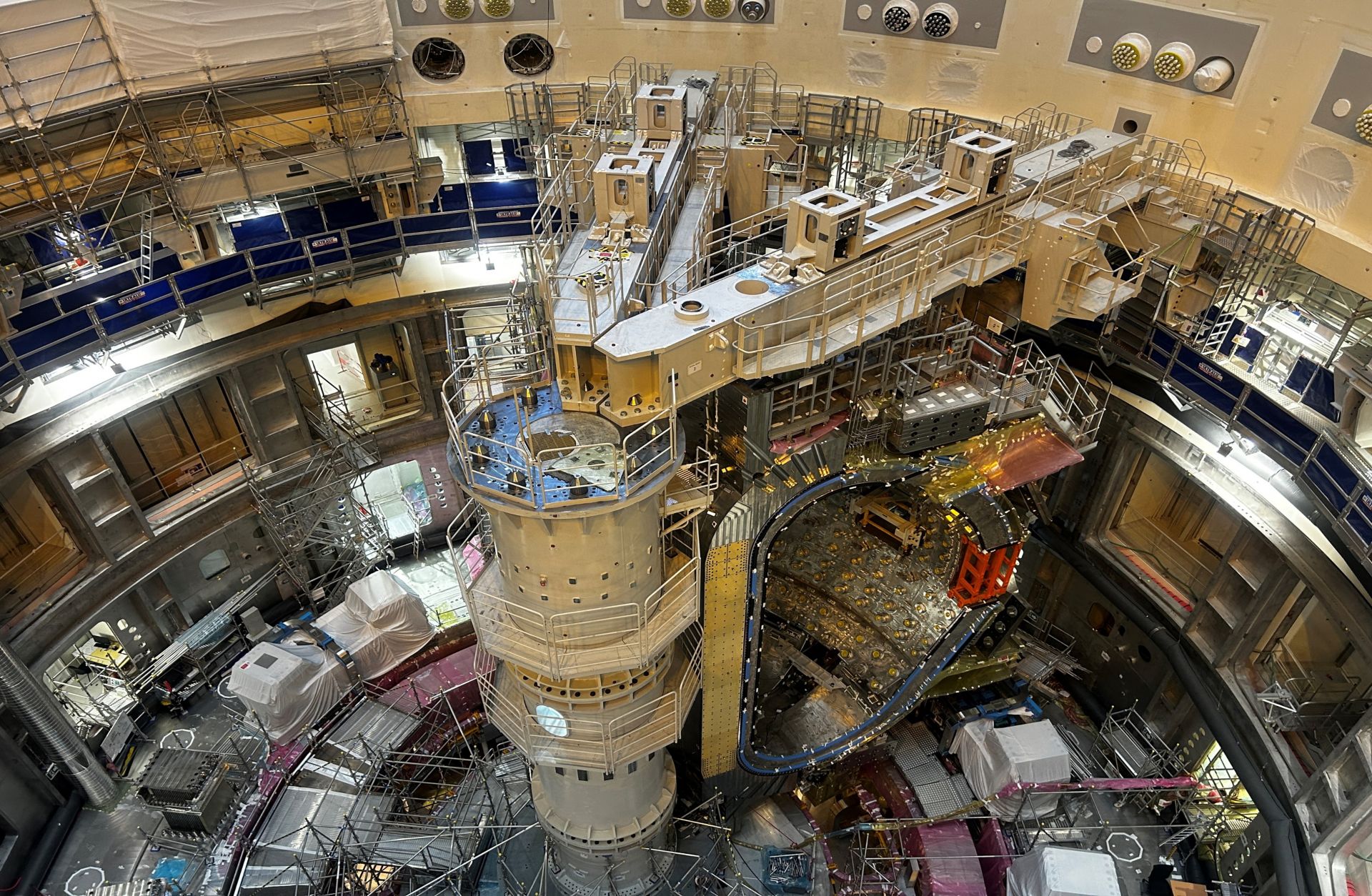
View from above of the JT-60SA tokamak in March 2026. (Photo: QST)
The project team for the world’s largest operational tokamak, JT-60SA, has announced that it is getting ready to resume operations. The machine has been undergoing upgrades since 2024, with testing of newly installed equipment occurring since February 27.
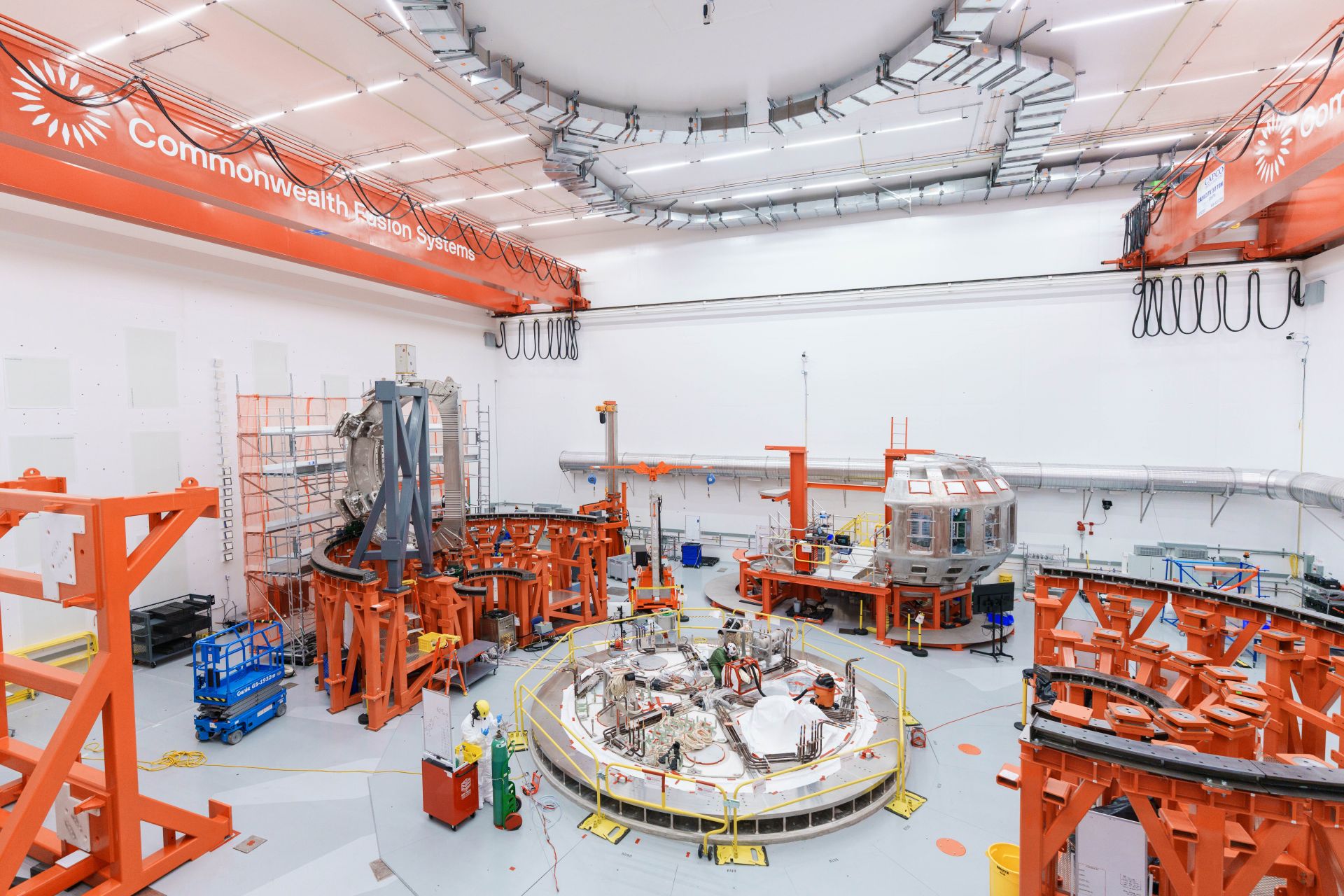
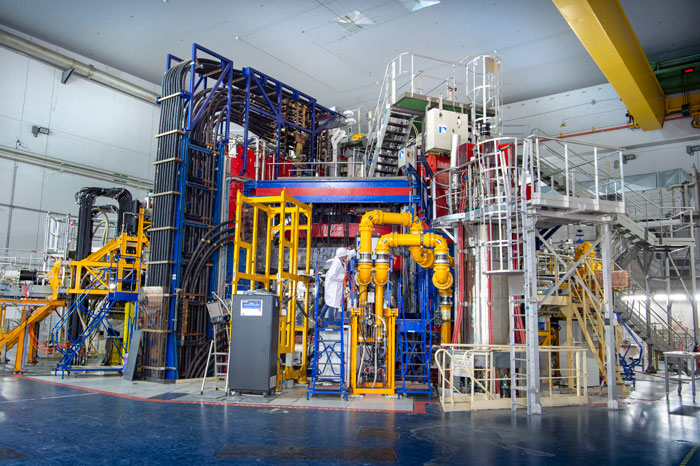
Tokamak Hall, where SPARC is being built, at CFS’s Devens, Mass., headquarters. (Photo: Commonwealth Fusion Systems)
Commonwealth Fusion Systems makes no small plans. The company wants to build a 400-MWe magnetic confinement fusion power plant called ARC near Richmond, Va., and begin operating it in the early 2030s. And the plans don’t end there. CFS wants to deploy “thousands” of fusion power plants capable of accelerating a global energy transition.
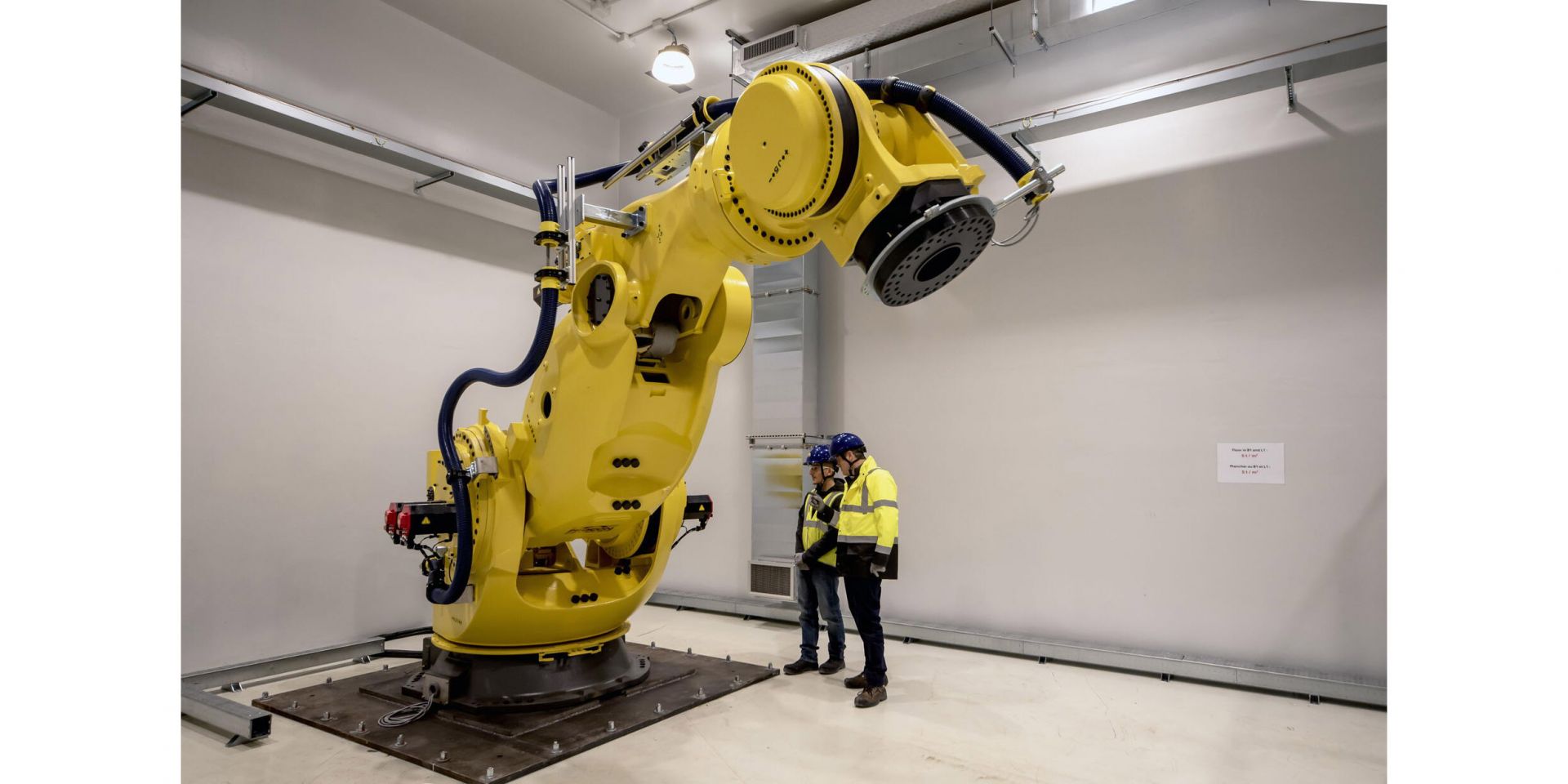
ITER employees stand by Godzilla, a powerful industrial robot. (Photo: ITER)
Many people are familiar with Godzilla as a giant reptilian monster that emerged from the sea off the coast of Japan, the product of radioactive contamination. These days, there is a new Godzilla, but it has a positive—and entirely fact-based—association with nuclear energy. This one has emerged inside the Tokamak Assembly Preparation Building of ITER in southern France.
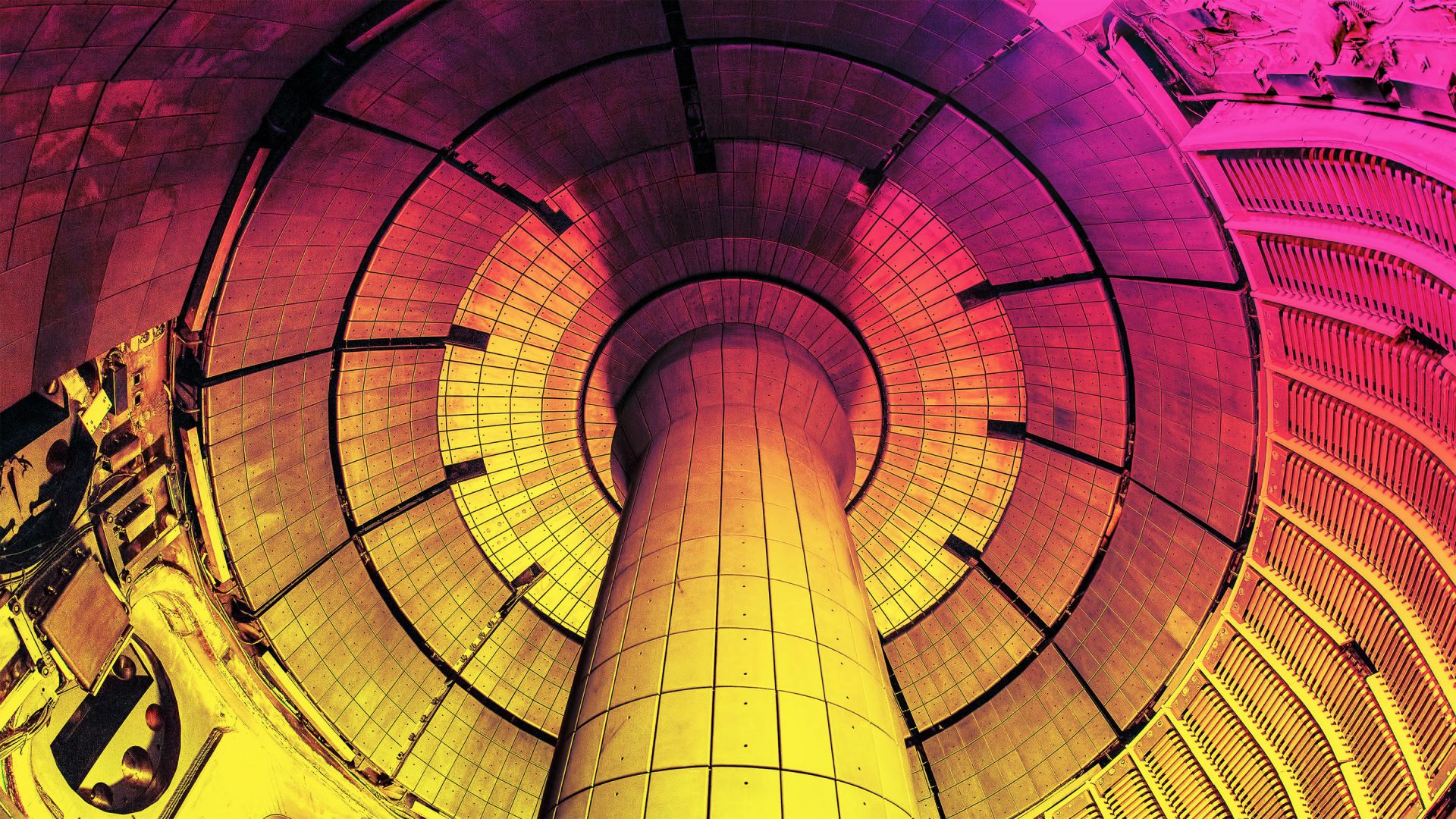
A colorized photo of the inside of PPPL’s NSTX-U. (Image: PPPL)
Princeton Plasma Physics Laboratory is leading a new initiative with the goal of using AI technology to accelerate the development of fusion energy research through high-fidelity computer simulations. The project includes national laboratories, universities, technology companies, and other partners.
Simulation, Technology, and Experiment Leveraging Learning-Accelerated Research enabled by AI (STELLAR-AI) has been developed as part of the Department of Energy’s Genesis Mission, which was established by presidential executive order last year to speed up the application of AI in scientific research.
Concept art of the SPARC digital twin. (Image: CFS)
Commonwealth Fusion Systems, a fusion firm headquartered in Devens, Mass., is collaborating with California-based computing infrastructure company NVIDIA and Germany-based technology conglomerate Siemens to develop a digital twin of its SPARC fusion machine. The cooperative work among the companies will focus on applying artificial intelligence and data- and project-management tools as the SPARC digital twin is developed.
An artist’s interpretation of the inside of a fusion vessel, where some of the inner surfaces are directly exposed to the plasma. Some regions lie in the “magnetic shadow” of other components and are therefore magnetically shielded from the intense heat of the plasma. (Image: Kyle Palmer/PPPL Communications Department)
The ITER tokamak pit with the two vacuum vessel sector modules installed. (Photo: ITER)
Westinghouse Electric Company announced that it has signed a $180 million contract with the ITER Organization for the assembly of the vacuum vessel for the fusion reactor being built in southern France. Designed to demonstrate the scientific and technological feasibility of fusion power, the ITER tokamak will be the world’s largest experimental fusion facility.
The WEST tokamak. (Photo: L. Godart/CEA)
The French magnetic confinement fusion tokamak known as WEST maintained a plasma in February for more than 22 minutes—1,337 seconds, to be precise—and “smashed” the previous record plasma duration for a tokamak with a 25 percent improvement, according to the CEA, which operates the machine. The previous 1,006-second record was set by China’s EAST just a few weeks prior. Records are made to be broken, but this rapid progress illustrates a collective, global increase in plasma confinement expertise, aided by tungsten in key components.
Korea’s KSTAR tokamak. (Photo: Korea Institute of Fusion Energy)
A rendering of Commonwealth Fusion Systems planned ARC power plant. (Image: CFS)
Commonwealth Fusion Systems (CFS) has announced that it plans to build a fusion power plant, named ARC, at the James River Industrial Park in Chesterfield County, Va.—and that it expects to be the first company to make fusion power available at grid scale.
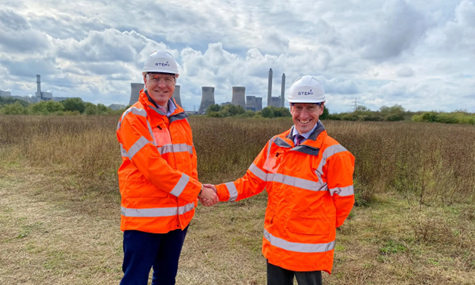
Chapman (left) and Methven at the West Burton power station. (Photo: UKIFS)
Leadership of the United Kingdom’s STEP (Spherical Tokamak for Energy Production) fusion program has transitioned to U.K. Industrial Fusion Solutions Ltd. (UKIFS), a wholly owned subsidiary of the U.K. Atomic Energy Authority (UKAEA). UKIFS was established in February 2023 to lead a public-private partnership that will design, build, and operate the STEP prototype fusion energy plant in Nottinghamshire in England’s East Midlands region.
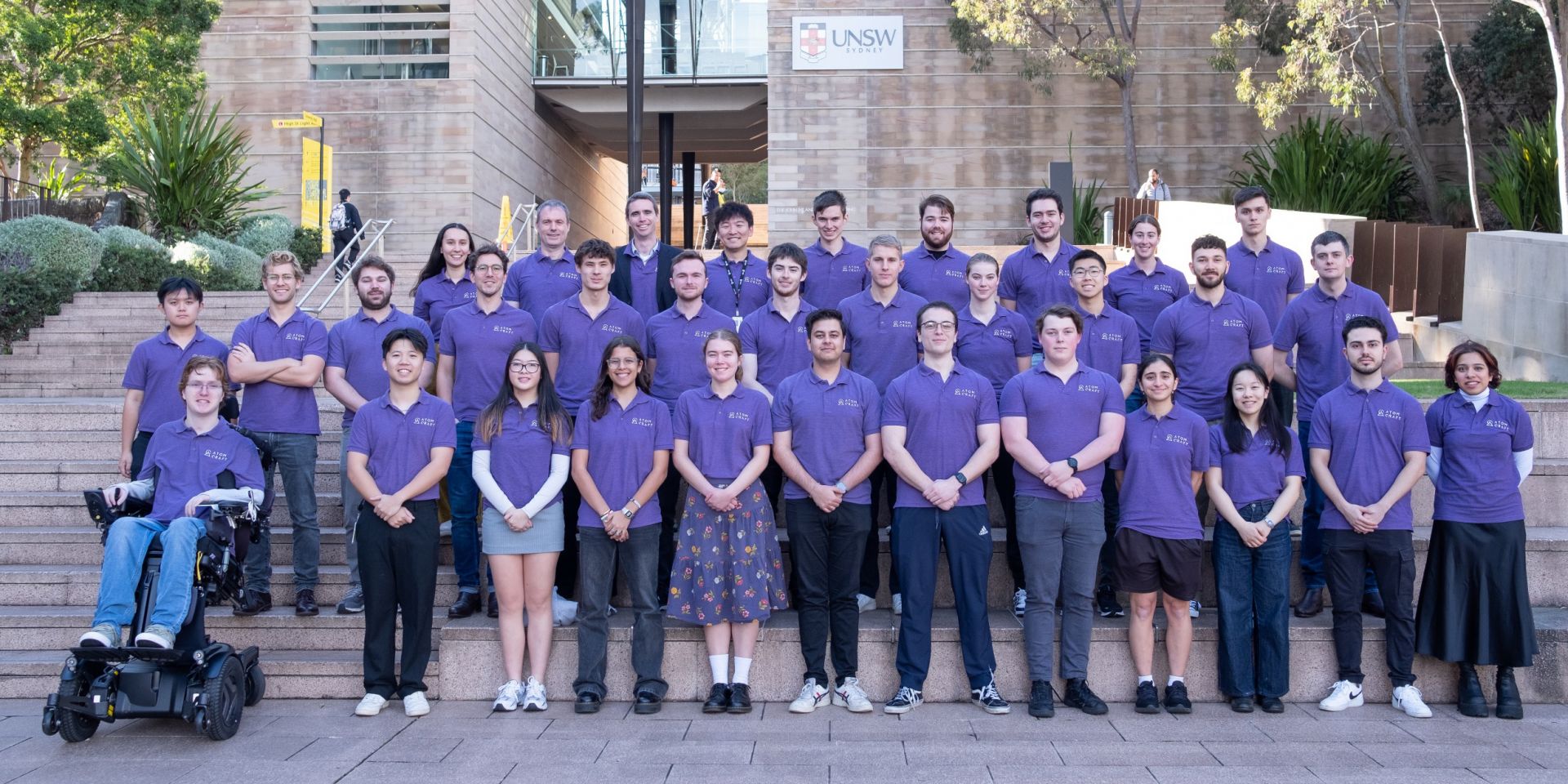
The cross-disciplinary AtomCraft team. (Photo: University of New South Wales)
Commercial nuclear power is illegal in Australia, and it has been since the 1990s. This past June, however, the country’s main opposition party announced plans to build seven commercial nuclear reactors in the 2030s and 2040s on sites presently occupied by aging coal-fired plants—should the party’s Liberal–National Coalition win power in federal elections next year. This statement has reignited a public debate regarding the potential role of nuclear energy in Australia.
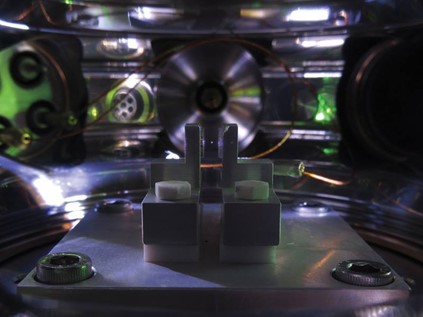
An optically trapped microparticle in high vacuum is visible as a white dot levitated between two lenses, which are used to focus and collect invisible infrared laser light used to trap the particle. (Photo: DOE/Yale Wright Lab)
Start talking about dust in a vacuum, and some people will think of household chores. But dust has featured in recent nuclear science and engineering headlines in curious ways: ITER is deploying oversized dust covers inspired by space satellites in the south of France, while at Yale University, researchers have watched every move of a dust-sized particle levitating in a laser beam for telltale twitches that indicate radioactive decay.
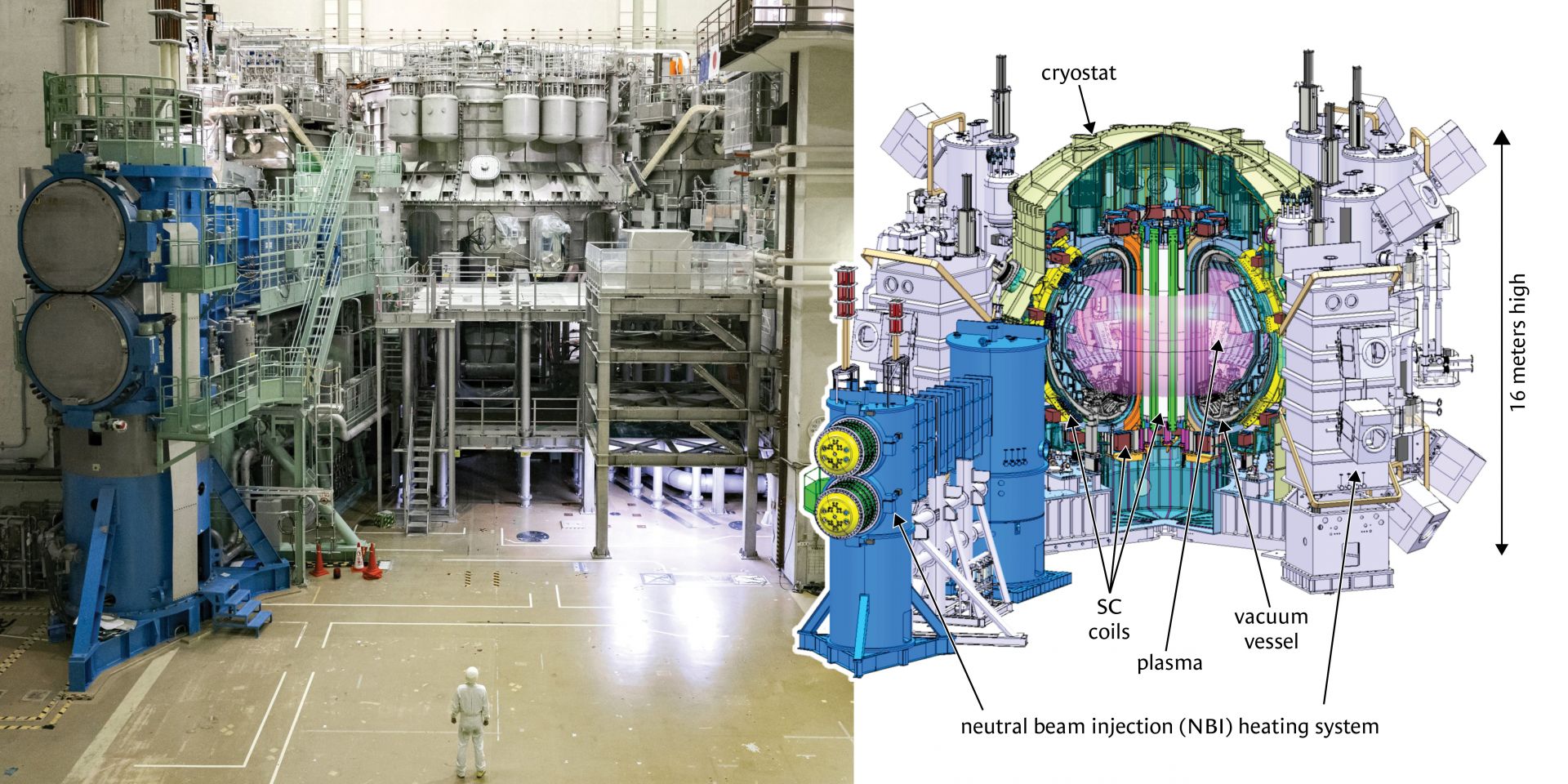
Fig. 1. A photograph (left) and schematic figure (right) of JT-60SA.
(Source: Naka Institute)
JT-60SA (Japan Torus-60 Super Advanced) is the world’s largest superconducting tokamak device. Its goal is the earlier realization of fusion energy (see Fig. 1). Fusion is the energy that powers the Sun, and just 1 gram of deuterium-tritium (D-T) fuel produces enormous energy—the equivalent of 8 tons of crude oil.
Last fall, the JT-60SA project announced an important milestone: the achievement of the tokamak’s first plasma. This article describes the objectives of the JT-60SA project, achievements in the operation campaign for the first plasma, and next steps.
Image: Kyle Palmer and Michael Livingston/PPPL Communications Department
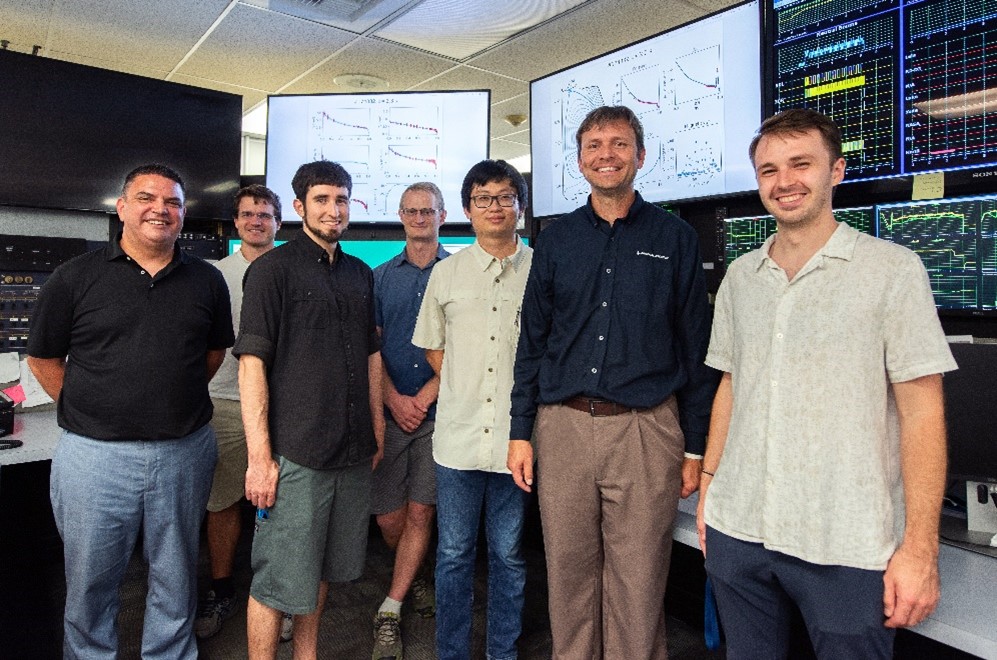
The DIII-D Superfacility team. (Photo: General Atomics)
Researchers at the DIII-D National Fusion Facility, the National Energy Research Scientific Computing Center (NERSC) at Lawrence Berkeley National Laboratory (LBNL), and the Energy Sciences Network (ESnet) are teaming up to make the high-performance computing (HPC) powers of NERSC available to DIII-D researchers through ESnet—a high-speed data network. Their collaboration, described in a May 29 news release, in effect boosts the computing power behind DIII-D’s diagnostic tools to make more data from fusion experiments available to researchers at DIII-D in San Diego and to the global fusion research community.