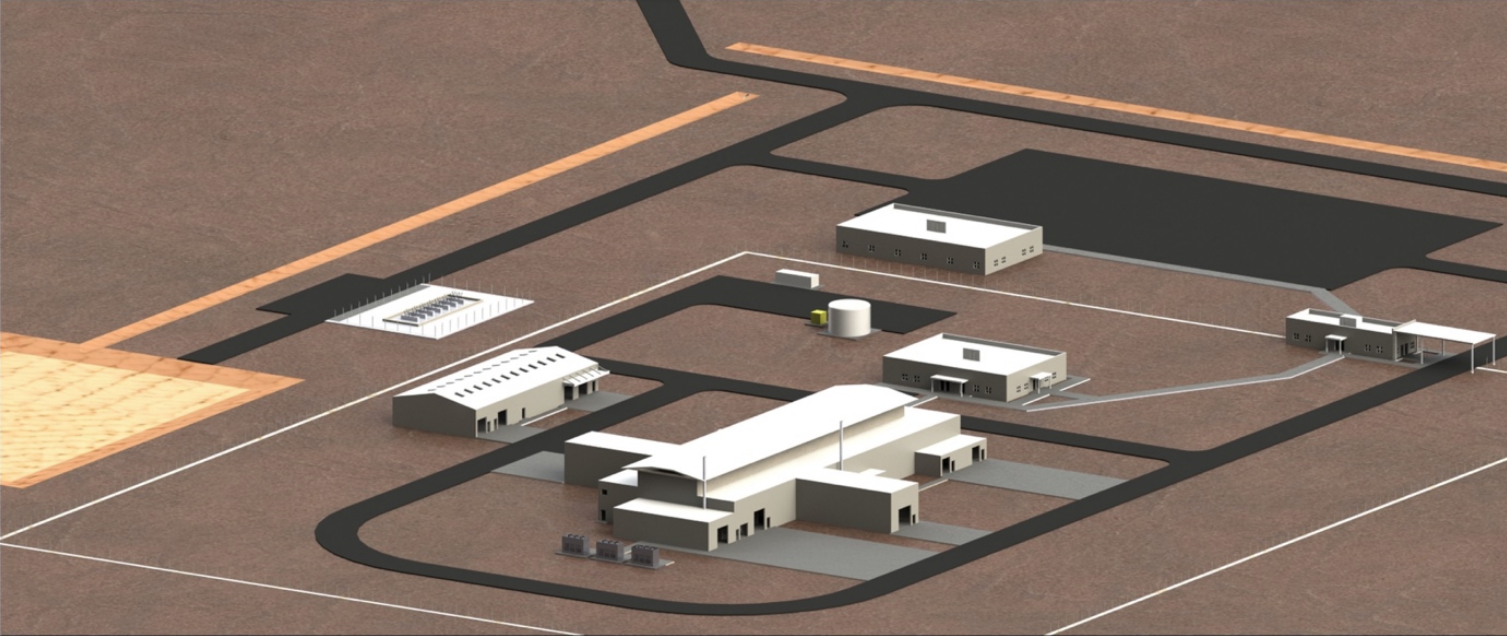
Eden isotope production complex site rendering. (Image: Eden)
Eden Radioisotopes has filed a construction permit application with the Nuclear Regulatory Commission for a facility to produce medical radioisotopes, primarily molybdenum-99 and lutetium-177.
The United States has lacked a reliable domestic source of Mo-99 for diagnostic imaging for decades, and has invested in infrastructure in South Africa, the Netherlands, and Belgium to assist facilities in producing the isotope using HALEU targets. These reactors are old, and there have been disruptions to the supply chain due to unplanned outages for repairs. With a 66-hour half-life, Mo-99 cannot be stockpiled.
SHINE’s isotope production building, called the Chrysalis, under construction in October 2022. (Photo: SHINE)
The Nuclear Regulatory Commission has issued its final safety evaluation report (SER) related to the operating license application for SHINE Technologies' large-scale medical isotope production facility, known as The Chrysalis, in Janesville, Wis. The SER documents the results of NRC staff’s technical and safety review of SHINE’s application. SHINE announced the NRC’s decision on February 27.
A record of decision concerning the proposed issuance of the operating license will be published by the NRC at a future date.

 After more than a decade of global efforts led by the Department of Energy’s National Nuclear Security Administration, all four major medical producers of the radioisotope molybdenum-99 for the U.S. market are now using low-enriched uranium (LEU) in their production processes instead of high-enriched uranium (HEU), the latter of which presents risks of nuclear weapons proliferation.