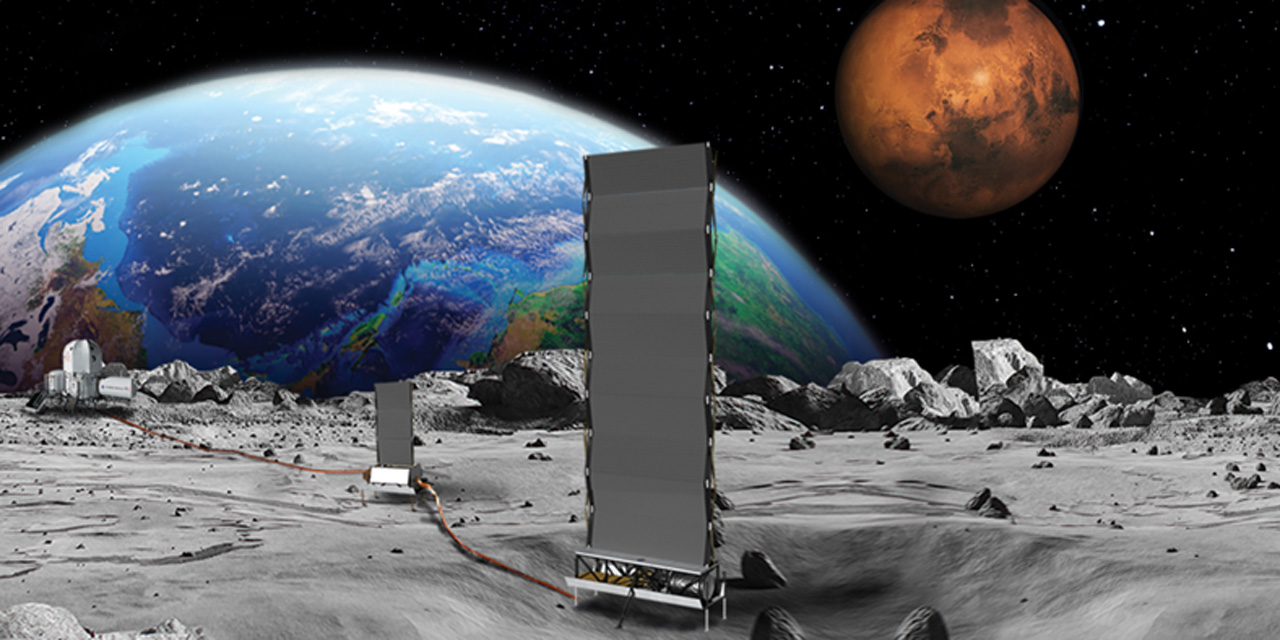
A concept image of NASA’s Fission Surface Power Project. (Image: NASA)
Imagine what our world would be like today without the benefits of electric energy. Think of the inventions and technologies that never would have been. Think of a world without power grids and the electricity that makes them run. Without this power, we’d find it difficult to maintain our industrial and manufacturing bases or enable advancements in the fields of medicine, communications, and computing.
Now consider the moon, our closest celestial neighbor about which we still know so little, waiting for modern-day explorers in spacesuits to unveil its secrets. Lunar exploration and a future lunar economy require reliable, long-lasting, clean sources of power. Nuclear fission answers that call. When assessing the application of nuclear power in space, three Ps should be considered: the present, the potential, and the partnerships.
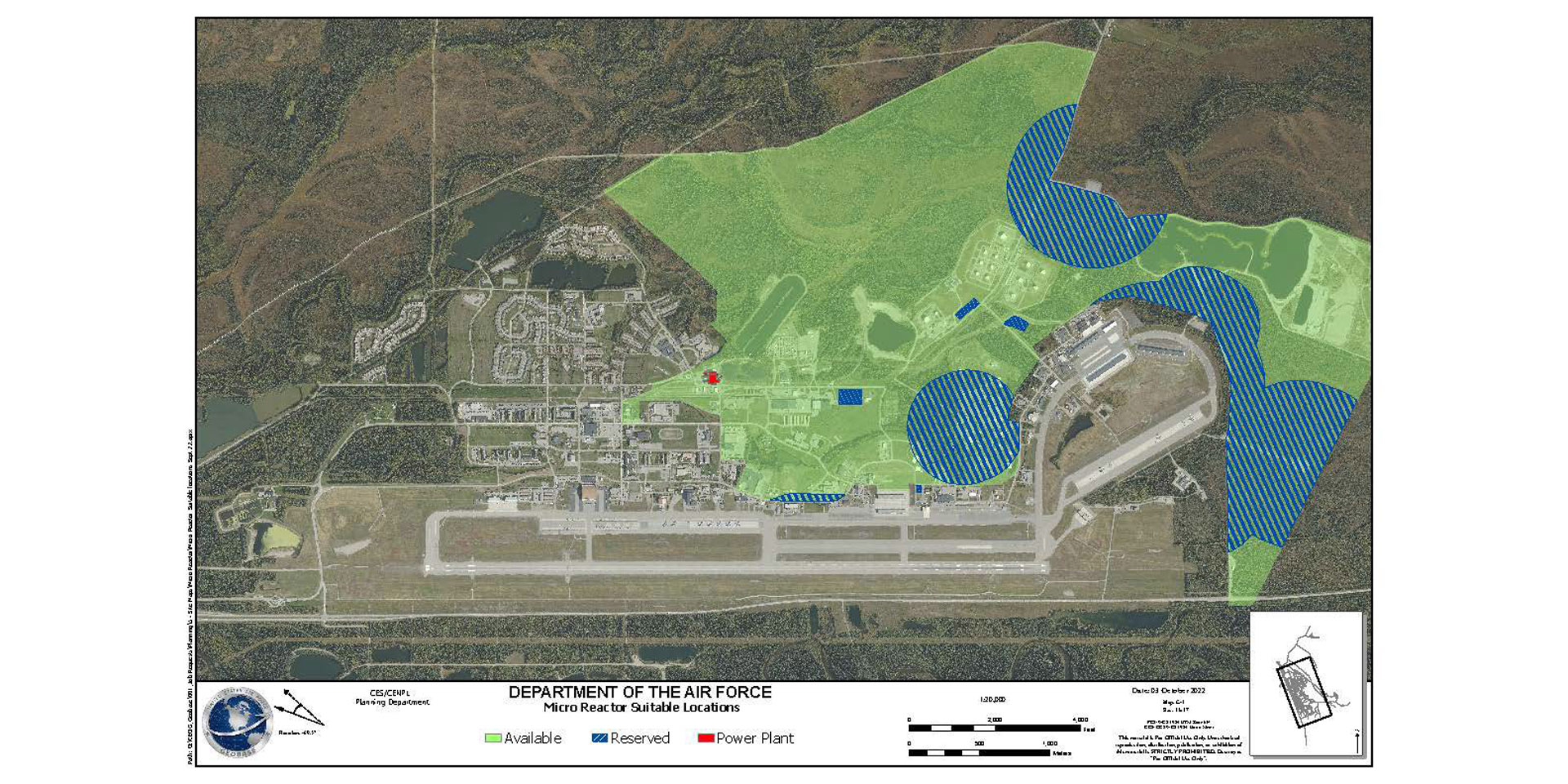
A map of the potential reactor siting area (in green) at Eielson Air Force Base in Alaska provided during a pre-proposal conference in October 2022. (Graphic: Department of the Air Force)
Plans announced with fanfare sometimes falter in the face of competition or economics. Take NuScale Power’s plans for the Carbon Free Power Project in Idaho: The project was canceled in mid-November by NuScale and its first customer, Utah Associated Municipal Power Systems, after nearly a decade. The significance of that news depends on the observer. NuScale intends to focus on other sites and customers. Competitors may redouble efforts to tout their own designs and customer lists. Media found an opportunity to speculate about the future of advanced nuclear. And while many in the nuclear community believe the momentum in favor of new nuclear deployments is continuing—or even increasing as COP28 continues—others would caution against high hopes and point to the persistent obstacles of regulation, supply chain constraints, and financing costs.
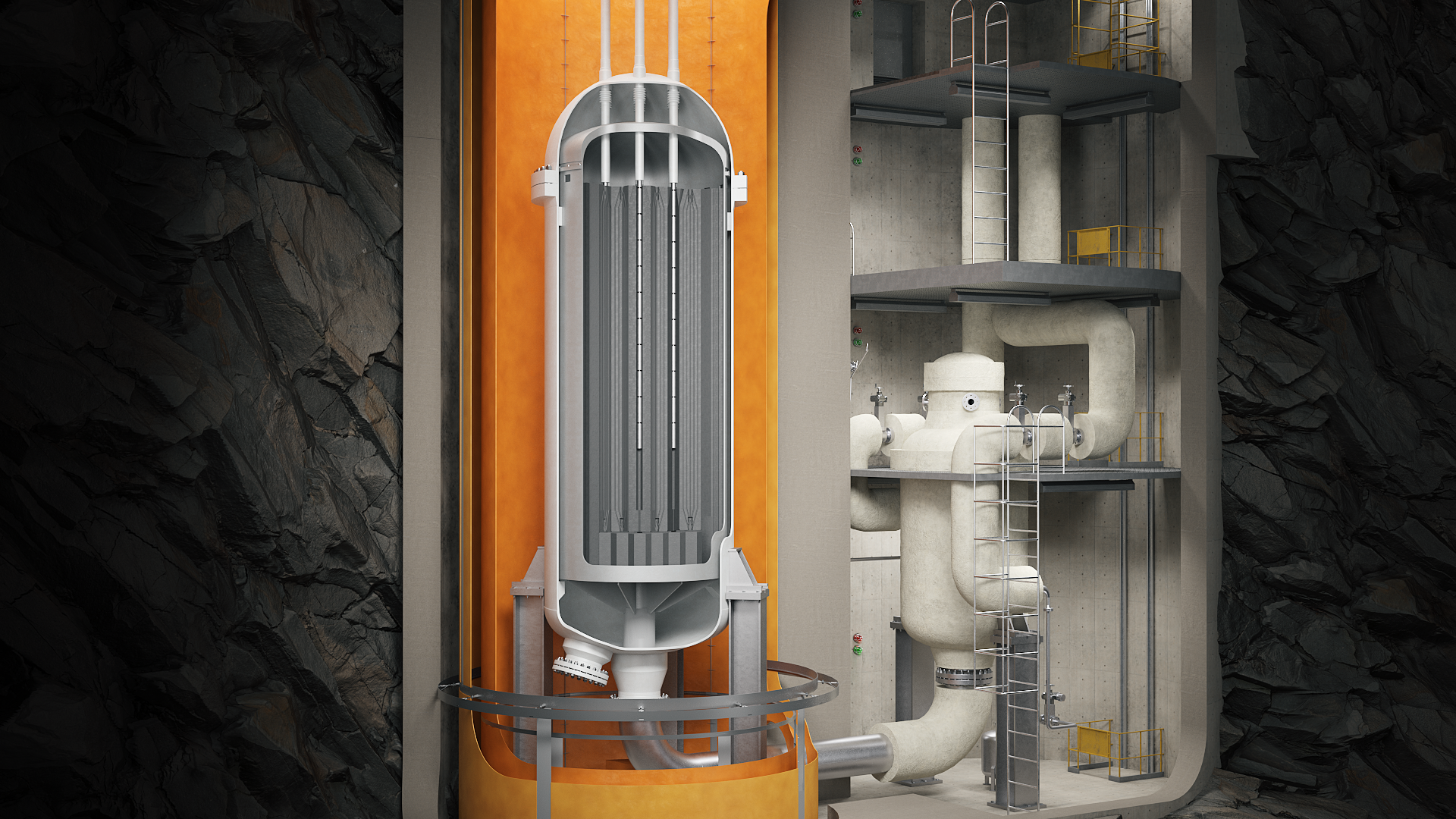
A cutaway image of a below-grade MMR module. (Image: USNC)
Ultra Safe Nuclear has signed a cooperative agreement with the Manila Electric Company (Meralco)—the Philippines’ largest electric distribution utility—to study the potential deployment of one or more of the company’s high-temperature, gas-cooled microreactors in the Philippines. The agreement, signed November 15, builds on a partnership between the two companies that was announced in August.
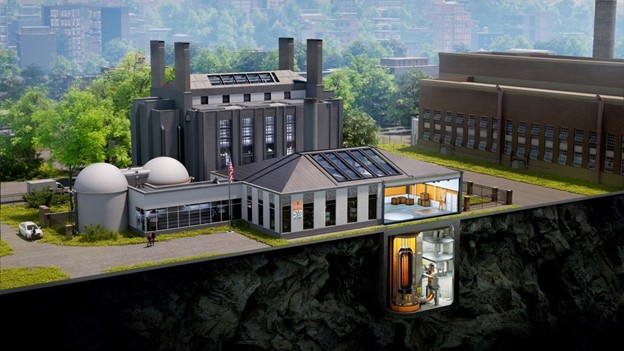
Conceptual art of USNC’s MMR, as proposed for construction on the UIUC campus. (Graphic: USNC)
It’s been almost 35 years since Illinois last added a nuclear power reactor to the grid (Braidwood-2, a pressurized water reactor operated by Constellation, reached commercial operation in October 1988). And it’s been 63 years since a research reactor reached initial criticality at the University of Illinois–Urbana-Champaign (UIUC). The university’s TRIGA Mark II started up in August 1960 and was shut down in 1998. For about 25 years, UIUC—the flagship public university in a state that generates more power from nuclear energy than any other—has lacked an operating research reactor.
The U.S. Capitol building.
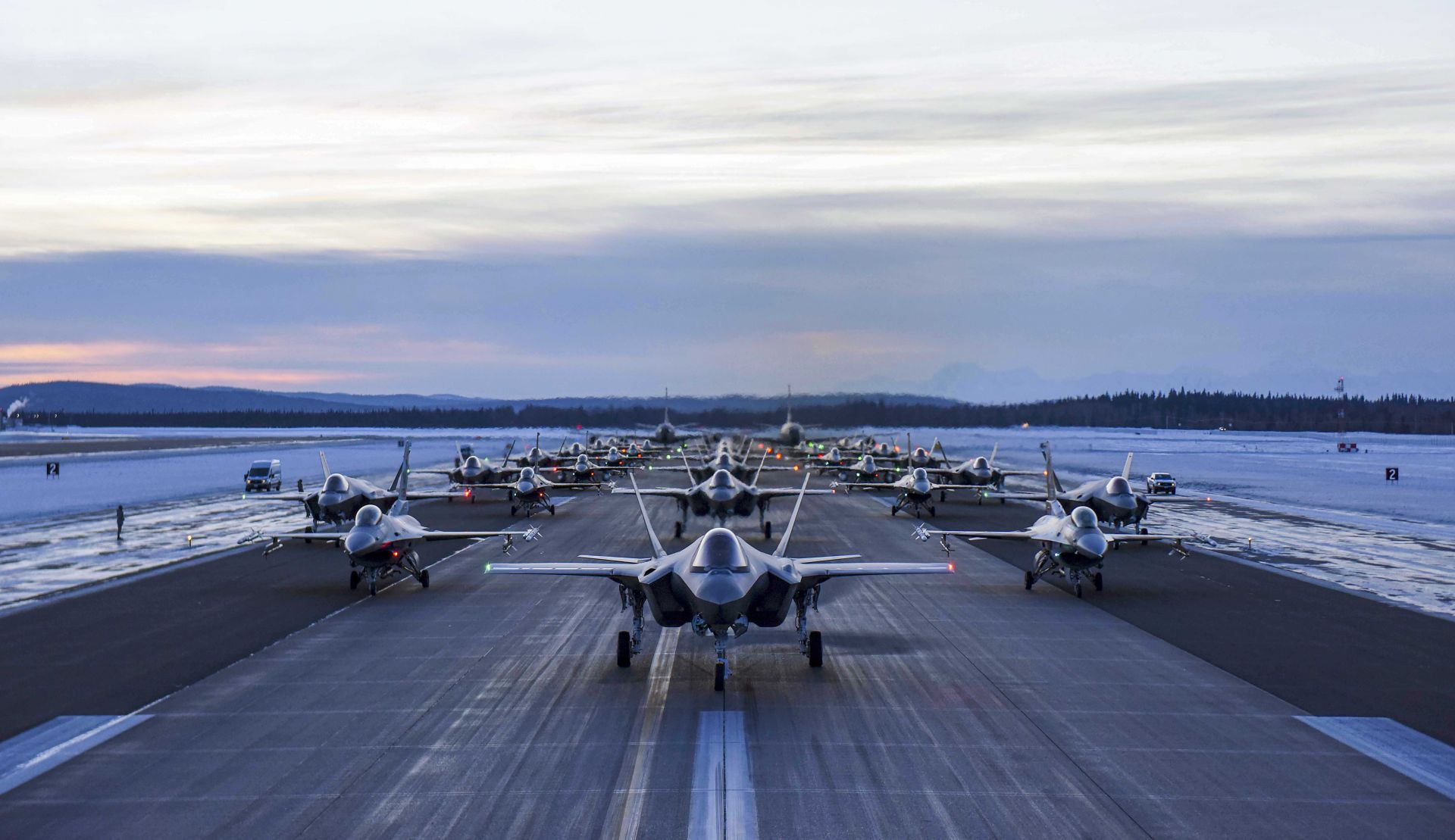
Aircraft line the runway at Eielson AFB in December 2020. (Photo: U.S. Air Force/Senior Airman Keith Holcomb)
The Department of the Air Force and the Defense Logistics Agency–Energy have released a request for proposals (RFP) for the construction and operation of a microreactor in central Alaska. The Department of Defense wants a 20-year supply of electricity and steam from a 1–5-MW microreactor, but the Eielson Air Force Base (AFB) Microreactor Pilot Program will go beyond a simple power purchase agreement and put the reactor through its paces with tests, at least annually, of the reactor’s walk-away safety and black-start capabilities. The final RFP is available at sam.gov.
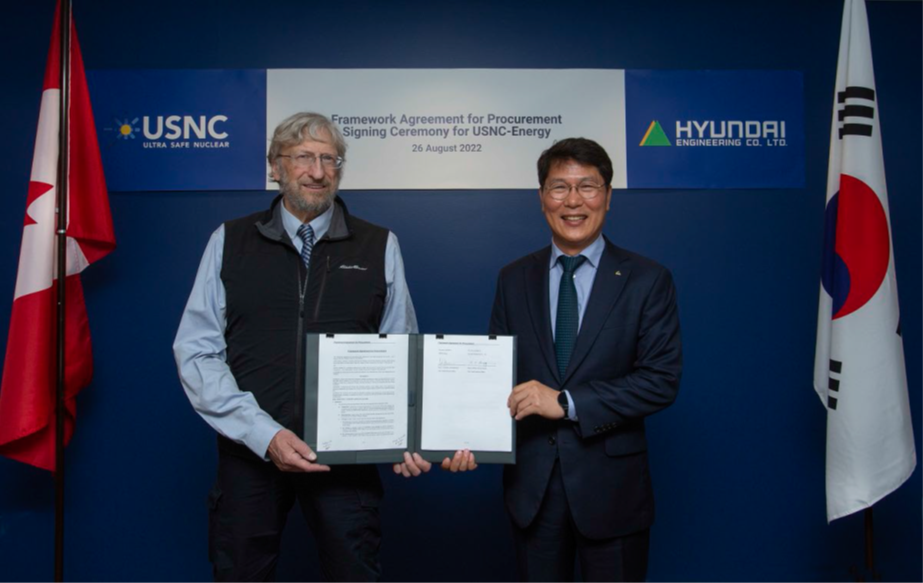
Francesco Venneri (left), USNC CEO, and Hyeon Sung Hong, Hyundai Engineering CEO, at a framework agreement signing for MMR project development and deployment.
Representatives of Ultra Safe Nuclear Corporation (USNC) of Seattle, Wash., and Hyundai Engineering of Seoul, South Korea, traveled last week between USNC project sites in Oak Ridge, Tenn., and Ontario, Canada, to sign two agreements extending their collaboration on the deployment of USNC’s high-temperature, gas-cooled Micro Modular Reactor (MMR). The agreements expand on a business cooperation agreement signed in January 2022 and an engineering agreement signed in June, and follow the closure earlier this month of a previously announced $30 million equity investment after its review by the U.S. Treasury Department’s Committee on Foreign Investment in the United States.

 A new report,
 Two teams of guest editors from Idaho National Laboratory have announced plans for special issues of the American Nuclear Society's Nuclear Science and Engineering, the nuclear community’s longest-running technical journal. Abdalla Abou Jaoude and Abderrafi M. Ougouag are leading the NSE issue Technical Challenges and Opportunities in the Development and Deployment of Microreactors, while Joseph Nielsen and Piyush Sabharwall are organizing the NSE issue Irradiation Experiments Supporting Advanced Nuclear Technologies.