Policy


Washington legislators look to nuclear

February 26, 2026, 7:19AMNuclear News

It has been an unusually busy week in the world of West Coast nuclear legislative momentum. In California, a bill is aiming to effectively repeal the state’s nuclear moratorium, while in Oregon, new legislation would have the state create a nuclear feasibility study.

Now, in Washington state, legislators are introducing various measures to move new nuclear prospects forward. One motion requests that Gov. Bob Ferguson respond to the Department of Energy’s request for information regarding states hosting Nuclear Lifecycle Innovation Campuses.

Oregon bill would create new feasibility study

February 25, 2026, 9:26AMNuclear News

Historical photo of Trojan nuclear power plant, ca. 1974. (Photo: DOE)

As concerns over growing energy needs persist, yet another state is reconsidering nuclear power. A piece of legislation is currently progressing through Oregon’s legislature that would direct the Oregon Department of Energy (ODOE) to conduct a study to assess the feasibility of deploying new power reactors in the state.

California bill looks to craft advanced nuclear exception to moratorium

February 24, 2026, 4:28PMNuclear News
Caption: California Assembly Member Lisa Calderon. (Photo: Office of Lisa Calderon)

Proposed legislation in California could exempt certain reactor designs from the state’s long-standing moratorium on new nuclear generation, effectively ending the moratorium.

California Assembly Member Lisa Calderon (D., 56th Dist.) filed A.B. 2647 with the California State Assembly last week.

If the bill progresses and becomes state law, it could pave the way to increasing the number of nuclear reactors in the state in the future. Currently, Diablo Canyon nuclear power plant houses the only operational commercial nuclear reactors in California.

Tempering ambition

February 23, 2026, 9:37AMNuclear NewsCraig Piercy

Craig Piercy
cpiercy@ans.org

I spent a fair amount of time over the holiday break pondering the makings of a good year for nuclear technology in 2026.

Last year was white-­hot. Between the fundamental upward shift in domestic electricity demand, the continuing proliferation of data center projects in all corners of the U.S., the increasingly voracious appetite of the financial markets for nuclear investment, and the Trump administration’s full-­throttle approach to nuclear policy, 2025 will likely be remembered as a significant, positive inflection point in the history of the harnessed atom.

I hope 2026 will be even better, but for it to be so, it will have to be different. It needs a seriousness about it, a scrape of the froth. Advanced nuclear energy technology is in a hardening phase at the moment, where the green shoots of innovation must now grow into robust commercial enterprises capable of scaling quickly and safely. Not everyone will succeed.

Gov. Evers announces siting study for new Wisconsin nuclear

February 20, 2026, 12:37PMNuclear News

Gov. Tony Evers delivering his 2026 State of the State address. (Photo: Tony Evers/YouTube @Governor Tony Evers)

During his State of the State address on February 17, Wisconsin Gov. Tony Evers announced the launch of a new nuclear siting study that will be undertaken by a partnership between the Public Service Commission (PSC) of Wisconsin and the Department of Nuclear Engineering and Engineering Physics at the University of Wisconsin–Madison.

Gov. Pritzker issues EO to boost nuclear energy in Illinois

February 19, 2026, 3:49PMNuclear News
Gov. J. B. Pritzker delivers his 2026 State of the State address in Springfield on February 18. (Photo: @GovPritzker/X)

Illinois Gov. J. B. Pritzker issued a new executive order (EO) on February 18 directing both the Illinois Power Agency and the Illinois Commerce Commission to issue a notice of intent (NOI) to potential developers of new nuclear power plants.

The signing of that EO took place on the same day Pritzker delivered his 2026 State of the State address, in which he set a goal of building at least 2 gigawatts of new nuclear capacity in the state.

Gallego and Risch submit ARC Act 2.0 in the Senate

February 11, 2026, 1:33PMNuclear News

Sens. Jim Risch (R., Idaho) and Ruben Gallego (D., Ariz.) reintroduced the Accelerating Reliable Capacity (ARC) Act in the Senate on February 10.

According to the Department of Energy, it could take up to 10 deployments for a reactor design to become a mature commercial reactor. Getting from the first-of-a-kind (FOAK) to full commercial deployment is challenging, and the risks of higher costs and longer deployment timelines for early nuclear projects create significant uncertainty for investors. The ARC Act is designed to reduce that early deployment risk.

From uncertainty to vitality: The future of nuclear energy in Illinois

February 6, 2026, 3:01PMNuclear NewsJohn Fabian
From left: Byron (Photo: Constellation), Clinton (Photo: Constellation), and a rendering of the Kronos reactor planned for the University of Illinois–Urbana-Champaign. (Image: Nano Nuclear)

Nuclear is enjoying a bit of a resurgence. The momentum for reliable energy to support economic development around the country—specifically data centers and AI—remains strong, and strongly in favor of nuclear. And as feature coverage on the states in the January 2026 issue of Nuclear News made abundantly clear, many states now see nuclear as necessary to support rising electricity demand while maintaining a reliable grid and reaching decarbonization goals.

ANS Congressional Fellowship program seeks 2027 applicants

February 4, 2026, 12:48PMNuclear News

Earlier this week, ANS opened the application process for the 2027 Glenn T. Seaborg Congressional Science and Engineering Fellowship, offering ANS members an opportunity to contribute directly to federal policymaking in Washington, D.C. Applications are due June 6.

DOE announces NEPA exclusion for advanced reactors

February 2, 2026, 3:32PMNuclear News

The Department of Energy has announced that it is establishing a categorical exclusion for the application of National Environmental Policy Act (NEPA) procedures to the authorization, siting, construction, operation, reauthorization, and decommissioning of advanced nuclear reactors.

According to the DOE, this significant change, which goes into effect today, “is based on the experience of DOE and other federal agencies, current technologies, regulatory requirements, and accepted industry practice.”

Nuclear legislation progresses in the Midwest

January 27, 2026, 12:36PMNuclear News
NextEra Energy’s two-unit Point Beach plant in Two Rivers, Wis., is the only nuclear power plant currently operating in Wisconsin. (Photo: NextEra Energy Resources)

In the past week, two pieces of nuclear legislation moved forward in two Midwestern states.

In Wisconsin, a bill to create new tax credits for new power plants passed through the state Assembly and went to the Senate, while in Indiana, a bill to simplify the state approval process for new plants passed through the state Senate and went to the House.

Katy Huff on the impact of loosening radiation regulations

January 26, 2026, 3:13PMNuclear News

Katy Huff, former assistant secretary of nuclear energy at the Department of Energy, recently wrote an op-ed that was published in Scientific American.

In the piece, Huff, who is an ANS member and an associate professor in the Department of Nuclear, Plasma, and Radiological Engineering at the University of Illinois–Urbana-Champaign, argues that weakening Nuclear Regulatory Commission radiation regulations without new research-based evidence will fail to speed up nuclear energy development and could have negative consequences.

NASA, DOE solidify collaboration on a lunar surface reactor

January 14, 2026, 9:35AMNuclear News
Secretary of Energy Chris Wright (left) and NASA Administrator Jared Isaacman (right) meet at DOE headquarters in Washington, D.C., on January 8. (Photo: NASA/John Kraus)

NASA and the Department of Energy have announced a “renewed commitment” to their mutual goal of supporting research and development for a nuclear fission reactor on the lunar surface to provide power for future missions. The agencies have signed a memorandum of understanding that “solidifies this collaboration and advances President Trump’s vision of American space superiority.”

NRC updates: New chair, rule reversal, and EO planning

January 9, 2026, 12:31PMNuclear News

Thursday was a busy news day for the Nuclear Regulatory Commission, with three significant announcements.

In the span of a few hours, the NRC released the news of Ho Nieh’s promotion to chair, the reversal of the plan to sunset its aircraft impact assessment provisions, and new guidance for interagency collaboration.

Illinois lifts moratorium on new large nuclear reactors

January 9, 2026, 9:34AMNuclear News
Illinois Gov. J. B. Pritzker displays the Clean and Reliable Grid Affordability Act during the signing ceremony in Joliet on January 8. (Image: Office of the Governor of Illinois)

New power reactors of any size can be now be sited in the state of Illinois, thanks to legislation signed by Gov. J. B. Pritzker on January 8. The Clean and Reliable Grid Affordability Act (CRGA)—which Pritzker says is designed to lower energy costs for consumers, drive the development of new energy resources in the state, and strengthen the grid—lifts the moratorium on new, large nuclear reactors that Illinois enacted in the late 1980s.

Nuclear power’s new rule book: Managing uncertainty in efficiency, safety, and independence

January 8, 2026, 5:12PMNuclear NewsGeorge Joslin, Arden Rowell, Ha Bui, Justin Valentino, Ziwei Che, Seyed Reihani, and Zahra Mohaghegh
Fig. 1. Example of a cost-benefit analysis for efficient and safe nuclear licensing. This framework illustrates how safety risk, traditionally quantified through PRA, must be combined with other relevant cost and benefit dimensions to meet statutory expectations of efficiency.

The U.S. nuclear industry is standing at its most volatile regulatory moment yet—one that will shape the trajectory and safety of the industry for decades to come. Recent judicial, legislative, and executive actions have converged to rewrite the rules governing the licensing and regulation of nuclear power reactors. Although these changes are intended to promote and accelerate the deployment of new nuclear energy technologies, the collision of multiple legal shifts—occurring simultaneously and intersecting with profound technological uncertainties—is overwhelming the Nuclear Regulatory Commission and threatening to destabilize investor and industry expectations.

From Capitol Hill: Nuclear is back, critical for America’s energy future

January 8, 2026, 3:08PMNuclear News
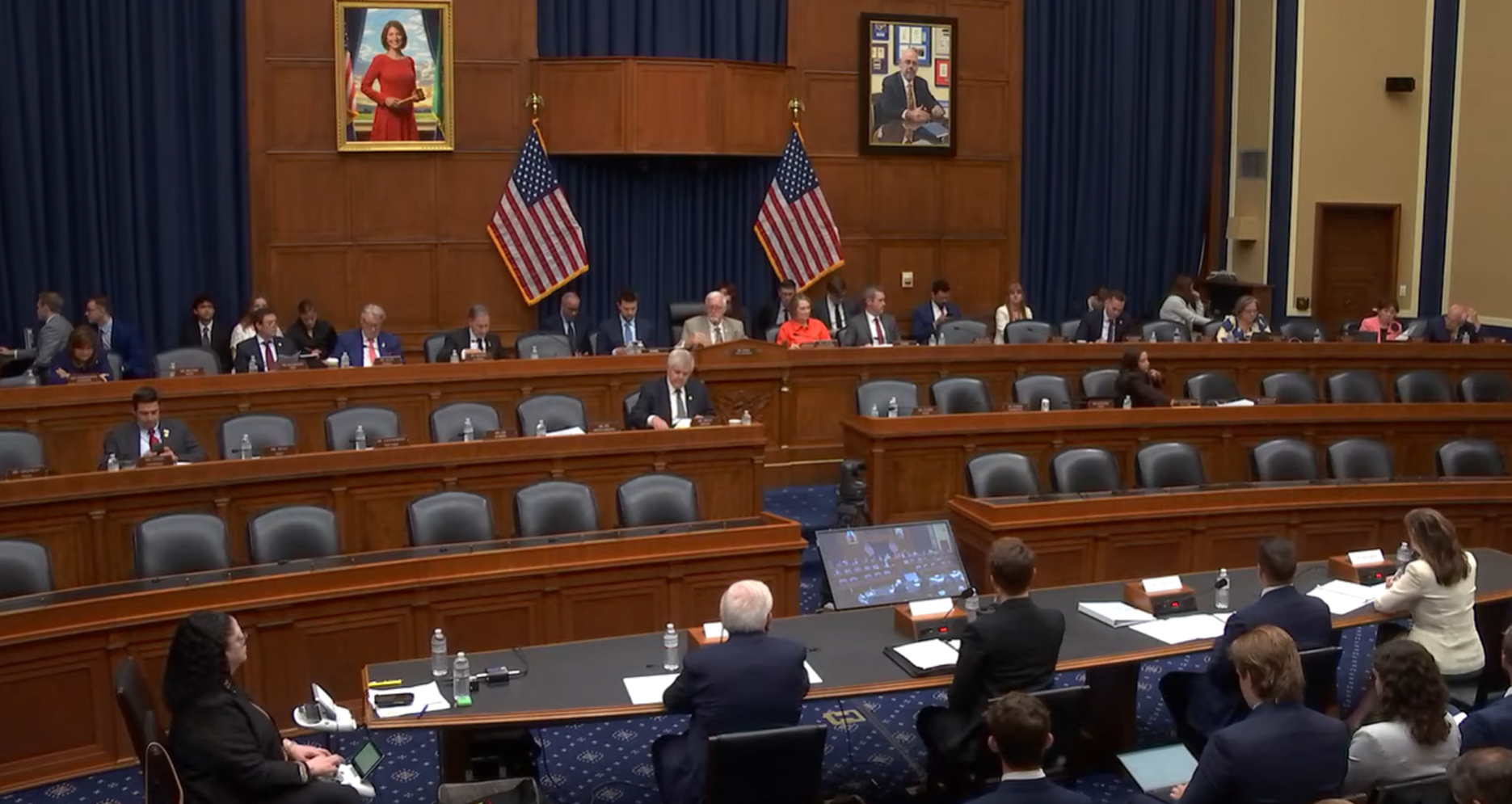
Still from a video of the Energy Subcommittee hearing, "American Energy Dominance: Dawn of the New Nuclear Era." (Credit: House Committee on Energy and Commerce)

The U.S. House Energy and Commerce Subcommittee on Energy convened its first hearing of the year, “American Energy Dominance: Dawn of the New Nuclear Era,” on January 7, where lawmakers and industry leaders discussed how nuclear energy can help meet surging electricity demand driven by artificial intelligence, data centers, advanced manufacturing, and national security needs.

PR: American Nuclear Society welcomes Senate confirmation of Douglas Weaver as NRC commissioner

December 17, 2025, 3:10PMPress Releases

WASHINGTON, D.C. — The American Nuclear Society (ANS) applauds the U.S. Senate’s confirmation of Douglas Weaver to serve as a commissioner of the U.S. Nuclear Regulatory Commission (NRC):

Fusion office bill introduced in line with DOE reorganization plan

December 17, 2025, 12:05PMNuclear News

Cornyn

Padilla

Sens. Alex Padilla (D., Calif.) and John Cornyn (R., Texas) have introduced bipartisan legislation to formally establish the Office of Fusion at the Department of Energy. This move seeks to codify one of the many changes put forward by the recent internal reorganization plan for offices at the DOE.

Companion legislation has been introduced in the House of Representatives by Reps. Don Beyer (D., Va.) and Jay Obernolte (R., Calif.), who are cochairs of the House Fusion Energy Caucus.

Details: According to Obernolte, “Congress must provide clear direction and a coordinated federal strategy to move fusion from the lab to the grid, and this legislation does exactly that.”