Its ultra-high melting point, strength in high temperatures, heat conductivity, and low sputtering yield allow for high performance even in such an extreme environment. But tungsten is not indestructible. Intense heat flux, thermal cycling, and irradiation near the fusion plasma can cause microscopic changes, including recrystallization and cracking, that can lead to component failure.
As such, it is useful to understand tungsten’s microstructural changes under fusion-relevant conditions. Scanning electron microscope (SEM) imaging is an effective tool, but it is an expensive process that is also logistically challenging to conduct at scale.
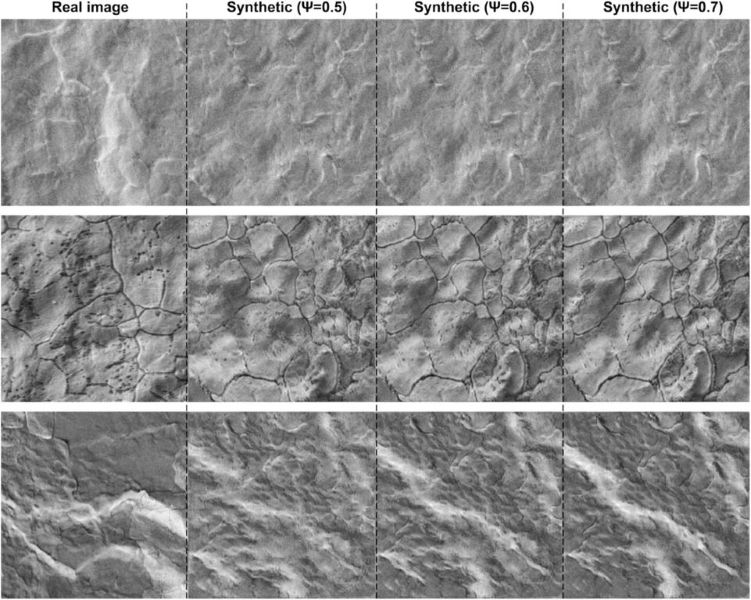
In a paper published in the Journal of Nuclear Materials, researchers trained a generative machine learning model on 3,200 SEM images from electron beam heat flux exposure studies on tungsten spanning controlled base temperature and heat flux conditions, focused on a single SEM magnification and tungsten grade. The team used the model to generate physics-plausible tungsten SEM microstructures spanning a range of exposure conditions.
With collaborators from Oak Ridge National Laboratory, the University of Wisconsin–Madison, and the Institute of Fusion Energy and Nuclear Waste Management, the project was led by Rinkle Juneja, an R&D staff scientist at ORNL, and described in an ORNL news release.
“This work is not about making pretty pictures, it’s about capturing the statistics of real damage on these materials,” said Juneja. “We train our generative workflow to learn tungsten’s microstructure signatures, like crack patterns, so it can generate new, statistically consistent microstructures, laying the groundwork for [a] robust, data-driven assessment of PFC fusion materials.”
According to the paper, the results demonstrate the capability of data-efficient, condition-aware generative modeling as a tool for informing degradation models and virtual experiments to supplement direct measurements, with the potential to bridge critical gaps in microstructure characterization. The model could be extended to PFC studies beyond tungsten.