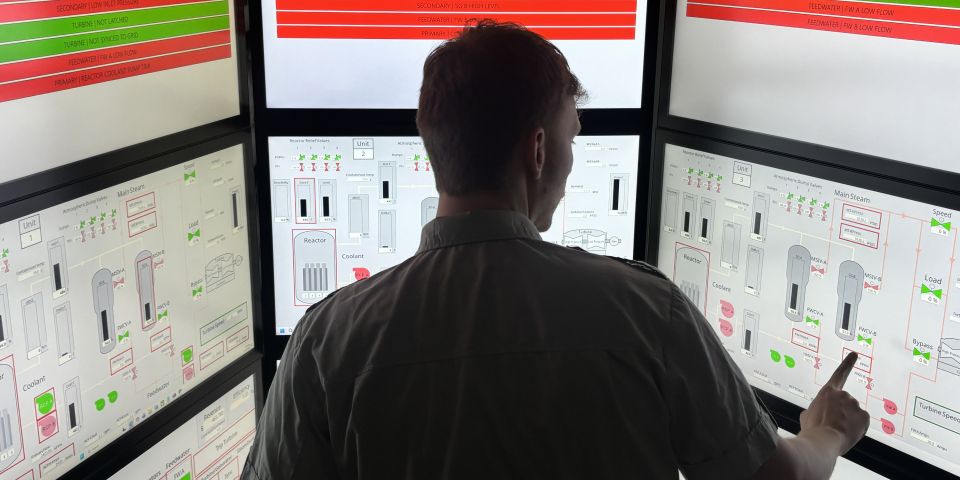
Safer, more efficient, more reliable: The idea behind the experiment was to use accurate computer modeling and autonomous operations to help make “future nuclear power plants safer, more efficient, and more reliable,” said Chris Ritter, the director of the Scientific Computing and AI Division at INL. He explained, “If you can model a reactor with enough fidelity, you can eventually let AI safely assist in operating it. The safety case is what makes this real: the system analyzes, predicts, and adjusts, but the reactor’s own safety controls always have the final say in this experiment.”
Three linked sites: During the experiment, facilities at three different sites were linked so that they could operate together in real time: the computing systems at INL, the PUR-1 reactor in Indiana, and a Microsoft Azure cloud platform in Virginia. The researchers used cloud-based connections between the PUR-1 digital twin (a high-fidelity model that can predict reactor behavior) and INL’s high-performance computing systems to calculate and deliver instructions for the movement of an auxiliary control rod in the research reactor. Working in Idaho, they fine-tuned the reactor’s power to minimize small power fluctuations and maintain the steady operation of the reactor. They were able to successfully demonstrate live autonomous reactor adjustments without the need for any manual control-rod manipulation at the Indiana site.
Training the next generation: Stylianos Chatzidakis, an assistant professor in Purdue’s School of Nuclear Engineering and the associate director of PUR-1, noted that the successful demonstration “greatly expands the kinds of experiments and control system research we can perform at PUR-1. Collaborations with national laboratories strengthen our ability to explore innovative reactor technologies and train the next generation of nuclear engineers.” Chatzidakis led the team that developed the PUR-1 digital twin.
Genesis Mission and digital twins: INL emphasized that the remote and autonomous operation of PUR-1 helps to advance the Department of Energy’s Genesis Mission, which has the goal of using AI to accelerate the design, licensing, manufacturing, construction, and operation of nuclear energy technologies.
INL also said that the experiment builds on reactor digital twin technology that the lab and Idaho State University demonstrated in 2023. This type of technology can be used to analyze reactor conditions, predict outcomes, and make adjustments autonomously, “acting as a smart bridge that links virtual models to physical systems without overriding essential safety protections.”
Reimagined from all angles: Timothy Grunloh, associate director of the Illinois Nuclear Power Institute at the University of Illinois, observed that the new PUR-1 remote demonstration is an example of how “nuclear energy technology is being reimagined from all angles. This platform will play a key role in understanding and optimizing the details of integrating these emerging designs with the applications that are building the backbone of our economy.”