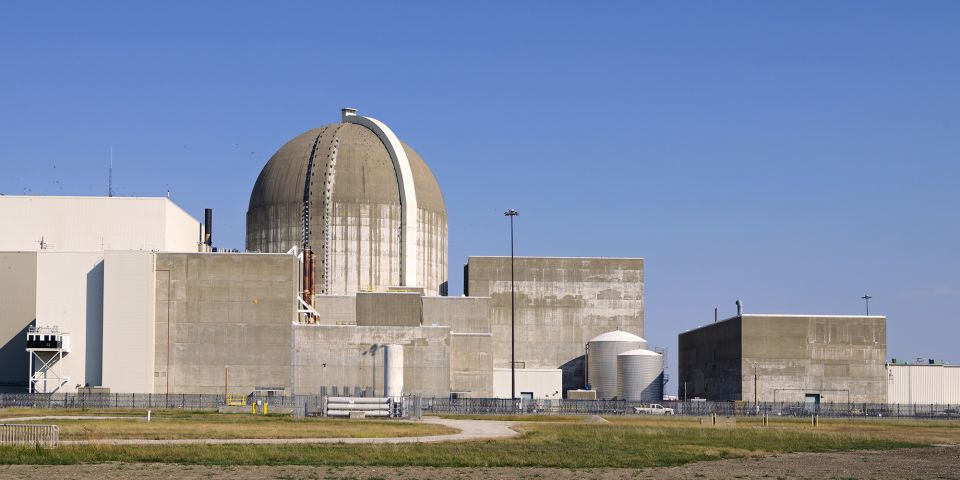
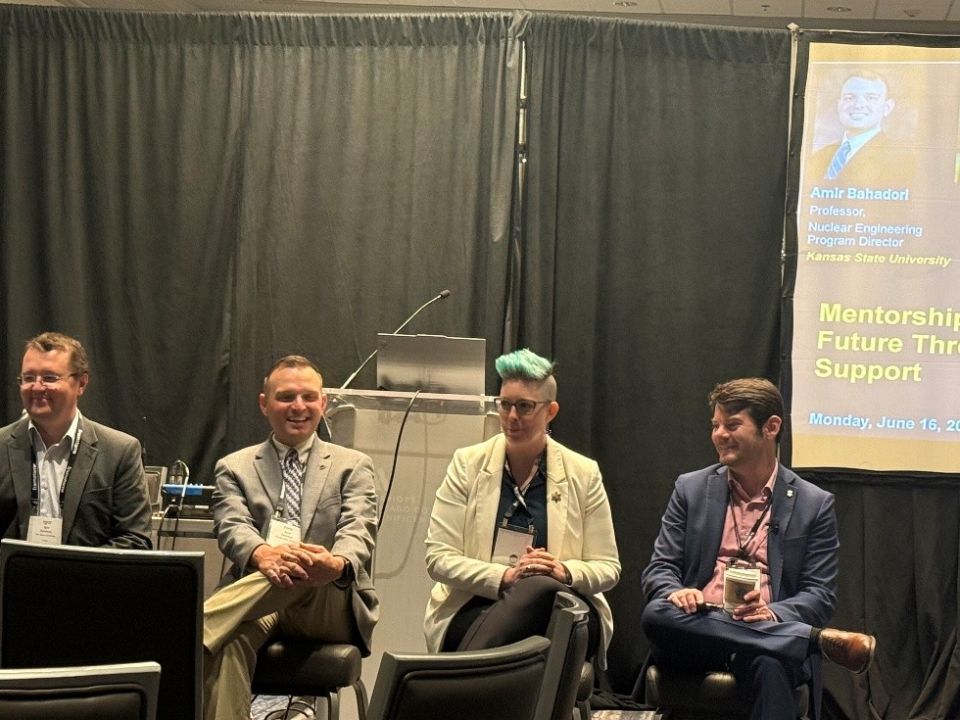
Starting off: The webinar was hosted by ANS CEO Craig Piercy, who was joined by Emily Caffrey, assistant professor of health physics at the University of Alabama–Birmingham; Amir Bahadori, professor and nuclear engineering program director at Kansas State University; and Adam Stein, director of nuclear energy innovation at the Breakthrough Institute.
Before turning to the experts with his questions, Piercy started things off with an extended metaphor: “It turns out that a significant percentage of the U.S. population is known to experience increased drowsiness and in many cases a lack of consciousness in the hour after putting their pajamas on. This association is robust. We see strong correlation across age, sex, and geography. And while this doesn't prove causation, the findings raise serious questions that can only be answered through more research. Should we be worried about wearing pajamas while driving or operating heavy machinery? Does the risk extend to other loose-fitting garments? A safety conscious policymaker might ask, should we mandate warning labels in every new pair of pajamas sold in the U.S.?”
As Piercy then pointed out, this somewhat absurd example clearly illustrates the faulty logic behind confusing correlation and causation or pointing a causal arrow in the wrong direction. With that framing in mind, he then turned to the experts.
Diving in: Piercy first asked Caffrey how she would reassure someone who lived near a nuclear power plant and was understandably scared by headlines arising from these proximity studies. Caffrey said that when she looks at these studies as a scientist, the first thing she notices is the lack of calculated radiation doses. She explained that, in simple terms, dose is the metric that measures your risk, and that using physical proximity as a proxy for that metric is simply “not valid scientifically.”
Getting a bit more specific, Bahadori added that the typical nuclear power plant releases “very small fractions of a single millisievert per year . . . . The risk that’s associated with those types of doses, if it exists, is on the order of one in 1 million, one in 10 million, one in 100 million.” Incredibly small risks of these magnitudes are assumed by the public every day, he said, acknowledging how scary headlines might immediately seem with an unfamiliar risk like radiation.
The group then shifted to a closer look at the various confounding variables, methodological issues, and faulty logic at play in these proximity studies. Those issues (each explained in detail) included a failure to calculate exposure from other sources of radiation; an oversimplification of proximity; and a failure to consider factors such as access to health care, age distributions, and biological sex.
With these various flaws in mind, Piercy then asked Stein a key question: Did the authors of these papers actually conclude that there was causation despite these issues, or did they stop short of it?
Stein responded that, confusingly, “they do both. They associate more than 100,000 potential deaths with exposure from nuclear power plants. But, at the very end of the study, they say that this cannot be assumed to be causal. But also, in the limitations of their own paper, they state that they assume causality because they have to assume causality to use [this] method.”
In other words, causality is simultaneously assumed and rejected. Regardless, Stein points out, “It's not possible for them to get to causality with this methodology, period.”
Go deeper: In the rest of the webinar, the group dives much deeper into the science of radiation, the simultaneous benefits and drawbacks of being able to detect miniscule amounts of radiation, the way radiation impacts the body, and much more. The full discussion—“What Does the Science Say? A Discussion on Radiation Studies and Living Near Nuclear Plants”—is available on the ANS YouTube channel.