Nuclear is prominent in Genesis Mission projects
The Department of Energy announced yesterday that it has selected 278 projects under the Genesis Mission request for applications, which opened in March.
According to a White House press release on the same day, $5 billion in federal commitments will be put toward the Genesis Mission.
While the selected projects cover a wide range of topics, nuclear took center stage as the focus of the largest award: $60 million over three years as a Phase II award for the Prometheus project, led by Idaho National Laboratory. This project aims to cut reactor development times and operational costs in half by using AI to design, license, manufacture, construct, and operate reactors with human-in-the-loop workflows.
Other selections: The DOE’s announcement stated that 87 of the selected projects will be led by DOE and National Nuclear Security Administration national laboratories, 168 will be led by universities, 19 will be led by companies, and four will be led by nonprofit organizations. It did not provide a total dollar amount for the project awards.
“America has no shortage of bold ideas or talented scientists, and the response to the Genesis Mission proves that,” said Secretary of Energy Chris Wright. (The July 22 announcement said the RFA received the largest response to a funding opportunity in the DOE’s history.) Wright continued, “The 278 projects selected today represent the very best of our nation’s scientific enterprise. The remarkable number of high-quality proposals we received demonstrates that America’s innovation pipeline is strong, and it points to even greater opportunities for future investment and continued expansion of the Genesis Mission portfolio.”
Genesis Mission background: The DOE launched the Genesis Mission in February with the goal of accelerating scientific and technological progress via the use of AI tools. At the time of launch, the DOE announced 26 challenges describing problems that the Genesis Mission was intended to address. This included using AI to accelerate the development and construction timelines of nuclear power plants and create and assess regulatory documents, developing digital twins for fusion research, and digitizing historical nuclear records as a reference resource.
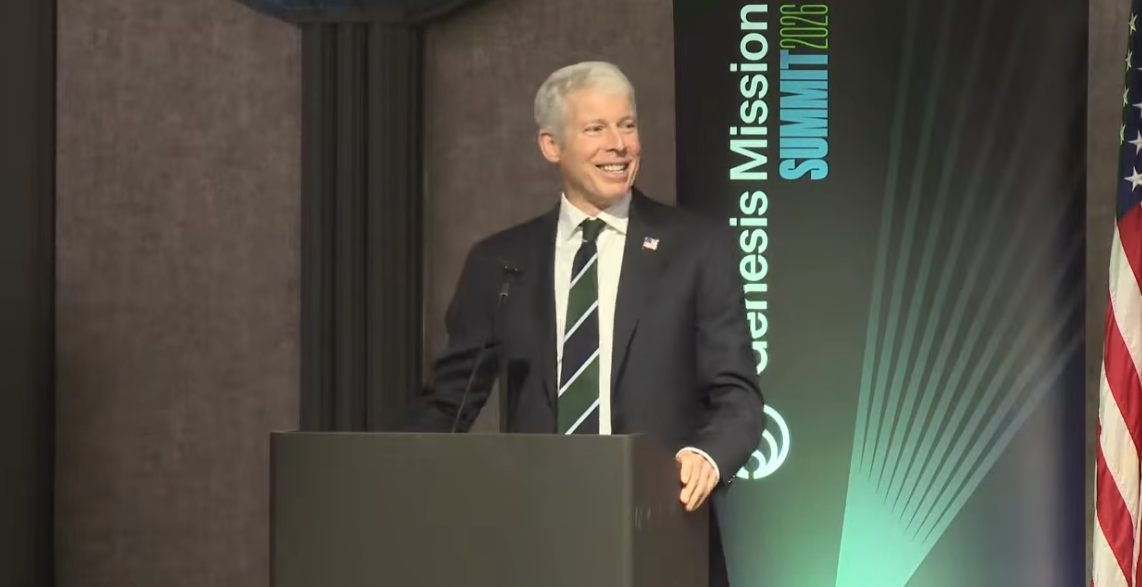
On the same day as the awards announcement, the DOE held a Genesis Mission 2026 summit, which gathered many of the researchers leading and participating in the selected projects.
During his keynote speech at the event, Under Secretary for Science Darío Gil announced that several of the challenges would be expanded and new ones would be added, bringing the total to 33.
Several challenges related to national security—roughly half of which focus on nuclear threat detection, deterrence, and nonproliferation—were restructured or added.
Labs well represented: Many awards related to nuclear and fusion research were granted to national labs, including Argonne, Lawrence Berkeley, Los Alamos, Oak Ridge, Pacific Northwest, Sandia, Savannah River, Idaho, and Lawrence Livermore National Laboratories as well as Princeton Plasma Physics Laboratory.
Project topics include digital twins for fusion systems, additive manufacturing of fusion targets, development of fusion structural materials, digital twins for molten salt reactors, and work related to various stages of the nuclear fuel cycle including supply, recycling, and waste management.
Fusion company recipients: Three fusion companies will lead Genesis awards:
Acceleron Fusion will lead a project titled “Developing a Digital Replica of a Deuterium-Tritium Process Loop for Fusion Fuel Cycle Optimization.”
Realta Fusion will lead a project titled “AI-Enabled Digital Twin for Near-Real-Time Optimization and Decision Support of Fusion NBI Systems.”
Shine Technologies will lead a project titled “AI-Guided Fuel Cycle Facility Optimization.”