Mark Peters: Building on a strong foundation
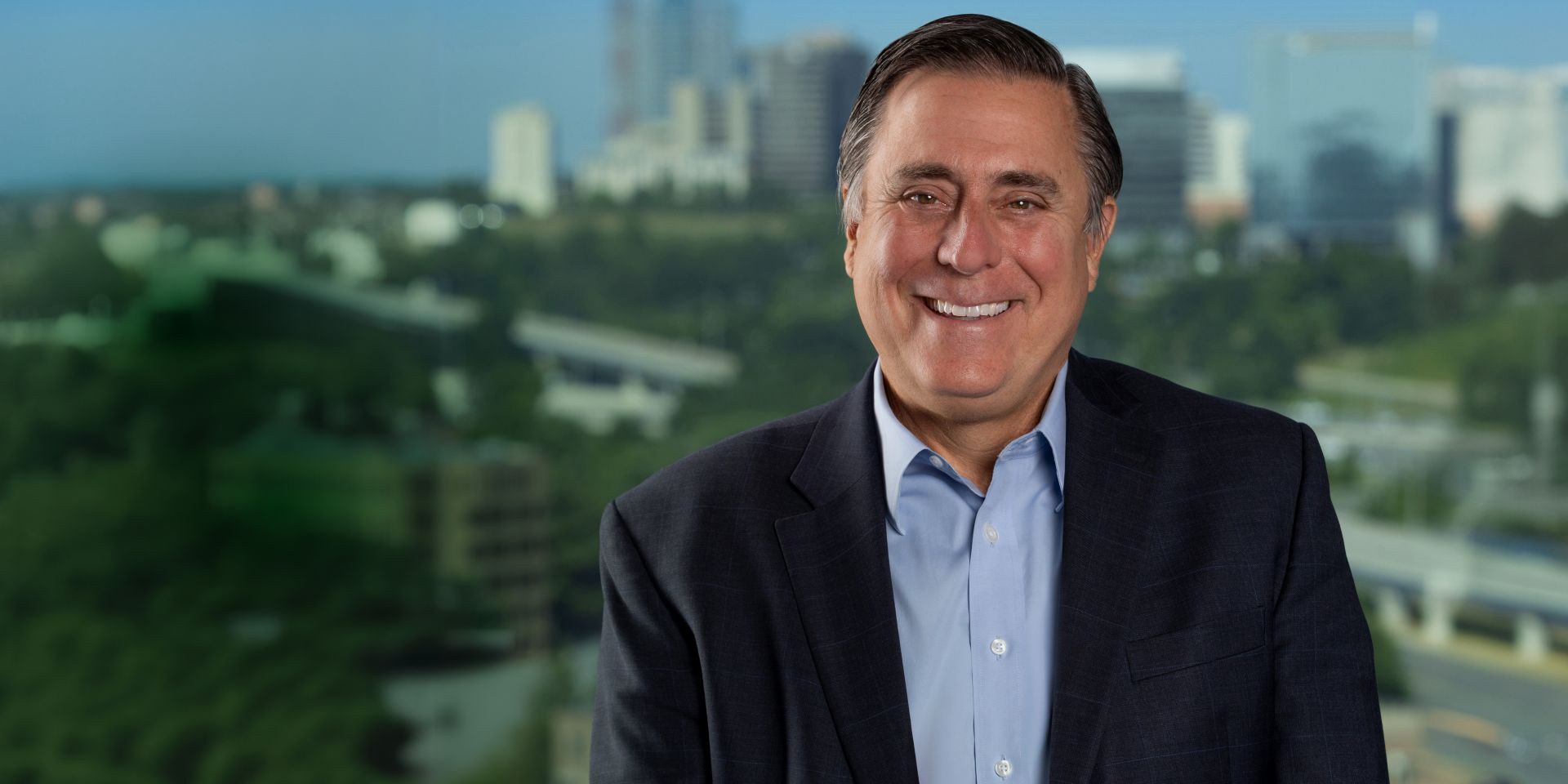
Summer at the American Nuclear Society carries with it a sense of renewed momentum as the incoming president takes office and starts making plans for the year ahead. This has been particularly true in the last few years, as nuclear energy moves into a new era marked by broader public interest, stronger policy support, and a growing sense of possibility across the field. Mark Peters, the Society’s 72nd president, shares that optimism—and he is focused on turning it into results.
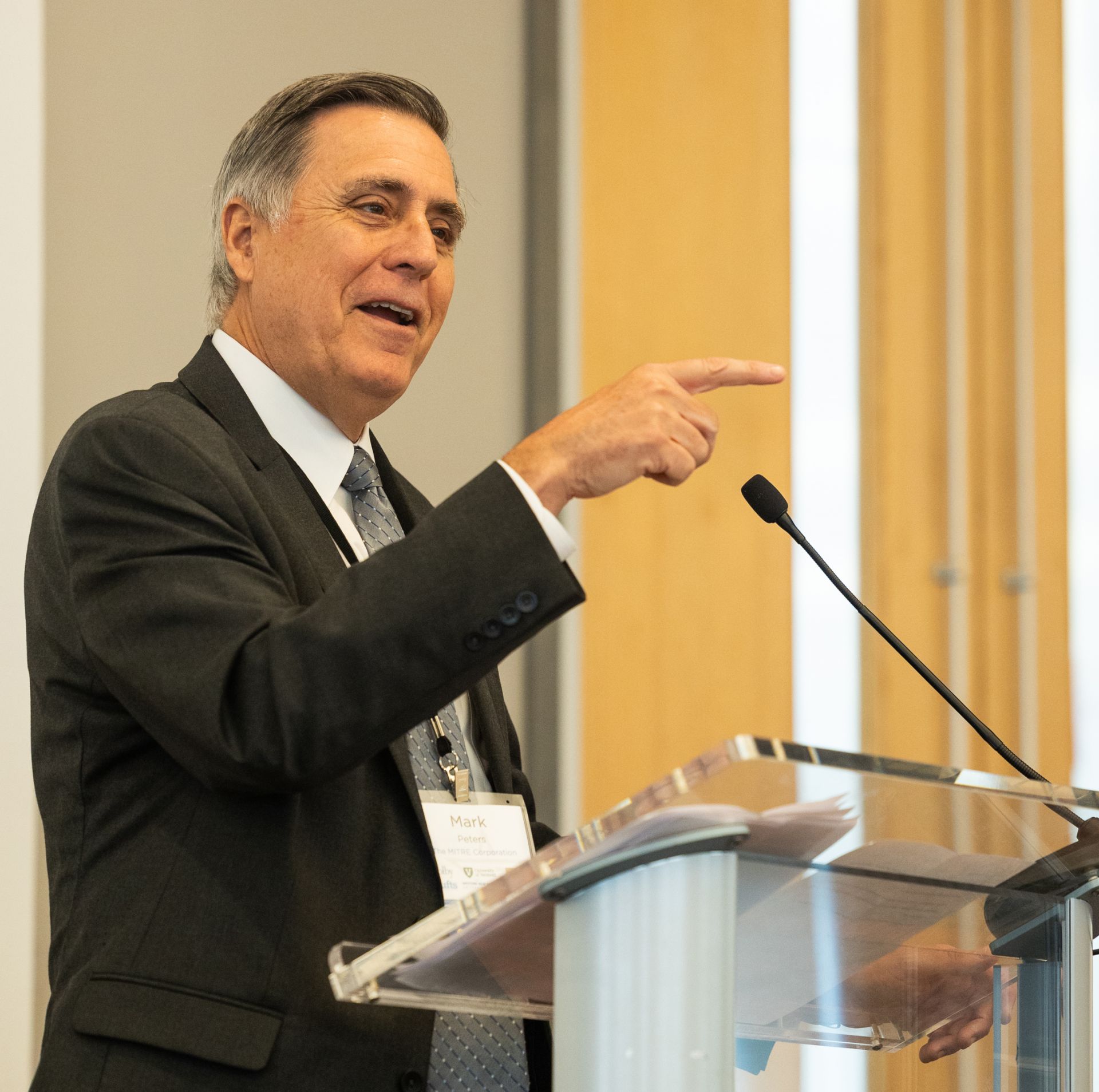
As an executive board member with the Council on Competitiveness, Peters delivers a keynote address at a 2025 Competitiveness Conversation in Medford, Mass. (Photo: Council on Competitiveness)
“We’ve been presented with a great opportunity,” Peters said, reflecting on the current state of the nuclear enterprise. Groundwork laid over the past decade, much of which Peters directly supported as director of Idaho National Laboratory from 2015 to 2020, is now driving progress across every corner of the sector.
While leading INL, Peters saw the first wave of advanced reactor companies—now familiar names like Oklo, Kairos, and X-energy—just getting underway. Those organizations were bolstered by the passage of legislation including the Nuclear Energy Innovation and Modernization Act (NEIMA), the Nuclear Energy Leadership Act (NELA), and the Nuclear Energy Innovation Capabilities Act (NEICA), which themselves helped lead to the Accelerating Deployment of Versatile, Advanced Nuclear for Clean Energy (ADVANCE) Act.
This legislation also was supported by the creation of key Department of Energy programs, such as the National Reactor Innovation Center (NRIC) and Gateway for Accelerated Innovation in Nuclear (GAIN).
“It was an amazing time to be in the nuclear space,” Peters recalled, thinking about his years at INL. “There was a growing bipartisan consensus around the importance of nuclear, not only as a secure and affordable source of power but also as a clean one.” Those policy developments helped shape today’s nuclear landscape and created the great opportunities that now lie before the industry.
However, for Peters, that opportunity also presents the greatest challenge: “We have to go from moving paper to moving dirt.” While momentum is doubtless important, the industry must transition from planning to building. “We need to deliver,” he said, “and there are many things required to make that happen. And we all have a role.”
He is certain ANS will continue to be a major force in that effort. During his presidency, he plans to focus much of his attention on workforce development, standards, and policy. In those key issues, he will draw on his decades of experience within the nuclear world and years spent in Alabama, California, Nevada, Illinois, Idaho, Ohio, and Virginia. But his story starts in Pennsylvania.
Starting Off
Peters was born in Pittsburgh in the summer of 1964 and is the oldest of three siblings; he has a sister, Tracy, and a brother, Craig. When asked who he views as the mentor who set him on his scientific path, Peters does not hesitate to say that “it has to be my dad.” Leonard Peters earned an undergraduate degree in chemical engineering from the University of Pittsburgh shortly before Mark was born. The elder Peters would go on to pursue a master’s degree and a Ph.D. in chemical engineering, also at the University of Pittsburgh.
The Peters family moved twice during Mark’s childhood as his father took academic positions after completing his Ph.D.—first to Cleveland, Ohio, and then to Lexington, Ky., where they remained through Mark’s middle and high school years. Overall, Peters characterizes his childhood as a fun and formative time, one in which his father’s career exposed him to science at a very early age. Because of that, Peters explained, he “always had engineering and science in my sights for what I would do when I grew up.”
Beyond a general enthusiasm for science, Peters had been interested in rocks, fossils, and minerals for as long as he can remember. That interest sharpened during his sophomore year of high school, when the eruption of Mount St. Helens sparked a fascination with volcanoes. When the time came for college, geology was the natural choice.
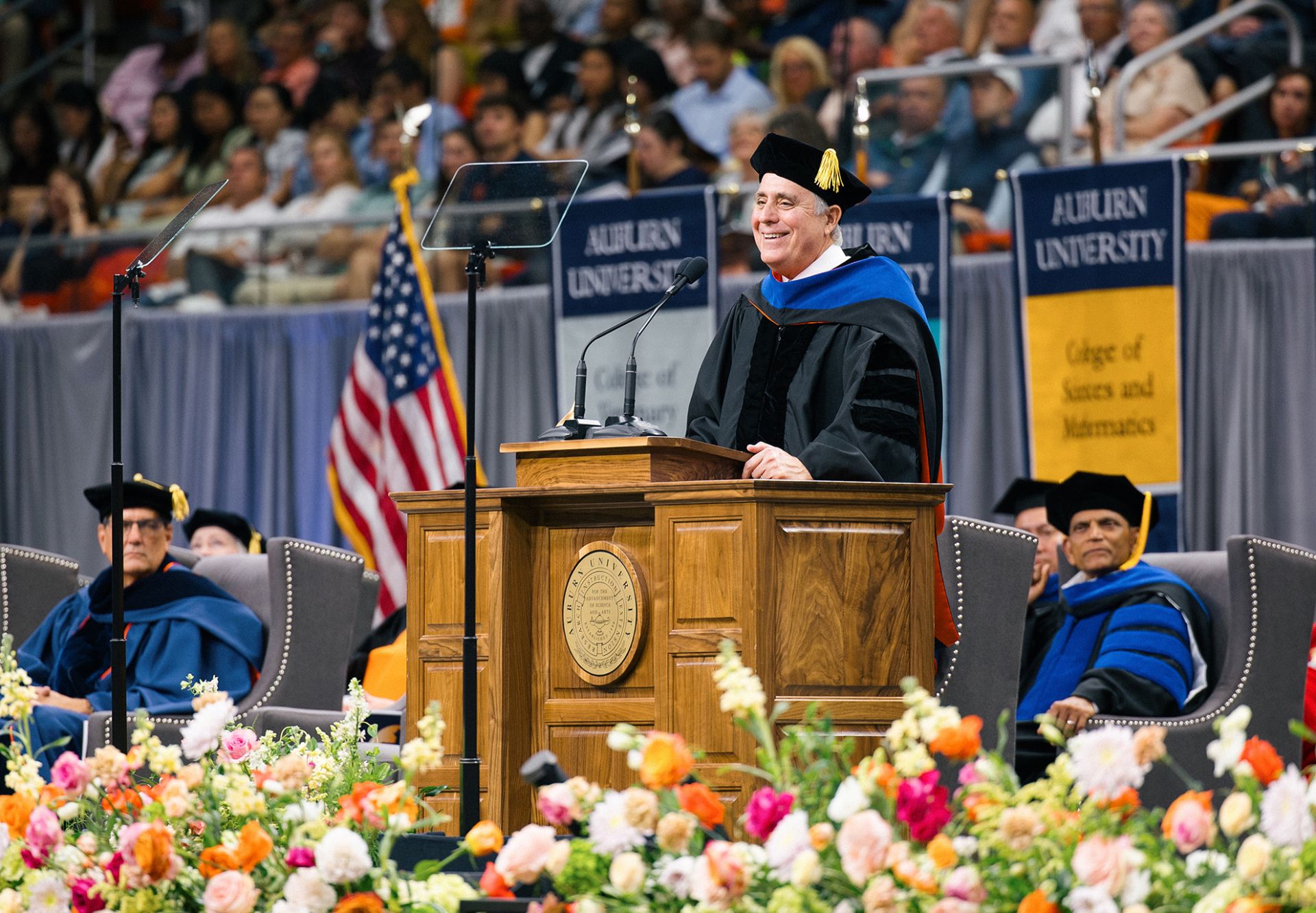
Peters gives a commencement address at his undergraduate alma mater, Auburn University, in 2026. (Photo: Auburn University)
That decision took him to Auburn University in Alabama, where he earned his undergraduate degree in 1986. From there, following in his father’s footsteps, he decided to pursue graduate study. That choice brought another decision: remain at Auburn or move once again. Ultimately, he chose the University of Chicago, a significant change of scenery from the relatively small southern city of Auburn, which was then home to fewer than 20,000 people.
While earning his Ph.D. in geochemistry, Peters met his wife, Ann Marie, who was also studying at UChicago. After earning their degrees and getting married, the couple moved to Pasadena, Calif., where Peters began postdoctoral studies focused on meteorites at the California Institute of Technology.
The Nuclear Transition
While Peters had some peripheral exposure to the nuclear world through visits to Argonne National Laboratory while living in Chicago, it was not until he left academia that he truly began his nuclear career.
With a postdoc completed and a burgeoning family, Peters began looking for a new role. “I often say the way a geologist gets into nuclear is typically through geologic disposal, and that was my path,” he explained. Specifically, he became a contractor for the DOE, moved to Las Vegas, and began working on the Yucca Mountain Nuclear Waste Repository Project.
“It was a great way to get into it,” Peters said. “It was where I really sharpened my technical skills in the back end of the fuel cycle, and it also introduced me to the national laboratories, which were very involved in Yucca Mountain.”
After three years of working as a contractor, Peters formally joined the DOE national laboratory complex in the Earth and Environmental Sciences Division of Los Alamos National Laboratory. Initially, his work with Los Alamos focused exclusively on Yucca Mountain, but after a few years he took on a broader role, one that would see him move once again and dive into another facet of the nuclear world.
This time, the journey took him to northern Virginia and a job in Washington, D.C., where he had a two-year assignment as a science advisor to Margaret Chu, then director of the DOE’s Office of Civilian Radioactive Waste Management.
For Peters, this was a transformational moment in his career for two reasons. First, it exposed him to the many sides of the nuclear industry beyond geologic repositories and the back end of the fuel cycle. Second, it sparked a passion for policy, which would ultimately shape the rest of his career path.
When his two-year assignment was over, Peters was faced with a new decision: return to Los Alamos or find something new. This time, his decision was motivated more by his personal life than his career. He and Ann Marie, a Chicago native, decided they wanted to raise their three children in the city where they first met. He secured a role at Argonne National Laboratory as program manager for the DOE’s Office of Nuclear Energy Programs, and the family moved to the western suburbs of Chicago.
Peters stayed at Argonne for 11 years. Toward the beginning of his time at the lab, he joined ANS. While he had previously learned about the Society during his time in D.C., he was directly encouraged to join by leadership at Argonne. Several years into his time there, Peters was promoted to deputy laboratory director for programs. “That was just incredible for me, because I got to learn about the whole lab and the complexity that comes with it,” he said.
At Argonne, Peters pivoted one more time with a promotion to associate laboratory director for energy and global security. This final role at Argonne gave him experience he had not yet gained in his career: managing a large organization with a substantial workforce. It was an important step for someone who by then aspired to become a U.S. national laboratory director.
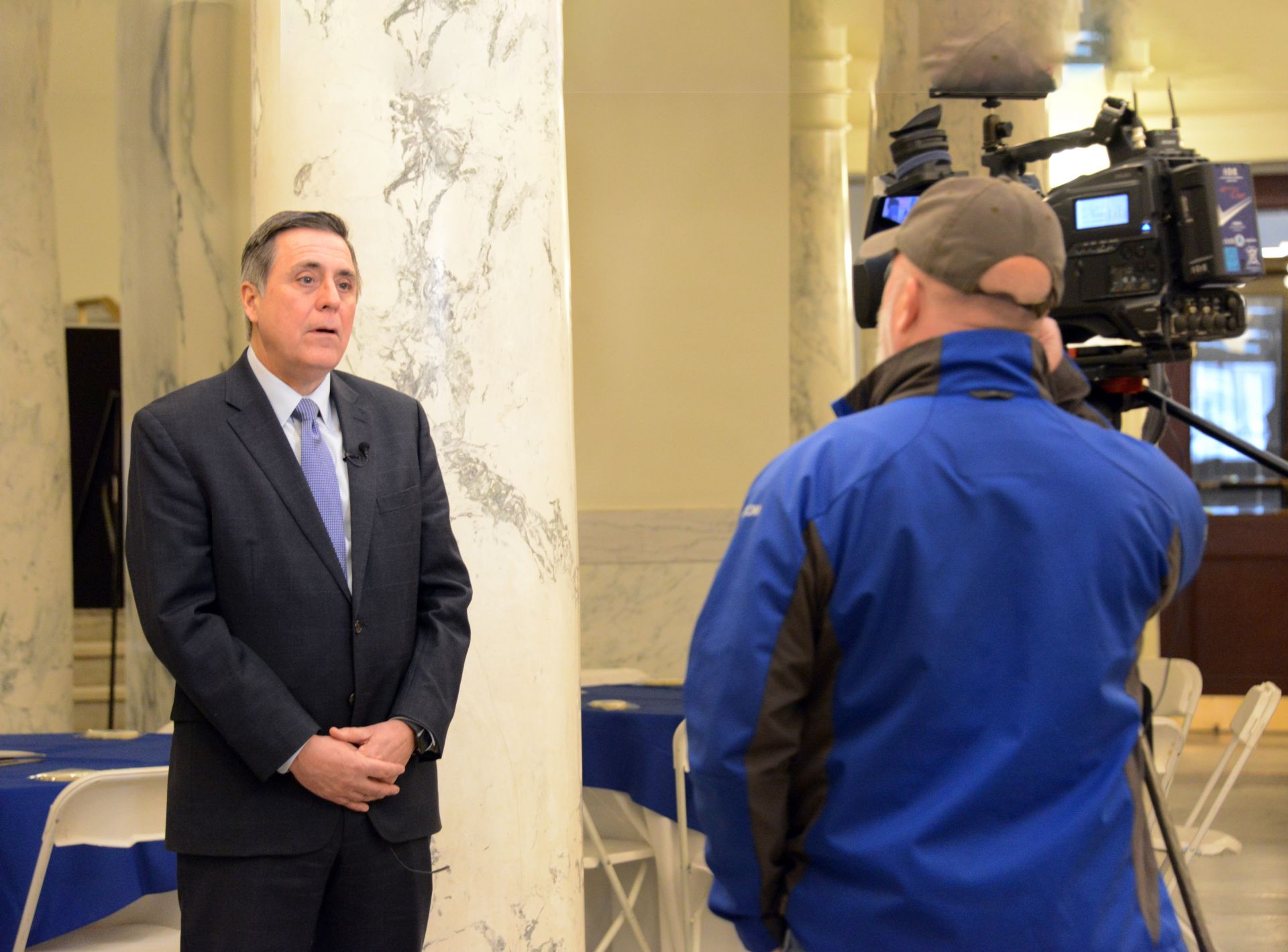
A nationally recognized expert in nuclear energy and national security, Peters has held significant advisory roles across government, research, and industry. (Photo: INL)
Then, in 2015, an opportunity through Battelle to become the laboratory director of INL presented itself. Together, he and his wife decided to pack their bags once again, this time for Idaho Falls. Recalling that time, Peters said that within a month of accepting his new role at INL, he was also named a Fellow of ANS. In his words, “It was quite a summer.”
For Peters, assuming the role of national laboratory director represented the achievement of a significant personal goal, and it also saw him once again following in the footsteps of his father. While he was working in Washington, D.C., under Margaret Chu, the elder Peters, like his son before him, decided to leave academia. After departing from Virginia Tech, he became the director of Pacific Northwest National Laboratory from 2003 to 2006. They remain the only father and son to have both served as national laboratory directors.
Peters spent his time at the helm of INL managing the organization, providing expert testimony to Congress, advising on policy, and generally helping lay the groundwork for the nuclear opportunities seen today. “Sometimes people ask me what my favorite job I’ve ever had is. While I love where I currently am, being a nuclear person, it’s hard to beat being lab director at INL,” Peters said. But, as he entered a new decade, he came to the latest chapter of his career: leading federally funded research and development centers (FFRDCs).
From One Lab To Many
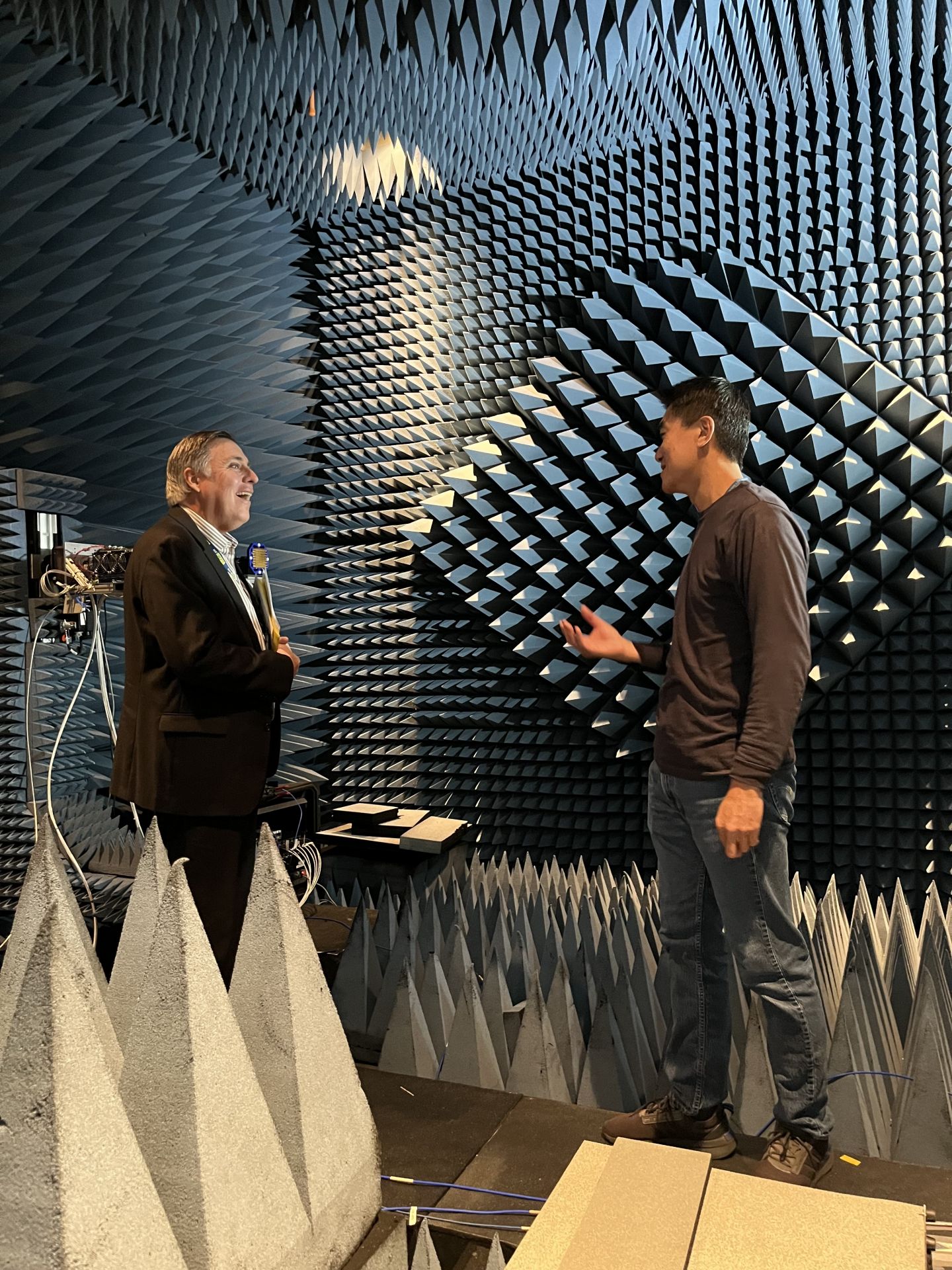
Visiting MITRE’s Far Field Antenna Anechoic Chamber in Bedford, Mass. (Photo: MITRE)
When asked why he made the decision to leave INL, Peters explained, “By the time you get past five years as director, it’s not good for you or the laboratory.” So, when his boss at Battelle retired, and Peters was asked to consider taking on the role, it was a logical next step. He then returned to Ohio, where he had briefly lived during elementary school, and became executive vice president for national laboratory management and operations at Battelle.
While he maintained an important role at INL as chair of Battelle’s board of managers, his new position gave him the opportunity to get involved in other key laboratories like Los Alamos, Oak Ridge, and the six other national laboratories Battelle is involved in leading. There, Peters gained an even deeper understanding of the true significance of FFRDCs.
“They are a really, really important part of our research and development ecosystem,” he said. “If you look at that full suite of things that happen in the nuclear space, whether it be for security or for energy, the labs represent the U.S. expertise and know-how across that entire landscape.”
After almost four years at Battelle, Peters transitioned to his current position as president and CEO of MITRE. Like Battelle, MITRE leads a variety of FFRDCs, but its portfolio is wider in scope. Peters now oversees the management of facilities involved in commerce, defense, aviation, and much more. Speaking on his day-to-day life now, Peters said, “I’m just finding it amazingly fascinating to be involved in research across such a wide swath of the government. I’m really enjoying it.”
Plans for ANS
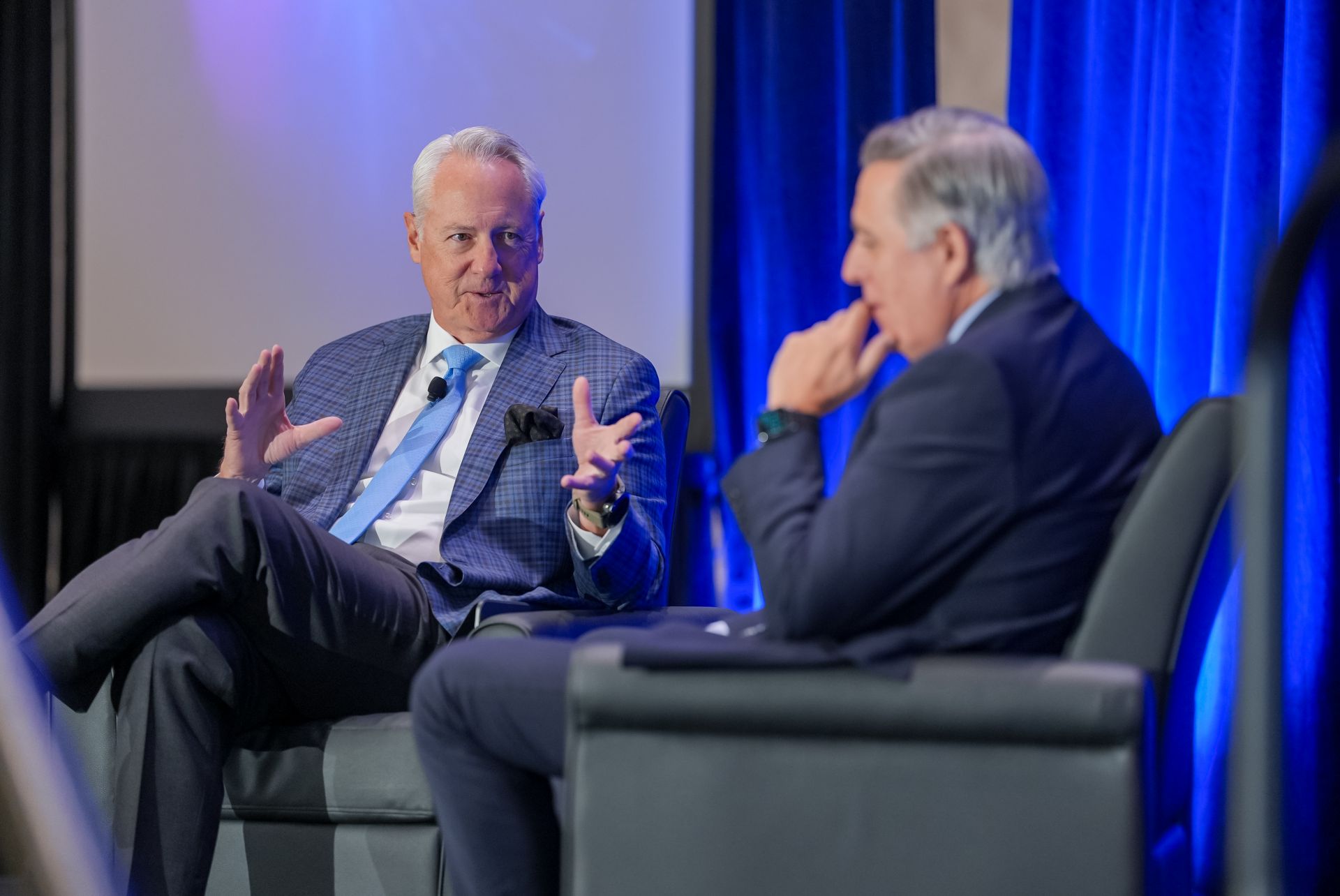
ANS CEO Craig Piercy and Peters on stage at this year’s ANS Annual Conference in Denver, Colo. (Photo: ANS)
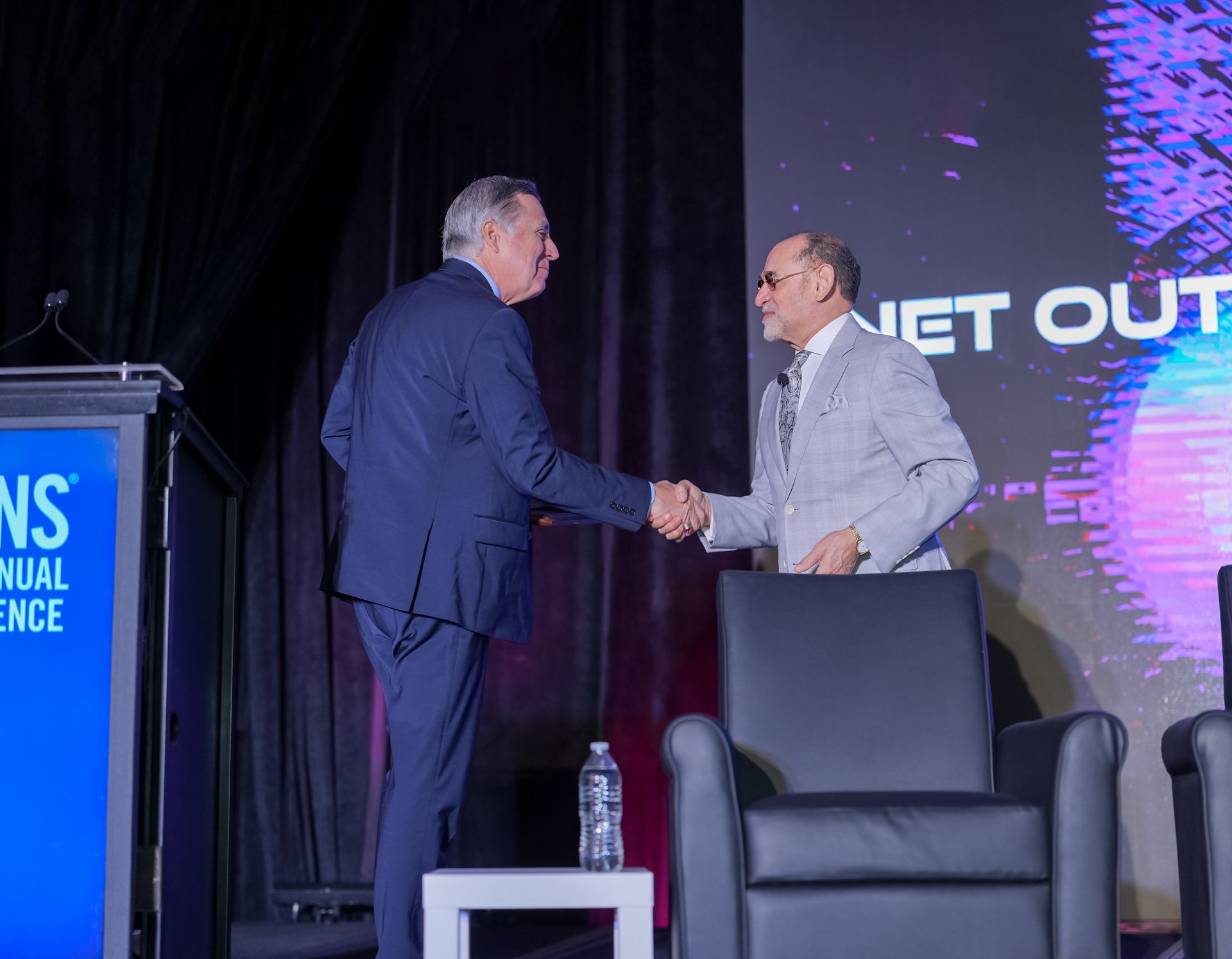
At the ANS Annual Conference, the mantle of ANS president passed from H. M. “Hash” Hashemian to Mark Peters. (Photo: ANS)
Peters is set to celebrate 20 years as a member of ANS during his term as president. In that time, he has received numerous Society honors and awards, served on the board of directors, and helped lead influential Society projects. Given this experience, he has big-picture plans predicated on what he sees as the fundamental roles of ANS.
“As a society of nuclear professionals, one part of our role is to be a voice of objective, technically sound information and advice to the public and to the government,” he said. “We also need to champion education. That work goes all the way from pre-K through to graduate programs and translates into an even broader role of being a catalyst for the future of the workforce.”
To those ends, Peters plans to lean into one of his greatest passions: policy. In that area, he hopes he can act as “a force multiplier,” elevating the strong work ANS is already doing. Beyond that, he has ambitions to further develop how the Society invests in its future through ongoing projects and programs in education, certification, and fundraising.
There is much to be done, and there are many reasons to be optimistic. Inside and outside of ANS, a strong foundation has been laid for the next chapter of nuclear. Now, in Peters’s view, is the time to build on that foundation, and the Society will be a key partner in making that happen.
Lucas Geiger is an associate editor for Nuclear News.