DOE approves Xcimer’s laser fusion power plant design
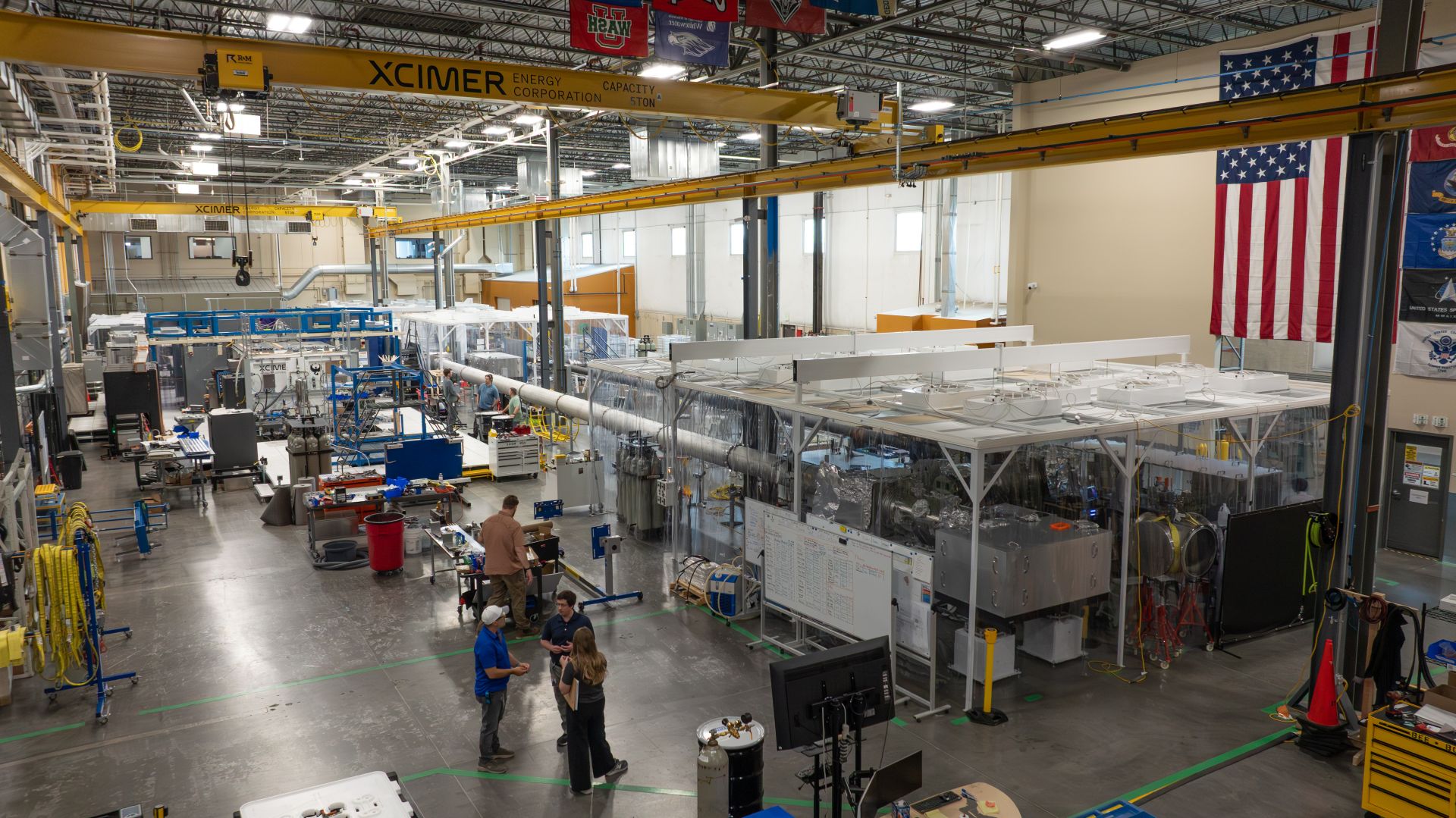
The Department of Energy has approved Xcimer Energy's Athena fusion power plant preconceptual technical design. With this milestone achieved, the Denver, Colo.-based company is now moving forward with its plans to develop economical laser inertial confinement fusion using two beamlines, gas laser technology, and a molten salt fusion chamber.
The National Ignition Facility at Lawrence Livermore National Laboratory demonstrated net energy gain from inertial confinement fusion in 2022 using solid-state glass lasers and 192 beamlines.
“NIF proved laser fusion physics works,” said Alexander Valys, Xcimer cofounder and president. “Our thesis is that commercial laser fusion becomes possible only if the laser system itself becomes dramatically simpler, cheaper, and more manufacturable.”
According to Xcimer, its e-beam pumped gas-laser design “targets laser costs under $100 per joule and a chamber design requiring no first-wall replacement,” resulting in both lower costs and simpler scaling, compared with conventional solid-state laser fusion systems.
Xcimer was founded in 2022 and is backed by venture capital investors, Department of Energy funding, and technical knowledge from the U.S. Naval Research Laboratory, which built and operates the two remaining large-scale excimer laser systems in the United States.
From Phoenix to Athena: Athena, which is being developed with support from the DOE's Milestone-Based Fusion Development Program, is the ultimate goal of Xcimer’s technology development road map, which has also been accepted by the DOE. The DOE’s acceptance of Athena follows Xcimer’s completion of earlier program milestones over the first 18-month budget period in the milestone program. The company’s next phases of work include full-scale subsystem testing, engineering validation, and preparation for an integrated plant demonstration.
That work will be carried out using four machines. First is Phoenix, a prototype, industrial-scale laser that recently began operations at Xcimer’s Denver facility. Phoenix is serving as a proof of concept for the company’s fusion architecture, which features a krypton fluoride (KrF) excimer laser using the stimulated brillouin scattering (SBS) process. In this process, the laser beam energy is amplified to produce intense light that interacts with acoustic waves, compressing a microsecond-long pulse into the nanosecond timescales necessary for fusion.
According to Xcimer, Phoenix is the largest privately owned laser system in the world and is demonstrating “end-to-end integrated operation of excimer amplification and SBS pulse compression. The light source for Phoenix operates at pulse energies over 1 kJ [kilojoule], and the SBS gas optic at the core of Phoenix is 38 meters long. This is the highest-ever energy and largest spatial extent of SBS in an optical system.” The company added that its KrF excimer lasers “are designed for higher efficiency, fewer beamlines, lower thermal stress, and compatibility with industrial-scale manufacturing.”
Next up is Anvil, slated for operation in 2028 in Denver. Anvil will feature commercial-scale Argos laser modules delivering 200 kJ on target in a two-sided inertial fusion energy excimer beamline demonstrator.
Vulcan, planned for the early 2030s, is an “engineering (wall-plug) breakeven demonstration” that will combine 40 Argos laser modules to produce 4 megajoules (MJ) of laser light to demonstrate net energy gain from laser fusion. The device would be upgradeable up to 12 MJ of laser energy.
Xcimer expects to select a site for Vulcan later this year. Once built, Vulcan would be the world’s largest laser. “It would outperform NIF in terms of yield,” said Conner Galloway, Xcimer cofounder, CEO, and chief science officer.
Athena, Xcimer’s power plant, would be designed for continuous grid-scale electricity generation, integrating the laser platform with target delivery, fusion chamber, tritium breeding, and power generation systems at an industrial scale. Xcimer expects to be operating Athena as a 400-MW fusion power plant in the mid-2030s at a site to be determined.
Designed for power: In the words of Susana Reyes, Xcimer’s vice president for chamber and plant design, “A commercially attractive power plant looks very different from a scientific breakthrough facility. We are designing Athena to run continuously at a repetition rate of up to 1 Hz, and the use of a liquid wall chamber maximizes availability by protecting the solid structures from the fusion reaction emissions over the entire plant lifetime."
She continued, “The molten salt curtain absorbs and moderates the flux, breeds fuel, and carries the heat—and it flows, so it renews itself continuously. We designed Athena around that property from day one, and it shapes everything: the materials choices, the thermal management, the maintenance philosophy, the economics."
Opting for a molten salt fusion chamber means that Xcimer’s design has “the lowest waste profile in terms of class of radioactive waste than any other fusion approach,” Galloway said.
Stay tuned: ANS journal Fusion Science and Technology is organizing a special issue on Xcimer Energy’s Athena fusion pilot plant design. Papers are led by authors from the company as well as from several national labs leading work in materials, molten salts, vacuum systems, tritium, and fuel processing, as well as from universities doing work in neutronics.