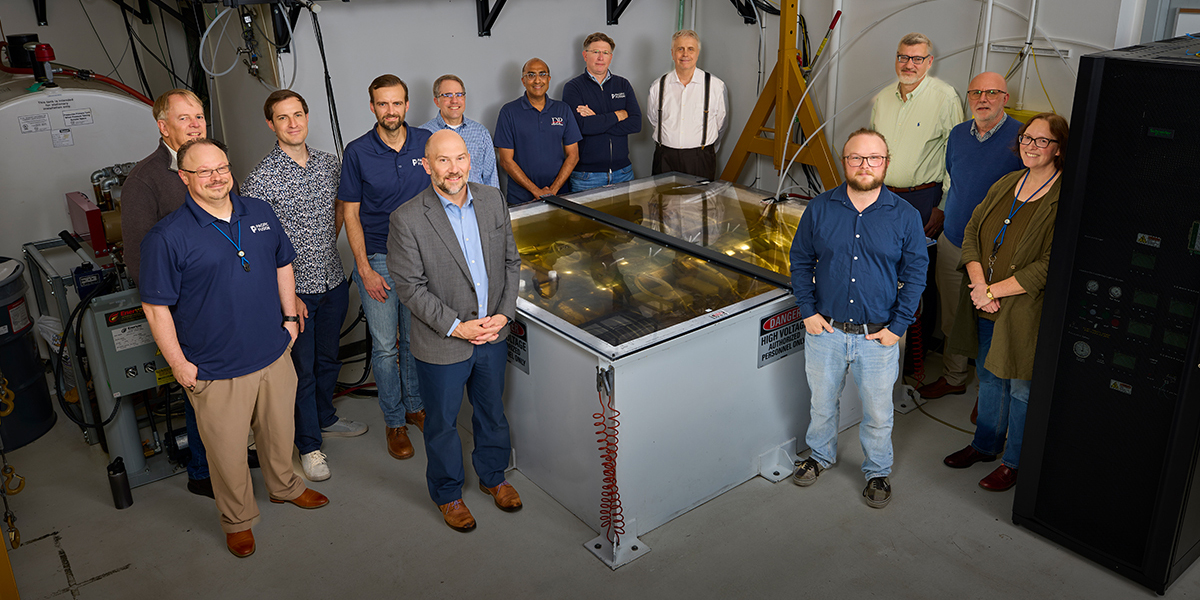
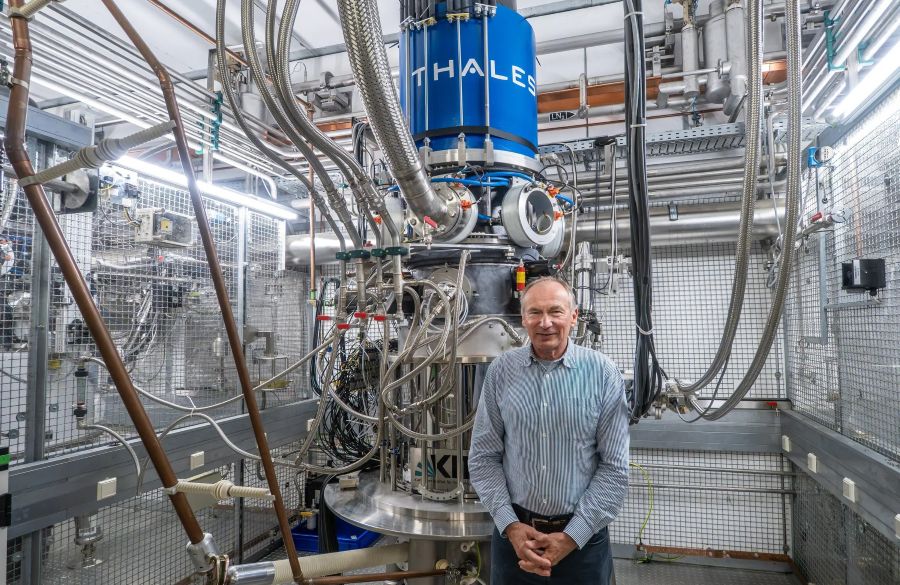
Sirius was designed and built at LLNL and uses the same core IMG technology that San Francisco area–based Pacific Fusion is scaling for its pulser-driven inertial fusion system. The lab and the company are working under a Cooperative Research and Development Agreement (CRADA).
Pulsed-power basics: In a pulsed-power accelerator, low-power electrical energy from a wall plug is stored briefly in a bank of capacitors before being released as a compressed, enormous burst (or shot) of power. The duration of the pulse is increasingly shortened until it is just billionths of a second long. With each shortening of the pulse, the released power increases.
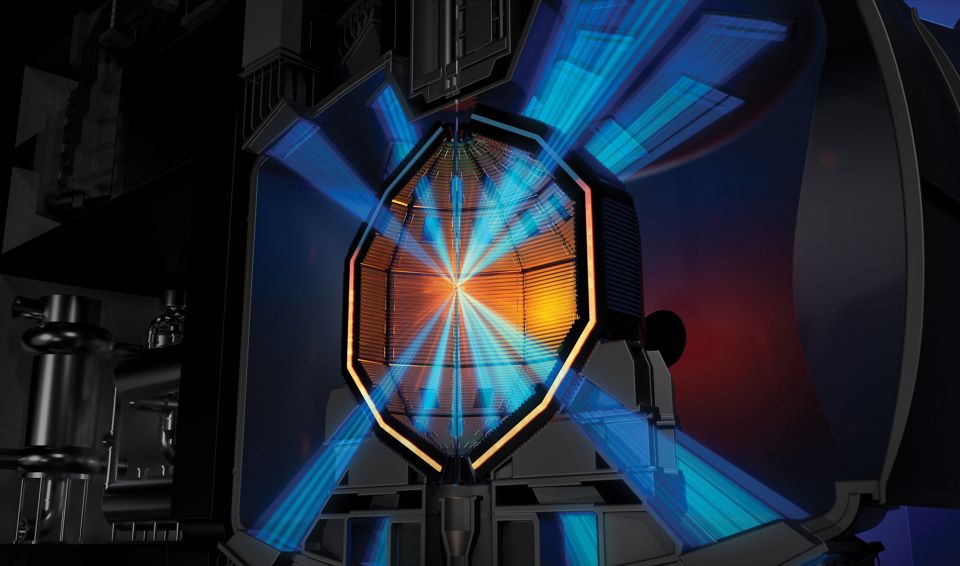
This pulser technology is relevant for fusion energy because the bursts can be used to create the extreme conditions needed to compress fuel and trigger energy-releasing fusion reactions. The pulser technology can also be used to create extreme states of matter for high-energy-density science experiments that have applications with radioisotope production, materials testing, national security, and other areas.
Pacific Fusion is developing a modular pulser platform with a pulsed magnetic fusion approach to produce electricity and for stockpile stewardship.
The innovation: Pacific Fusion’s design uses IMG technology invented by LLNL researcher Bill Stygar and Pacific Fusion cofounder and chief technology officer Keith LeChien. This IMG is designed to deliver a faster, more efficient electrical pulse than conventional Marx generators by charging capacitors in parallel and then discharging them in a single step through carefully timed stages. In Sirius, each 100-nanosecond pulse can deliver 60 GW to a resistive load with 95 percent energy efficiency.
The 3,000-shot achievement for Sirius is seen as a key step in advancing the pulsed-power accelerator prototype from the Department of Energy’s Technology Readiness Level (TRL) 4 toward TRL 5, a benchmark for system demonstrations in laboratory test environments. In addition, the data that are being collected during Sirius testing will help document the reliability and lifetime performance information that is needed to guide future scale-up.
Stygar explained, “For a future IMG-powered accelerator concept, reliability is a key requirement. Such systems could need components capable of operating over long service lives, potentially at up to 100 shots per year for 30 years. We needed to show that our components could last 3,000 shots and that their reliability was high enough for a next-generation machine.”
Close collaboration: LeChien observed, “This milestone shows what close collaboration between national laboratories and private industry can accomplish. The CRADA gives Pacific Fusion and LLNL a shared testbed for refining components, validating models, and understanding how IMG systems perform under repeated operation. Pacific Fusion is rapidly building an IMG module for our high-yield fusion system that is roughly 40 times larger in parallel, advancing IMG technology for energy and national security applications.”