Simulations show nichrome microstructure could impact corrosion
Researchers at Pennsylvania State University have reported evidence that small adjustments to a material’s atomic-level ordering can significantly affect the rate and extent of corrosion, even with identical baseline chemical compositions.
For the study, published recently in Corrosion Science, the team ran simulations for nichrome-based alloys, which have excellent strength, creep resistance, and tolerance to radiation-induced degradation, making them top candidates for use in molten salt reactors and other advanced energy systems.
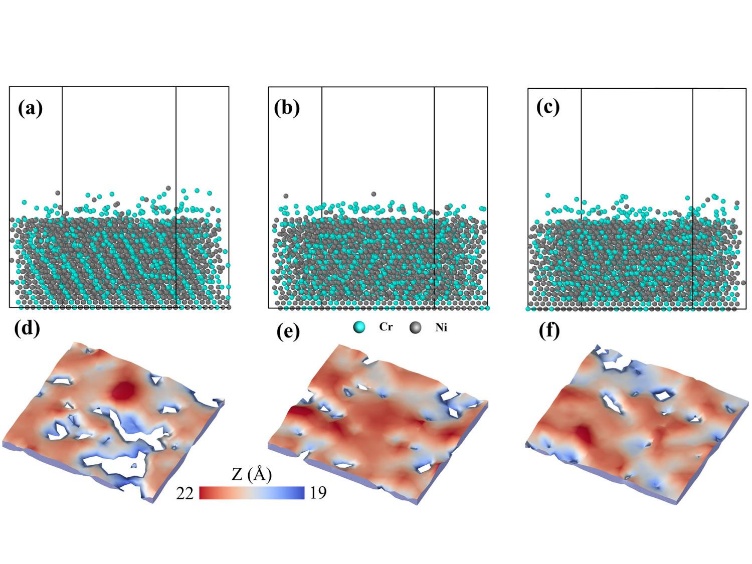
Scientists created hyper-detailed simulations of nichrome and exposed them to a popular molten salt mixture candidate for use in advanced nuclear reactors. The team found that particular atomic arrangements created “corrosion highways” that made the material much more susceptible to corrosion. (Image: Hamdy Arkoub)
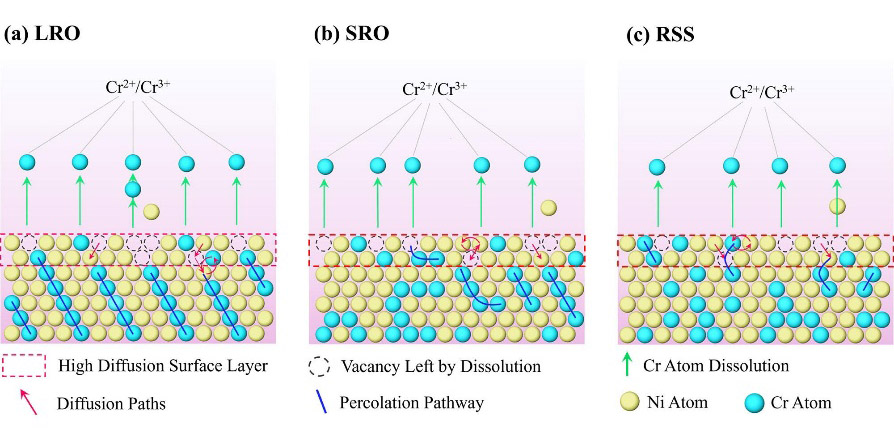
Examples of nichrome with (a) long-range ordering (LRO), (b) short-range ordering (SRO), and (c) random solid solutions (RSS) configurations of the nickel and chromium atoms. LRO creates continuous networks of chromium atoms throughout the alloy, offering streamlined pathways from the external surface—where the nichrome comes in contact with the molten salt—to the internal structure of the metal, significantly accelerating corrosion compared to alloys using SRO or RSS. (Image: Hamdy Arkoub)
From the authors: “Maintaining material stability is a challenge for any reactor, but molten salt reactors specifically struggle with corrosion,” said Miaomiao Jin, an author of the study and assistant professor of nuclear engineering at Penn State. “Many factors play a role in this corrosion, many of which we don’t entirely understand, including the temperatures, the specific salts, or even the chemical makeup of the materials at the microstructure level.”
“The high temperatures and the presence of radiation in these reactors make it difficult to experimentally study how corrosion starts and propagates in nichrome,” added corresponding author Hamdy Arkoub, a nuclear engineering doctoral candidate at Penn State. “Our work aims to use modeling and simulation to fill in the gaps.”
Arkoub said that other studies have observed notable variance in corrosion rates in nichrome samples but attributed the effect to mechanical stress. This study finds that the microscopic structure can play a prominent role, with the ordering of chromium atoms having the potential to streamline corrosion pathways.
The study: The team created simulations with different atomic arrangements, which led to differences in how the atoms traveled, or percolated, through the material.
“We knew going into our test that percolation impacted the corrosion behavior of the alloy, but we didn’t understand the specific mechanisms at play when we consider atomic ordering,” said Jin.
One arrangement, where the chromium atoms were in long, connected stretches from the surface of the sample into the internal structure, was found to have significantly accelerated corrosion after simulated interactions with FLiNaK salt, compared to configurations with short-range or random ordering.
According to a Penn State press release on the research, “In just three nanoseconds of exposure to the molten salts . . . the surface of long-range-ordered nichrome became rough and pitted, while the short-range-ordered and randomly assorted simulations remained smooth, further evidence that these percolation pathways are a primary cause of this corrosion.”
In the paper, the authors state that this work provides the first atomistic evidence that chemical ordering fundamentally alters early-stage corrosion kinetics in nichrome alloys.
What’s next: “Using this new understanding, we are trying to build a high-length-scale model that allows us to see the real-time evolution of how certain alloy materials will behave when exposed to molten salt,” said Arkoub. “Scientists have previously tried to do this, but there were a lot of limitations because we lacked a close understanding of how this corrosion worked on the atomic scale—because of our findings, we can create a much better predictive models of how these alloys corrode.”