A transformative technology: Ocampo Giraldo kicked things off with an overview of why digital twins have emerged as a transformative technology in the context of nuclear safeguards.
As he explained, nuclear energy infrastructure is undergoing a global expansion that is further complicated by increasing complexity in facility designs. These changes necessitate an evolution in the methods used to verify, monitor, and safeguard nuclear materials.
Here, Ocampo Giraldo said, is where digital twins can help. “They offer unprecedented capabilities for real-time state estimation, process monitoring, anomaly detection, and predictive simulation. Integrating digital twins into international and domestic safeguards frameworks brings a unique opportunity and complex technical, regulatory, and security challenges.”
Before going deeper, Ocampo Giraldo also offered a brief, straightforward definition of digital twins: “near real-time, high-fidelity virtual representations of physical systems.” In his presentation, Kreutle complemented this characterization, explaining a digital twin as “a set of models and contextual data traces collected from the original system—also called the physical twin.” This twin must also have a graphical user interface, be updated on a regular basis, interact with the original system, and provide services with respect to that system (for example, monitoring, remote control, education, or training).
The presentations: After Ocampo Giraldo’s introduction, the bulk of the webinar was made up of seven-minute presentations from each panelist, all of whom gave a detailed rundown of their respective digital twin projects.
Kreutle’s project is currently exploring the use case of digital twins in the context of safeguards for nuclear waste management. The physical twins he is considering for this use case include interim storage facilities, encapsulation plants, and geological repositories.
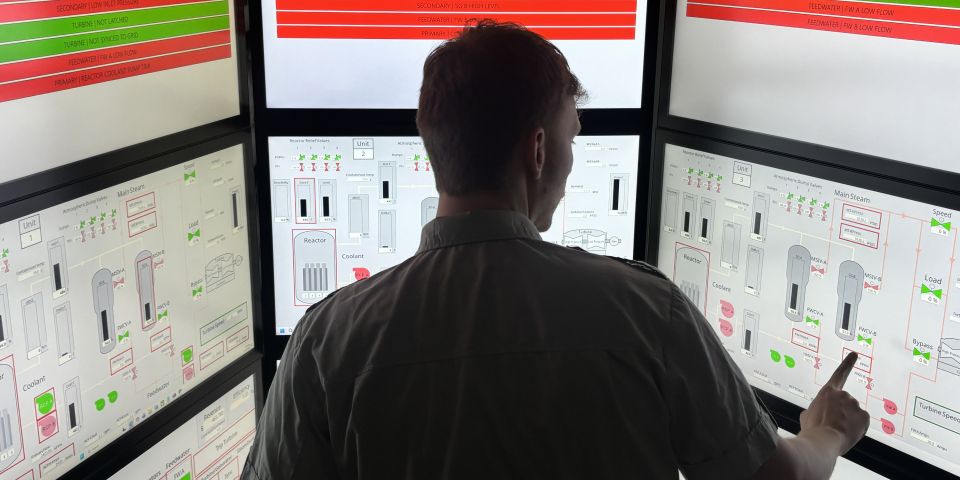
Luciano discussed the digital twin he has been helping to build and has been using for the past two years at UT-Austin’s TRIGA reactor, which has been used to generate models deployed in the reactor’s control room.
Stewart’s presentation focused on another TRIGA reactor—the Neutron Radiography Reactor at INL, for which he and his team are aiming to build a digital twin that can enable remote monitoring.
Tsvetkov focused on different ongoing projects at Texas A&M to advance demonstration efforts toward digital twins, especially as they pertain to the leveraging of artificial intelligence.
Go deeper: To watch each panelist’s full presentation, along with an ensuing Q&A session, visit the ANS website.