ANL dust study aims to improve emergency response models
Researchers at Argonne National Laboratory have conducted experimental tests on how particles from paved surfaces become suspended from activities such as walking, driving, and vacuuming, aiming to improve modeling of radiological and other contamination scenarios where emergency operations may kick up hazardous dust.
The results, published in Health Physics, found that older simulations significantly underestimated the number of particles kicked up into the air due to certain activities, resulting in inaccurate resuspension factors.
Resuspended hazardous dust raises the risk of exposure to workers through inhalation, and it complicates cleanup efforts by causing contaminated material to spread out. Accurate modeling of resuspension helps develop contamination control strategies, guide emergency response, and keep people safe.
Improving models: Study author Michael Kaminski, a senior nuclear chemical engineer at ANL, explained that radiation exposure models didn’t handle the dust that is thrown back up in the air very well.
“There wasn’t any guidance on how to run that part of the model correctly, so we started looking into it,” he said.
The main barrier turned out to be a lack of experimental data.
“Previous studies on people’s movement exclusively focused on indoor activity and surfaces such as carpeting and hardwood flooring. Vehicle resuspension studies were looking primarily at everyday air quality,” Kaminski said.
The experiments: The team simulated scenarios that would be relevant to an emergency response—walking, marching (which aimed to replicate the intensity and pace of movement observed during emergency evacuations), vacuuming, and driving over dust setups—and used particle detectors to measure how much dust was kicked up.
“This is the only study that has quantitatively measured dust on concrete in this way,” said Kaminski. “Almost all of the data we have was collected from nuclear weapon detonation experiments in the desert early on during the Cold War and within uranium and plutonium nuclear facilities.”
The tests used Arizona Test Dust (ATD), which has similar properties to dust that would be expected from radioactive fallout.
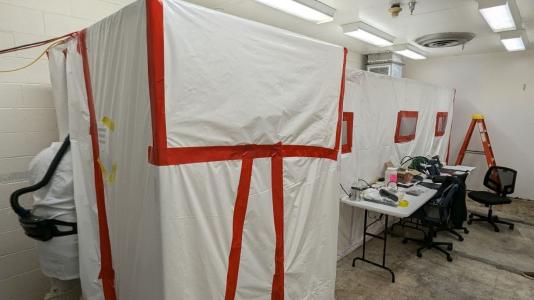
Pedestrian tests on dust resuspension were conducted inside a tent to control the humidity and temperature and contain the dust. A researcher is seen entering the tent, at left. Particle counters are located on the white table with their hoses extending into the tent to sample the air within. (Photo: Argonne National Laboratory)
The results: Models have typically used resuspension factors in the range of 10−6 to 10−5 m−1. The measurements in this study found that range to be accurate for casual walking, but all other scenarios had higher resuspension factors, in some cases by several orders of magnitude.
Marching significantly increased resuspension. For larger particles the resuspension factor was measured to be 6 × 10⁻³ m−1, hundreds of times larger than what models have been using. Vacuuming showed an increased resuspension factor for smaller particles.
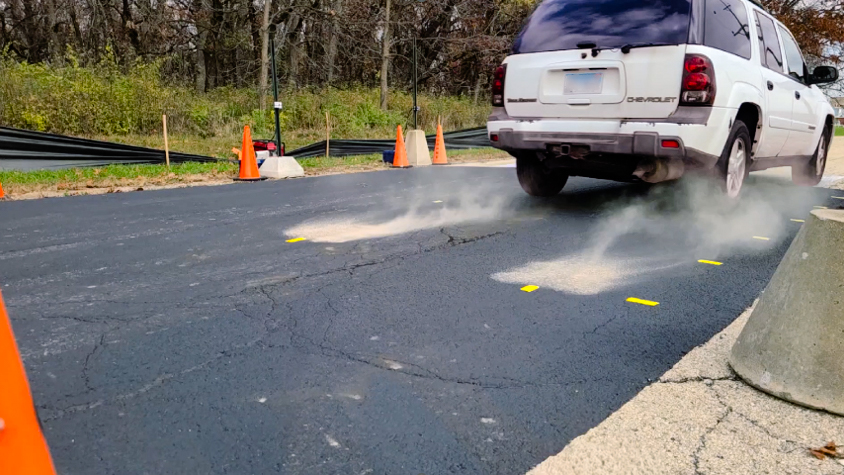
For the driving test, the researchers cleaned the natural dust off a section of road on the laboratory campus and spread ATD onto test areas before driving an SUV over them. The results showed substantial resuspension, with a resuspension factor of 2 × 10⁻² m−1 for larger particles on the first test pass—thousands of times higher than the default model’s values.
Increased values were found both when the test area was directly driven over by the vehicle tires and when the measured area was beneath the vehicle undercarriage. According to the paper, tests after the first pass showed reduced resuspension factors, but the values remained significantly higher than what models have been using.
According to the paper, “This study enables modelers to better predict airborne concentrations of hazardous particles, inform decisions on personal protective equipment requirements, and optimize emergency response strategies, such as evacuation [versus] shelter-in-place protocols.”