ORNL explores hybrid approach to manufacturing HIP cans
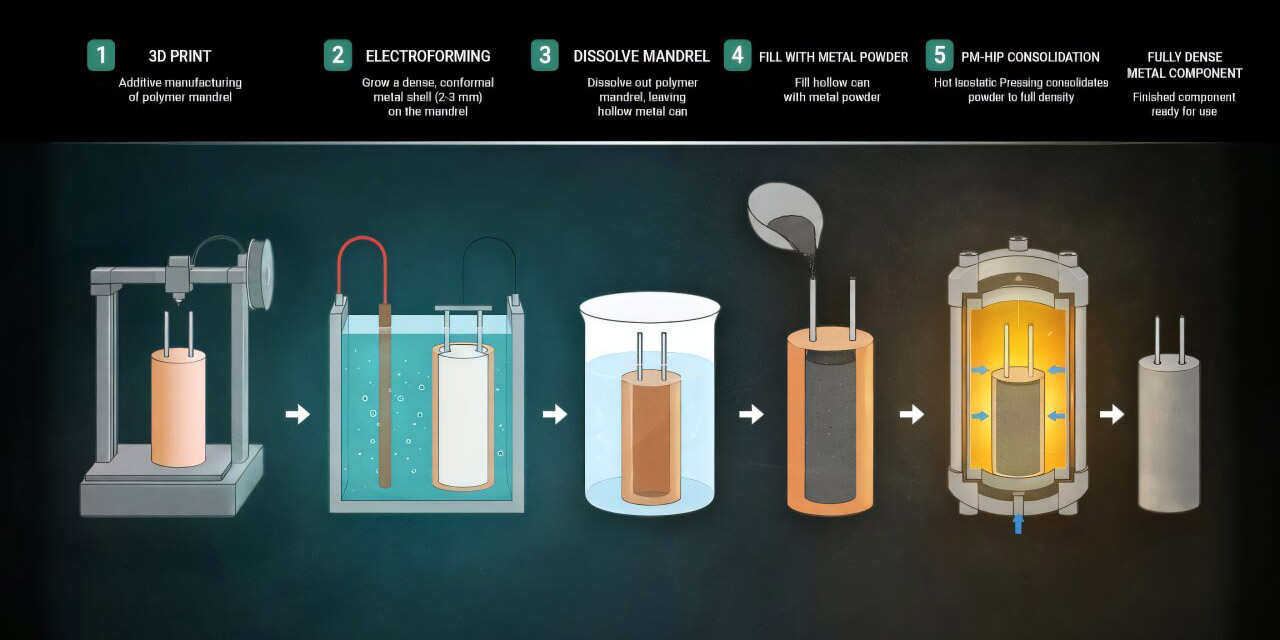
Oak Ridge National Laboratory scientists have collaborated with A.J. Tuck Company to develop a new manufacturing approach for use with the hot isostatic pressing (HIP) technique. The hybrid approach combines 3D printing and electroforming to produce so-called HIP cans used to form metal parts from powder materials, aiming to simplify the production of critical reactor components.
According to ORNL, the technique is designed to enable high-precision, multi-material components while simplifying how complex reactor parts are manufactured.
ORNL’s invention disclosure describes the technology as being designed to reduce manufacturing time, material waste, and production costs associated with conventional large metal component fabrication.
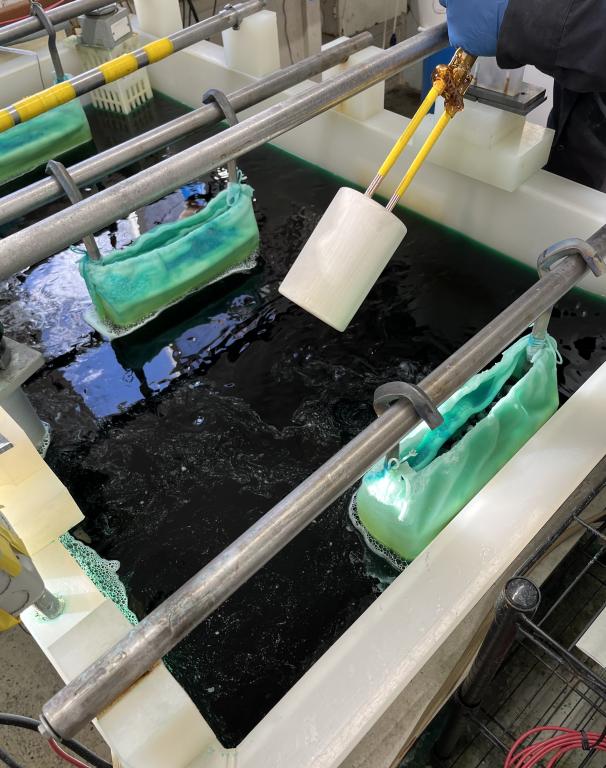
A.J. Tuck Company electroforms a leak-free HIP can using a 3D-printed polymer form and a nickel bath (Photo: A.J. Tuck Company)
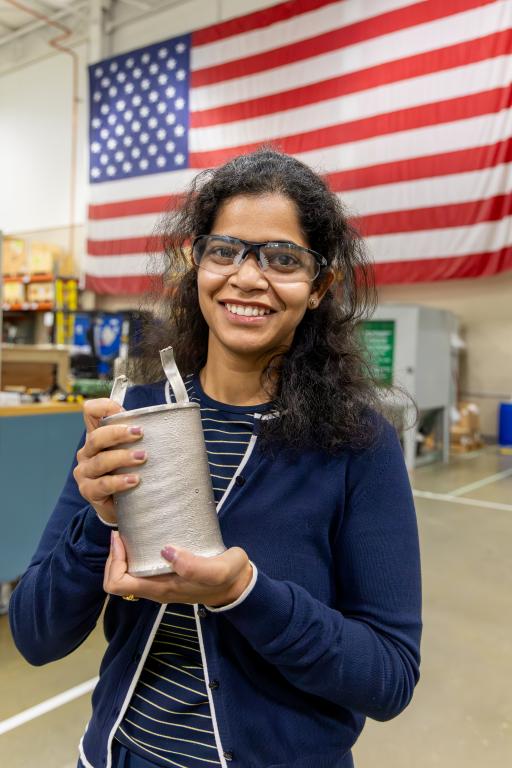
ORNL’s Vanshika Singh holds a 15.7-pound solid nickel component produced using the leak-free HIP can fabricated during phase 1 of the project (Photo: Alonda Hines/ORNL)
The technique: The approach builds on powder metallurgy hot isostatic pressing (PM-HIP), a manufacturing method in which metal powder is sealed inside a hollow container that is in the desired shape of the final component. Under high heat and pressure, the powder particles fuse together into a fully solid piece.
Making the container—called a HIP can—can be complicated, especially for complex shapes that may require several fabrication and assembly steps.
To address this challenge, the team created a process that begins with 3D printing a polymer form into the desired geometry. That is then placed in an electrolyte bath, where electroforming is used to build up a dense, uniform nickel shell 2 to 3 millimeters thick in the exact shape of the printed piece.
The polymer is then dissolved in acid, leaving a hollow HIP can that is then filled with metal powder, sealed, and processed using HIP to form a solid component.
“Electroforming allows us to rapidly create very detailed shapes with high precision while avoiding many of the challenges of traditional manufacturing methods,” said ORNL mechanical engineer Amiee Jackson. “Because the process depends mostly on how thick the metal layer needs to be—not how large the part is—we can scale production efficiently and even batch multiple components in a single process.”
This hybrid technique, which combines 3D printing and electroforming, provides the advantages of advanced manufacturing while reducing the material strain and distortion usually associated with printing metal directly, which does not occur when printing polymer.
The project: As proof of concept, the team started with a basic shape and demonstrated the ability to use the technique to produce five leak-free cylindrical HIP cans measuring 6 inches tall and 4 inches in diameter.
According to the press release, the team also developed an integrated port design that eliminates the separate welding of process tubes, which is a common source of failure during the HIP process, resulting in a more robust and streamlined approach.
“This project shows that electroforming can successfully produce leak-free HIP cans for advanced nuclear energy applications,” said Vanshika Singh, ORNL research associate staff scientist. “This approach could make it easier to produce these components in the U.S., reducing supply chain challenges for advanced nuclear energy systems.”
Now the team is working to apply the process to more complex geometries such as an impeller or a valve.
According to the ORNL press release, the technology is well-suited for a range of energy applications requiring large, high-precision metal components. This includes reactor pressure vessels, valves, and turbine systems.
The project was conducted under a cooperative research and development agreement and subsequent licensing agreement between A.J. Tuck Company and ORNL.