GSE Solutions gives talk on enabling uprates
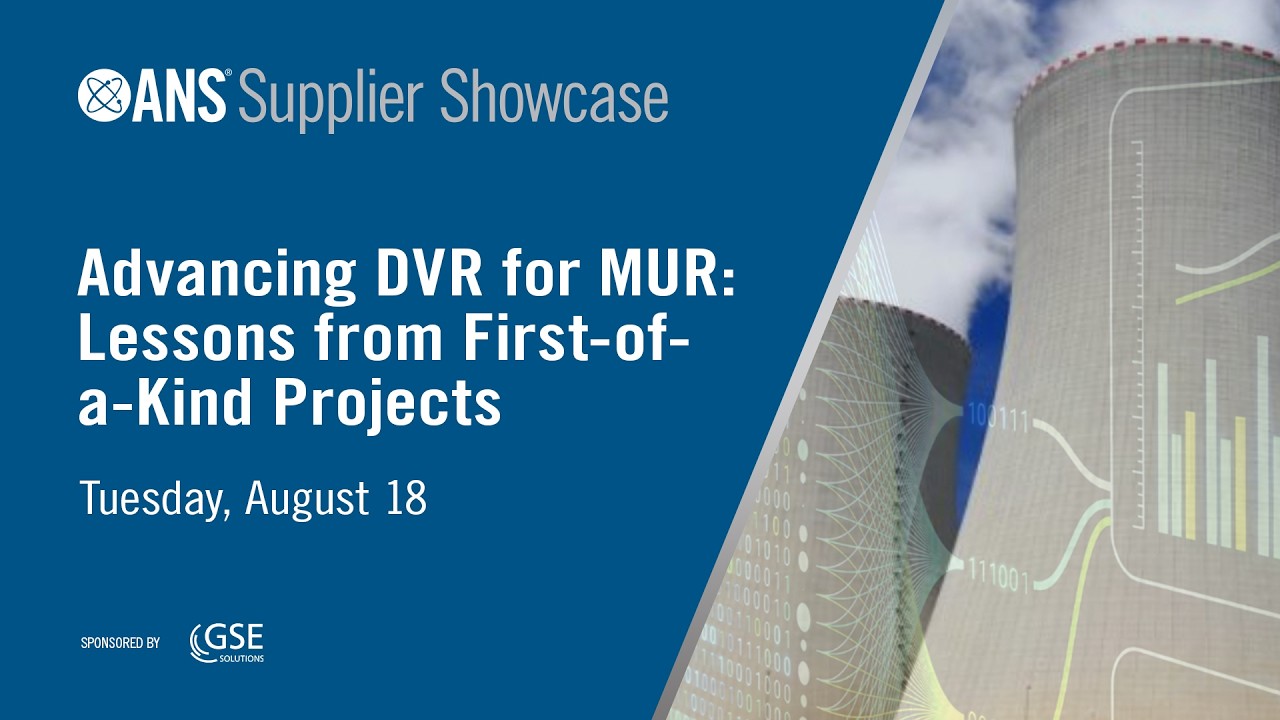
The American Nuclear Society recently hosted a Supplier Showcase webinar, “Advancing DVR for MUR: Lessons from First-of-a-Kind Projects,” featuring Greg Kanuckel, director of thermal performance at GSE Solutions, who shared his insights on data validation and reconciliation (DVR) and its impact on conducting measurement uncertainty recapture (MUR) uprates in nuclear power plants.
Starting off: Before Kanuckel got underway with his presentation, Travis Duckro, senior vice president and head of sales at GSE, gave a brief overview of the company as a whole. GSE was founded in 1971 primarily as a simulation business. Over the ensuing decades, the company has grown significantly in scope; its primary objective is now to improve reliability, reduce risk, and increase profitability for nuclear plants across the world. This high-level goal is manifested through projects in the fields of design engineering, simulations, thermal performance, engineering programs, and balance of plant work.
DVR basics: Taking the floor, Kanuckel gave a refresher on DVR. As he explained, data validation and reconciliation has two steps. Data validation involves “ensuring that the data is reasonably accurate; there’s no obvious problems like zero values.” Data reconciliation “is the more powerful aspect” of the process, according to Kanuckel: comparing and verifying data across systems.
As for the problem that DVR attempts to address, Kanuckel explained that “we know that our measurements coming from the process instrumentation at the plant have some amount of error associated with them.” However, when confronted with irreconcilable data, unknowns still remain. “We don’t know what is causing the error and which instruments have that error and likely how that error is distributed across these various instruments.”
DVR attempts to solve this issue by quantifying the expected amount of error in each system or instrument and assigning each measurement an uncertainty, with the ultimate aim being the creation of a reconciled, contradiction-free data set.
A benefit of DVR is the reduction of uncertainty associated with the output data for any given instrument or parameter by building in multiple measurement redundancies.
“If you have an excess amount of information, then you can leverage that excess amount of information,” Kanuckel explained. “You can reduce sensitivities for key parameters to any various single input and that process ends up driving down your uncertainty for these major parameters.”
Applied to MUR: “The basis for an MUR uprate lies entirely in the existence of that instrument uncertainty” that a DVR seeks to reduce, Kanuckel said. The core thermal power of a reactor is calculated by several instruments, each of which contributes some amount of uncertainty to the calculation.
That uncertainty is accounted for in Nuclear Regulatory Commission regulations by ensuring that a plant’s safety analysis limit is 2 percent higher than its operating limit, creating a small but significant margin between the two figures. However, if an operator can demonstrate that its calculated core thermal power uncertainty is less than 2 percent, the operating limit of the plant can be raised closer to the safety analysis limit. “This has been the process through which all of the [MUR] uprates have been achieved,” Kanuckel said.
Go deeper: To dive much deeper into how DVR impacts and enables MUR uprates, watch the full webinar on the ANS YouTube channel.