World Bank and IAEA partnership at one year
The International Atomic Energy Agency and the World Bank Group (WBG) recently provided an update on their partnership’s progress at the one-year mark. That partnership, entered into only weeks after the World Bank reversed its long-standing ban on nuclear power investment, aims to facilitate new financing and construction of advanced nuclear projects in developing countries.
The history: WBG was founded in 1944, is headquartered in Washington, D.C., and is composed of five international financial and lending organizations. The group’s overall mission is to end extreme poverty and increase prosperity; as a development bank, it aims to achieve those goals by issuing loans to developing countries.
On September 16, 1959, WBG issued its first and (so far) only loan to a nuclear power project: Garigliano nuclear power station in Italy. That loan was worth $40 million (roughly $477 million in 2026 dollars) and was intended to fund the construction of the plant, about 60 miles of transmission lines, and a substation. The decision to issue a loan for Garigliano came after a 1957 joint study between WBG and the Italian government.
Garigliano entered commercial operation in May 1964, powered by a 160-MWe BWR. It was one of four commercial nuclear power plants to ever connect to the grid in Italy, and it was plagued with issues throughout its operational lifetime. A February 1970 Nuclear News article, for example, states that—in three operating cycles—Garigliano experienced 24 unscheduled shutdowns, seven feedwater heater leakages, and extensive issues with “CRUD deposition on the fuel elements.”
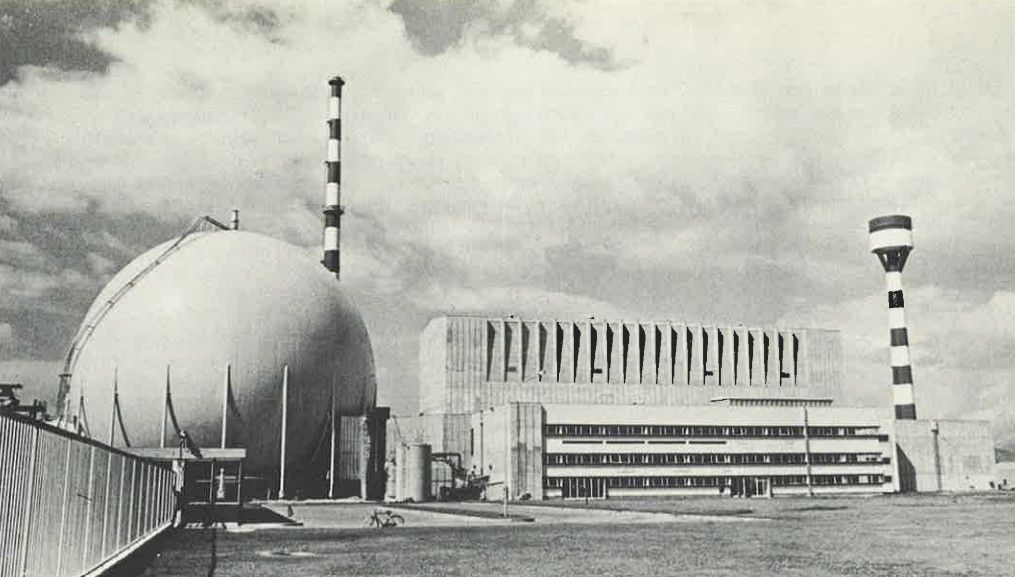
The Garigliano nuclear power station in Sessa Aurunca, in southern Italy. (Photo: Nuclear News, February 1970, p. 45)
By 1978, it became Italy’s first operating commercial nuclear power plant to shut down. A post-Chernobyl referendum in 1987 led to the country shutting down the remainder of its fleet.
No more loans for nuclear projects were issued by WBG in the ensuing decades, and the group formalized a ban on funding nuclear power in 2013.
Jumping ahead: WBG formally reversed course on its nuclear policy in June 2025. At the time, WBG president Ajay Banga explained that the group would “support efforts to extend the life of existing reactors in countries that already have them, and help support grid upgrades and related infrastructure. We will also work to accelerate the potential of Small Modular Reactors—so they can become a viable option for more countries over time.”
Weeks later, WBG and the IAEA entered into their partnership, which has three main areas of cooperation:
Expand the World Bank’s technical expertise surrounding nuclear safety, safeguards, fuel cycles, regulatory frameworks, and waste management.
Support countries in extending the lifespans of existing nuclear reactors and power plants.
Expedite the deployment of small modular reactors and other advanced technologies in developing countries.
Since then, announcements on the collaboration have been few and far between. In May, Reuters reported that WBG was in exploratory talks with Eskom, South Africa’s state power utility, over a potential multibillion-dollar nuclear investment covering up to 5,200 megawatts of new capacity.
The latest: The IAEA’s new update highlights several collaborative actions involving both groups. According to the press release, IAEA Director General Rafael Mariano Grossi briefed senior officials from WBG and other multilateral development banks, the IAEA held information sessions with broader WBG staff, and several technical meetings have been convened “on issues such as the safety aspects of long term operation and the key elements needed to assess WBG financing for nuclear activities.”
The IAEA also hosted a workshop at its Vienna headquarters that aimed to get other multilateral development banks on board with WBG’s new course. There, senior experts from WBG, the European Bank for Reconstruction and Development, the Asian Development Bank, and the OPEC Fund for International Development discussed how their organizations might finance “the technical groundwork that is often needed before decisions to invest in nuclear energy can be made.”