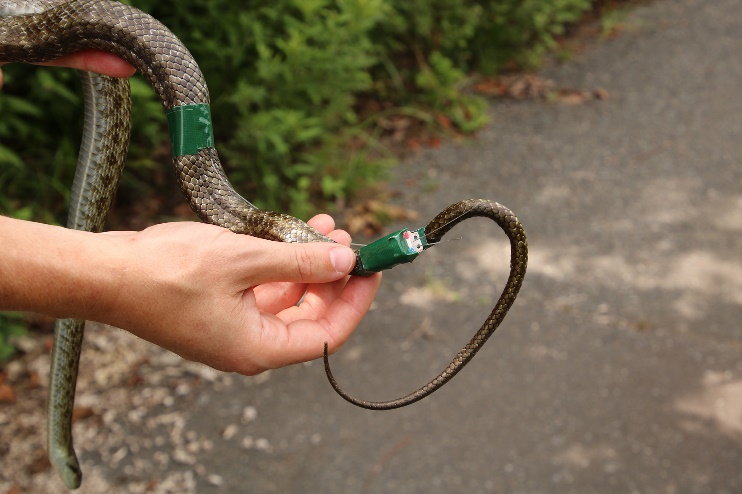
A Japanese rat snake is fitted with a GPS transmitter that will allow researchers to track its movements. (Photo: Hannah Gerke)
The team’s findings, published recently in the journal Ichthyology & Herpetology, report that rat snakes are an effective bioindicator of residual radioactivity. Like canaries in a coal mine, bioindicators are organisms that can signal an ecosystem’s health.
Why snakes? An abundant species in Japan, rat snakes travel short distances and can accumulate high levels of radionuclides. According to the researchers, the snakes’ limited movement and close contact with contaminated soil are key factors in their ability to reflect the varying levels of contamination in the zone. Hanna Gerke, a member of the research team, said that the tracked snakes moved an average of just 65 meters (approximately 213 feet) per day.
Details: The team identified 1,718 locations of the snakes while tracking them for over a month in the Abukuma Highlands, approximately 15 miles northwest of the Fukushima Daiichi plant, which is now being decommissioned. The paper’s findings reinforce the team’s previous study published in 2020, which indicated that the levels of radiocesium in the snakes had a high correlation to the levels of radiation in the soil where the snakes were captured.
They said it: “Our results indicate that animal behavior has a large impact on radiation exposure and contaminant accumulation,” Gerke said. “Studying how specific animals use contaminated landscapes helps increase our understanding of the environmental impacts of huge nuclear accidents such as Fukushima and Chernobyl.”





.jpg)