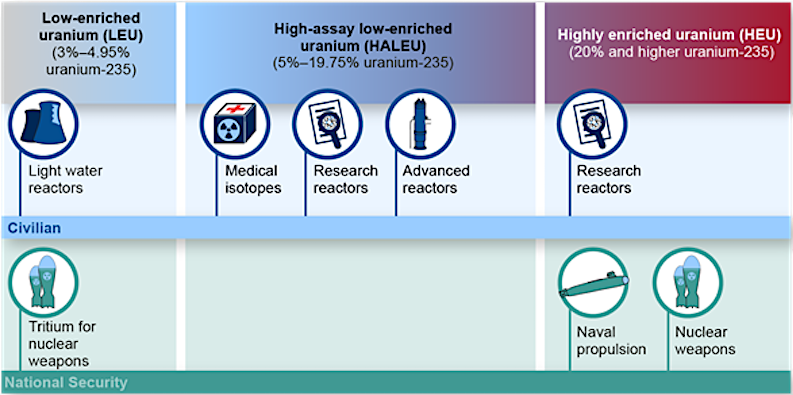
The program: The DOE established the Surplus Plutonium Utilization Program last year with a request for applications from prospective companies interested in receiving almost 20 metric tons of DOE-owned plutonium materials (4.4 MT metal and 15.3 MT oxides) for “recycling, processing, and manufacturing” into nuclear fuel for advanced reactors.
The program follows President Trump’s Executive Order 14302, “Reinvigorating the Nuclear Base,” which ordered the DOE to halt its Biden-era “dilute and dispose program” and to “establish a program to dispose of surplus plutonium by processing and making it available to industry in a form that can be utilized for the fabrication of fuel for advanced nuclear technologies.”
In 2024, the DOE’s National Nuclear Security Administration issued a decision to dispose of up to 34 MT of surplus defense-related plutonium at the Waste Isolation Pilot Plant in New Mexico using a “dilute-and-dispose” strategy. Also known as plutonium downblending, the strategy was adopted after the cancellation of the DOE’s mixed oxide (MOX) fuel project in 2018.
The DOE has declared it has about 61.5 MT of weapons-grade plutonium as surplus to national security needs.
Oklo: On May 26, Oklo announced that its selection for surplus plutonium negotiations with the DOE supports the company’s “broader fuel strategy, which includes multiple pathways to source fuel to support advanced reactor deployment while domestic enrichment and fuel infrastructure continue to scale.”
“Fuel supply constraints are a key throttle to advanced reactor development,” said Oklo CEO Jacob DeWitte. “This program creates a pathway to use existing surplus material as bridge fuel for advanced reactors to bring more reactors on line sooner. Material that has been set aside for disposal can instead be converted into fuel to produce electricity through fission.”
Oklo said it would work in partnership with Newcleo, a Europe-based developer of advanced reactors and MOX nuclear fuel, on the program.
In October 2025, Oklo announced a strategic partnership with Newcleo to develop a $1.68 billion advanced fuel center in Oak Ridge, Tenn., which will include a recycling facility for reprocessing spent fuel into fresh fuel.
Flibe: Alabama-based Flibe Energy, which announced on May 27 that it was selected for negotiations by the DOE, said the program complements the company’s study of the use of electrochemical methods to process spent nuclear fuel. Flibe, along with Oklo, Shine, Alpha Nur, and Curio Solutions, was one recipient of a total of $19 million awarded by the DOE in February for research and development of spent fuel recycling technologies.
Flibe also said the surplus plutonium is ideal for the lithium fluoride thorium reactor technology being developed by the company.
“This opportunity aligns with our focus on utilizing materials in spent nuclear fuel to sustain future reactors,” said Flibe CEO Kirk Sorensen. “The program will help unlock new advancements in modern nuclear power technology and provide a real benefit to the citizens of the United States. We are grateful to the DOE for the opportunity to put this marvelous resource to its most productive use.”
Point, counterpoint: In its Position Statement #47, the American Nuclear Society endorsed EO 14302’s halt to the surplus plutonium dilute-and-dispose program, arguing that making portions of DOE-owned plutonium available to industry could help alleviate some of the cost and supply issues associated with acquiring fissile materials.
Some Democratic Party members of Congress, however, are opposed to the program. In a September 2025 letter to President Trump, Sen. Edward Markey (D., Mass.) and Reps. John Garamendi (D., Calif.) and Donald Beyer (D., Va.), wrote that making weapons-grade plutonium available to private industry “raises serious weapons proliferation concerns, makes little economic sense, and may adversely affect the nation’s defense posture.”