LLNL simulations calculate ICF’s asymmetry limits

August 28, 2026, 10:52AMNuclear News
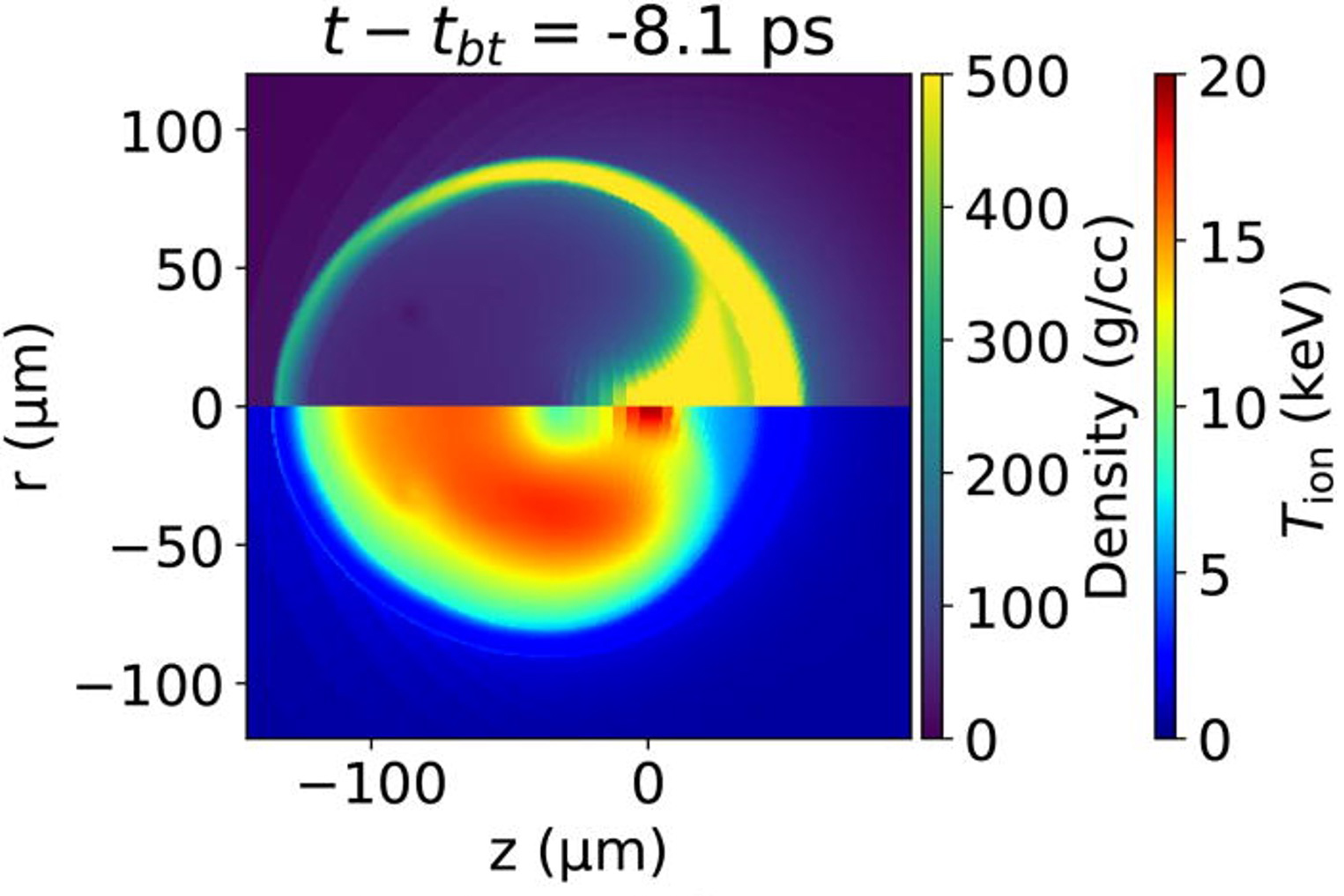
A simulation from the study shows density (top) and temperature (bottom) just before the time when fusion reactions peak in an asymmetric implosion. The hottest point coincides with the densest point of fuel, illustrating the direct ignition of a dense jet of fuel driven by asymmetry. The image was recently selected for the cover of Physics of Plasmas. (Image: LLNL)

Researchers at Lawrence Livermore National Laboratory used simulations to show that inertial fusion power plants could tolerate significant low-mode asymmetries, such as those caused by laser alignment being off-center, revealing a trade-off between robustness and yield that could impact how power plants are brought on line.

At LLNL’s National Ignition Facility, each inertial confinement fusion shot is carefully controlled and calibrated, ensuring targets are hit by the lasers exactly as intended. In the power plant version of this concept, where targets must be injected and imploded multiple times per second, alignment must be achieved through fast automation, and imperfections could lead to asymmetries in how the target heats up and implodes.

In a recent Physics of Plasmas paper, researchers described their process of using two-dimensional hydrodynamic simulations to study the impact of these asymmetries, showing minimal change in yield up until a point where the hot spot stops having enough time to ignite, past which performance drops severely.

“Asymmetries in the implosion tend to rob energy from the hot spot,” said LLNL physicist Timothy Johnson. “But if it's a good implosion, taking some energy away still results in a good implosion, and you're still going to ignite.”

The study also found an inherent trade-off between yield and robustness that likely will leave scientists with a range of options to consider when designing a power plant. It may be beneficial to focus initially on high robustness, even at the cost of some yield, followed by a tuning process that increases energy output and decreases the cost of electricity produced.

“As you're turning on the power plant, understanding the sources of asymmetry, over time you can tighten tolerances, solve problems, and then switch to a higher-yield but less-robust implosion,” Johnson said.


Related Articles

In transition: Commercializing fusion power

July 24, 2026, 3:06PMNuclear NewsSimon Morrow

Commercial fusion power is closer than ever. There are now around 30 U.S. fusion companies, several of which claim to be on track to connect to the grid as early as the 2030s.Tokamak and laser...