Wendelstein 7-X designing 2-MW gyrotrons to upgrade heating system
The Max Planck Institute for Plasma Physics (IPP) announced yesterday that it is developing 2-MW gyrotrons to be used as the main plasma heating system of the Wendelstein 7-X (W7-X).
W7-X, located at IPP, is currently the largest superconducting stellarator facility in the world. The project conducts research aimed at filling key knowledge and technology gaps for developing a stellarator-based power plant.
Currently, 11 gyrotrons with output powers ranging from 0.6 MW to 1.3 MW are used to heat the plasma through a process called electron cyclotron resonance heating (ECRH). The gyrotrons produce microwaves at a frequency that matches that of electrons moving through the plasma, causing energy transfer.
According to an IPP webpage, 10 gyrotrons were used for W7-X’s second campaign (conducted in 2017–2018), providing a maximum power of about 7.5 MW to the plasma. To achieve the facility’s goal of reaching reactor-relevant plasma parameters, higher power is needed.
This project, called High Power Microwave Beams (HiPMiB), aims build gyrotrons with a maximum power of 2 MW and use these to replace the gyrotrons currently in place.
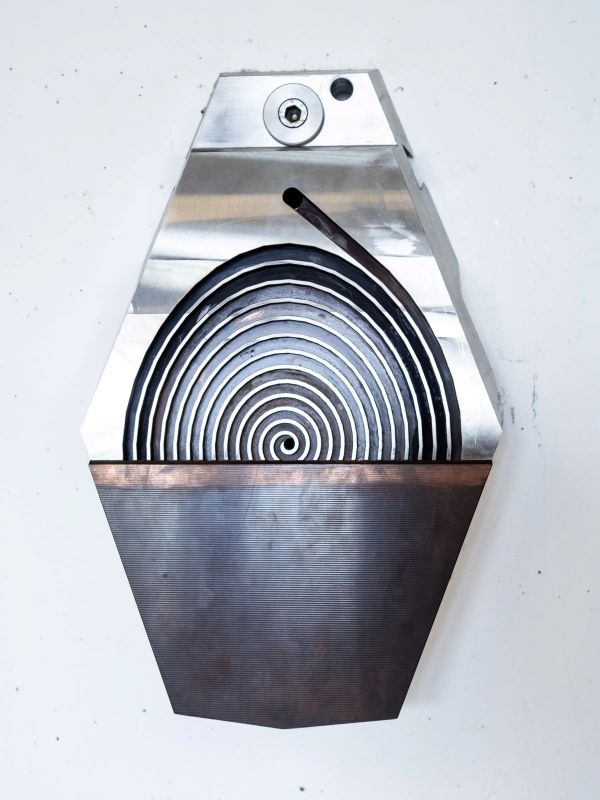
A mirror for microwave transmission at Wendelstein 7-X, suspended on display near W7-X. The copper cladding on the upper half is missing, leaving the water-cooling channels exposed. (Photo: Frank Fleschner/MPI for Plasma Physics)
Heinrich Laqua, HiPMiB project manager at IPP, said that despite W7-X being equipped to heat the plasma using ion cyclotron resonance heating and neutral beam injection, ECRH is “the most important heating method.”
“We estimate that we will need a total heating power of up to 30 MW,” he said. “The ECRH is expected to provide the majority of this, with neutral particle heating contributing a significantly smaller portion.”
W7-X currently has 12 gyrotron positions. The team chose to replace the existing gyrotrons rather than add new positions for economic reasons.
“Each additional new gyrotron position would cost around 10 million euros, regardless of its power output. We would need a new building, additional tunnels for transmission and a massive expansion of the high-voltage power supply. So, we save a significant amount in costs if we instead develop more powerful gyrotrons for the available slots,” said Laqua.
According to IPP, ECRH is particularly relevant to a future power plant application because the energy transfer to electrons “creates conditions that are very similar to those in a power plant plasma.” Also, gyrotron technology scales up well. Microwave transmission is very efficient, allowing the gyrotrons to be installed outside the stellarator building—as microwave transmission is very efficient—and the antennas in the plasma vessel can withstand the harsh reactor conditions.
Collaborative effort: IPP is conducting the HiPMiB project in collaboration with Karlsruhe Institute of Technology (KIT), the University of Stuttgart, and Thales. According to IPP, the German Federal Ministry of Research is providing 6 million euros in funding.
KIT is working on designing and testing a high-power gyrotron for short pulses in the laboratory, IPP said, including microchannel cooling for heat transfer at the walls of the gyrotrons’ resonators, which are expected to receive an extremely high load at around 20 MW per square meter.
Thales will manufacture a demonstrator with an output power of 2 MW, suitable for pulse durations of a half-hour. The University of Stuttgart and IPP are focusing on the technology for transmitting the microwaves quasi-optically using mirrors from the gyrotron into the W7-X vacuum vessel.
“A three-year timeframe is planned for this complex project, which is very ambitious,” said Laqua.
International partnerships: The United States has a longstanding history of work on the W7-X. In May, the DOE announced a 10-year project agreement to continue this work.
“Our collaboration with DOE has been a key factor in the major successes we have achieved at W7-X since the first plasma was produced in 2015. We are delighted to be able to continue our joint work,” said Sibylle Günter, scientific director of IPP.