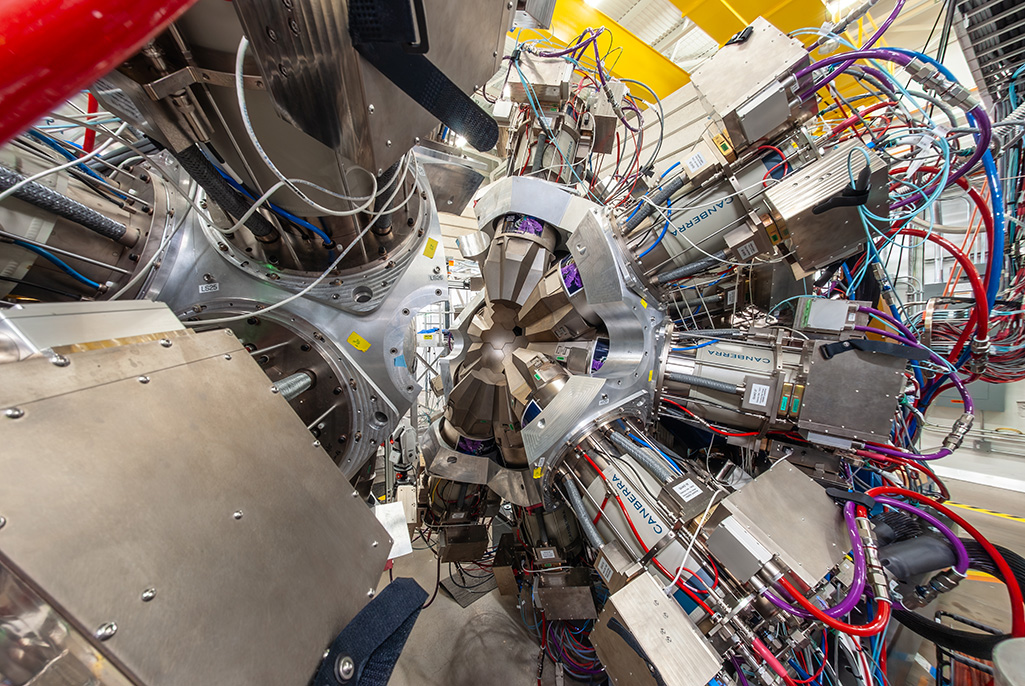
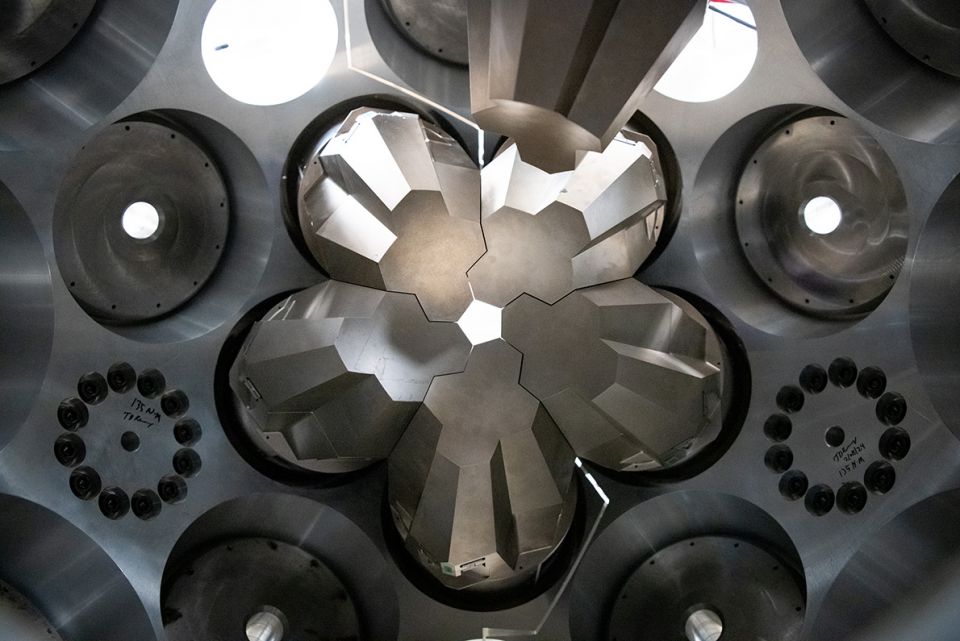
The system: GRETA is an array of 30 quad detector modules offering full 4pi coverage. The detectors offer high-resolution and high-efficiency gamma ray measurement, providing new levels of resolving power for understanding nuclei at a fundamental level.
“It’s very exciting to see GRETA now fully installed with a complete complement of detectors at FRIB,” said Heather Crawford, deputy project director for GRETA and head of the low-energy nuclear physics program at Berkeley Lab. “GRETA has more high-purity germanium than we’ve ever had around a target. It’s an exceptional array and capability for our field. It has been a long time coming, and the result of years of effort from a very big team.”
The project has been in the works since the early 2000s, but a subset of the detectors was used in an array called GRETINA, first assembled in 2010, while the team worked on the remainder of GRETA. Researchers completed the construction of GRETA at Berkeley Lab in August 2025 and then shipped it to FRIB.
“GRETA will enable researchers to investigate how nuclei are assembled, how many protons or neutrons they can hold, how they behave under extreme conditions, and how the elements heavier than iron are forged in stars. They can also search for subtle asymmetries in nature that could help explain why our universe is made of matter rather than antimatter,” Berkeley Lab stated.
Commissioning: The team calibrated GRETA and collected experimental data to ensure the equipment was working as expected. According to the lab, during the characterization run, the researchers collided two nuclei together and then measured the cascades of gamma rays emitted in the resulting nuclear decays.
While the test was done with lighter nuclei, FRIB’s high-energy heavy-ion beam capabilities will allow researchers to produce short-lived rare isotopes through collision with a target.
“By exploring the sensitivity of GRETA to the weakest gamma ray transitions, we can benchmark the performance against previous gamma ray detector arrays,” said Paul Fallon, GRETA project director and director of Berkeley Lab’s Nuclear Science Division. “There’s still a lot of analysis work to be done, but the data are fantastic.”
On the road: GRETA is designed to be portable, meaning it will be able to move between the various beamlines at FRIB. It will also allow the system to move to other facilities in the future, expanding the possibilities for what experiments it can be used to conduct. According to the GRETA website, it will eventually make its way to the Argonne Tandem Linac Accelerator System (ATLAS) stable-beam facility at Argonne National Laboratory.