Integrating Waste Management for Advanced Reactors: The Universal Canister System and Project UPWARDS
When the Department of Energy’s Advanced Research Projects Agency–Energy launched the Optimizing Nuclear Waste and Advanced Reactor Disposal Systems (ONWARDS) program in 2022, it posed a challenge that the nuclear industry had never seriously confronted before: how to design waste management solutions that anticipate the coming shift to advanced reactors and not merely retrofit existing systems built for an older generation of technology. The program’s objectives were ambitious—reduce disposal footprint, enable scalable pathways for unfamiliar waste streams, and build the technical foundations for future disposal—yet also tightly grounded in the realities of emerging nuclear fuel cycles. For the nuclear community, this was a timely call. Advanced reactors were accelerating toward deployment, but the waste management systems needed to support them had not kept pace.
Project UPWARDS (Universal Performance Criteria and Canister for Advanced Reactor Waste Form Acceptance in Borehole and Mined Repositories Considering Design Safety), led by Deep Isolation with NAC International; University of California, Berkeley (UCB); and Lawrence Berkeley National Laboratory (LBNL), was conceived within this environment. The project set out to answer a deceptively simple question: What would it take to develop a technically defensible, disposal-ready system capable of supporting the broad diversity of advanced reactor waste forms and multiple geologic disposal pathways? The answer required not one discipline, but four—waste-form characterization, engineered canister design, safety and performance modeling, and waste acceptance criteria (WAC) development—each informing the others in an integrated, iterative process.
By the time UPWARDS concluded in July 2025, it had delivered a comprehensive engineering and scientific foundation for managing advanced reactor waste using a universal canister system (UCS), comprising several canister configurations that can support multiple waste types, repository concepts, and disposal depths. Rather than presenting a theoretical framework, the project produced experimentally informed data, a complete canister design with a physical prototype, engineering analyses, and performance models that can now form a practical toolkit for reactor and fuel cycle developers, policymakers, and future repository implementers.
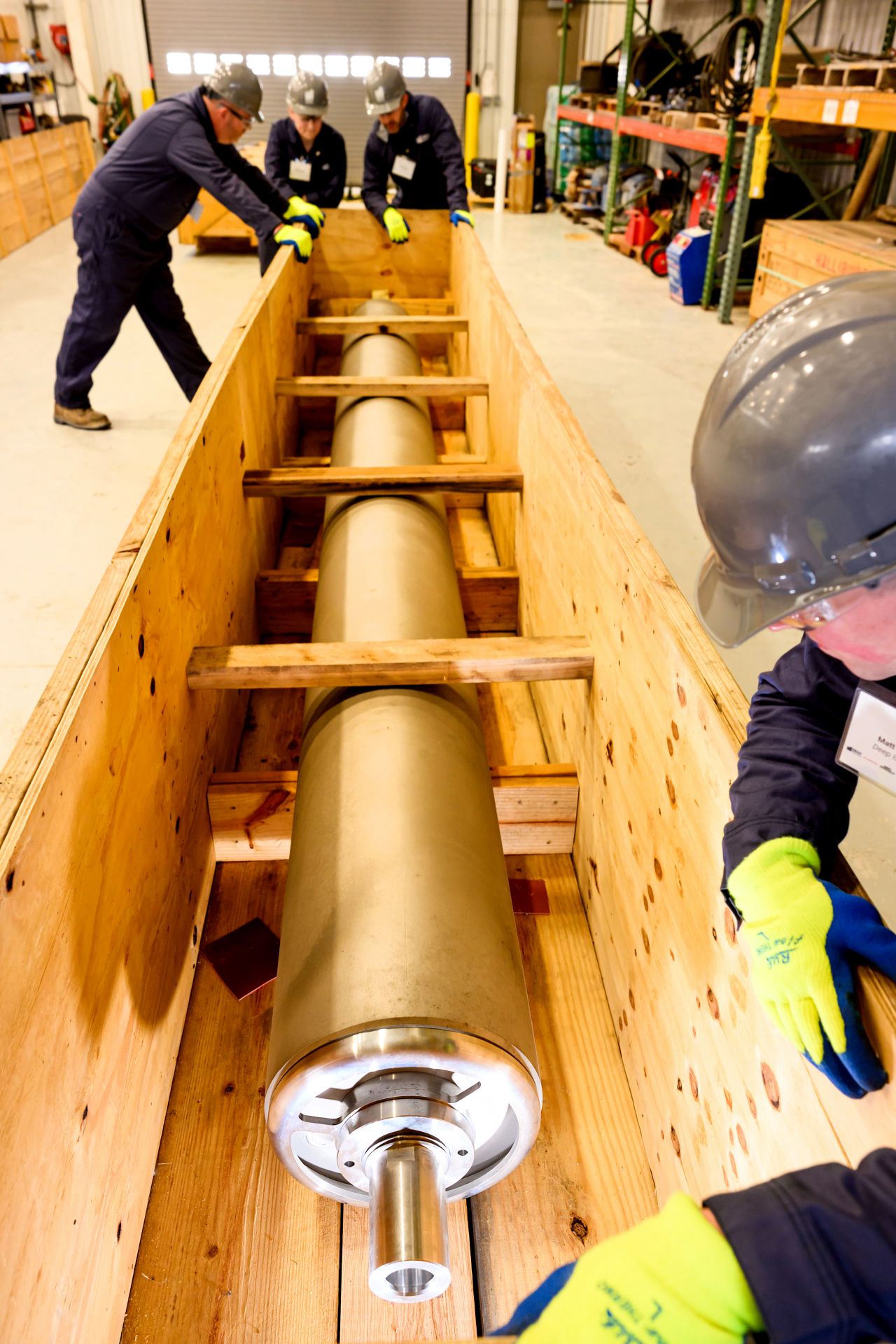
The final UCS canister is inspected at the Deep Borehole Demonstration Center in Texas. Project UPWARDS completed a three-year project to manufacture, physically test, and validate a disposal-ready universal canister system capable of storing, transporting, and disposing of advanced reactor waste.
Understanding the waste before designing the system
The UPWARDS effort began with a basic observation: Before designing any canister, package, or disposal system, one must first understand the characteristics of the intended cargo. Advanced reactors offer the promise of modularly deployable energy but also introduce materials that differ fundamentally from today’s commercial spent fuel—physically, chemically, thermally, and radiologically. UCB led the project’s waste-form characterization effort, beginning with comprehensive research of industry designs, fuel cycle concepts, and scientific literature to determine which waste streams were most likely to be early market entrants.
Three representative waste forms emerged, which together encompass a potential majority of waste streams to be seen from the deployment of advanced reactors and fuel cycles: lanthanide borosilicate (LaBS) glass, tristructural isotropic (TRISO) spent fuel, and frozen halide salts from molten salt reactors. Taken together, they offered a balanced cross-section of potential advanced reactor waste—high-waste-loading glasses; particle-based, ceramic-coated spent fuels; and chemically reactive salt residues. Their selection was not abstract. ARPA-E asked ONWARDS teams to explore approaches that could reduce repository footprint, and LaBS glass was chosen in part because its ability to incorporate higher radionuclide concentrations compared with traditional vitrified waste forms directly allows for a reduction in the volume of waste requiring disposal, ultimately reducing repository footprint.
From the outset, UCB found that although substantial information existed for these waste forms, several safety-relevant properties were missing or only partially characterized. Literature gaps appeared in long-term degradation rates, radionuclide release mechanisms, temperature- and pH-dependent behaviors, and waste-rock interactions. To fill these gaps, UCB developed targeted experimental programs tailored to each waste type.
LaBS glass samples were evaluated using accelerated leach testing to determine the temperature dependence of their dissolution in water. Those tests provided experimentally derived parameters for repository performance assessment models. TRISO experiments focused on understanding the temperature- and pH-dependent dissolution of the silicon carbide (SiC) layer, which serves as the primary containment boundary for the inner fuel particle; understanding its degradation is central to predicting the release of radionuclides from the waste form. For molten-salt-derived waste, experiments examined the solubility and speciation of key fission products in conditions relevant to deep geologic disposal. UCB ensured that each experimental dataset focused on filling previously identified knowledge gaps in parameters relevant to repository safety, resulting in experimentally grounded inputs for repository performance assessment models.
This work laid the scientific foundation for everything that followed. Without realistic inputs for waste-form behavior, even the most sophisticated canister designs or performance models would be untethered from physical reality.
Designing the universal canister system
While UCB examined waste behavior, NAC undertook a parallel challenge: Develop a canister system that would be technically capable of packaging these diverse materials and moving them seamlessly through storage, transportation, and disposal. The result of this effort was the UCS—not a single vessel, but an engineered system comprising multiple canister configurations, all sharing universal features such as a welded closure lid and a common lifting and engagement interface (lift adapter assembly). The goal was flexibility—not in the sense of custom engineering for each user, but in providing a set of standardized canister options capable of accommodating multiple waste types while remaining within analyzed safety margins across multiple back end configurations.
NAC led the UCS design effort, performing structural, thermal, shielding, and criticality analyses across a series of bounding configurations. These evaluations considered the unique challenges posed by advanced reactor waste, including atypical geometries, potential for higher radionuclide inventories, and heat loads that differ from traditional spent fuel. By using engineering judgment based on decades of nuclear industry experience to examine the most limiting configurations rather than only nominal cases, NAC ensured the UCS would be both robust and adaptable.
The design incorporated corrosion-resistant stainless steel construction, a welded closure system, and a lift adapter assembly compatible with both surface and subsurface operations, ensuring the feasibility of both emplacement into and retrieval from deep boreholes, while at the same time facilitating standardized emplacement operations for a mined repository. Each element was chosen to support not just short-term handling, but the full life cycle through final geologic disposal.
The UCS was designed to function as a single, sealed waste package across storage, transportation, and ultimate deep geologic disposal, once waste is encapsulated within. Leveraging NAC’s extensive experience with already licensed storage and transport systems ensured the UCS’s ability to interface smoothly with representative back end infrastructure and reduced regulatory and operational uncertainties across the waste management life cycle.
NAC’s design efforts culminated with the fabrication of a prototype UCS by R-V Industries. The completion of structural welds, verification of manufacturing tolerances, and validation of fabrication processes transformed the design from engineering drawings into a physical piece of hardware. The final prototype UCS was loaded with weights to simulate a loaded canister, allowing for future test programs to further demonstrate the feasibility of deploying the canister in prototypic repository environments at the Deep Borehole Demonstration Center in Texas.
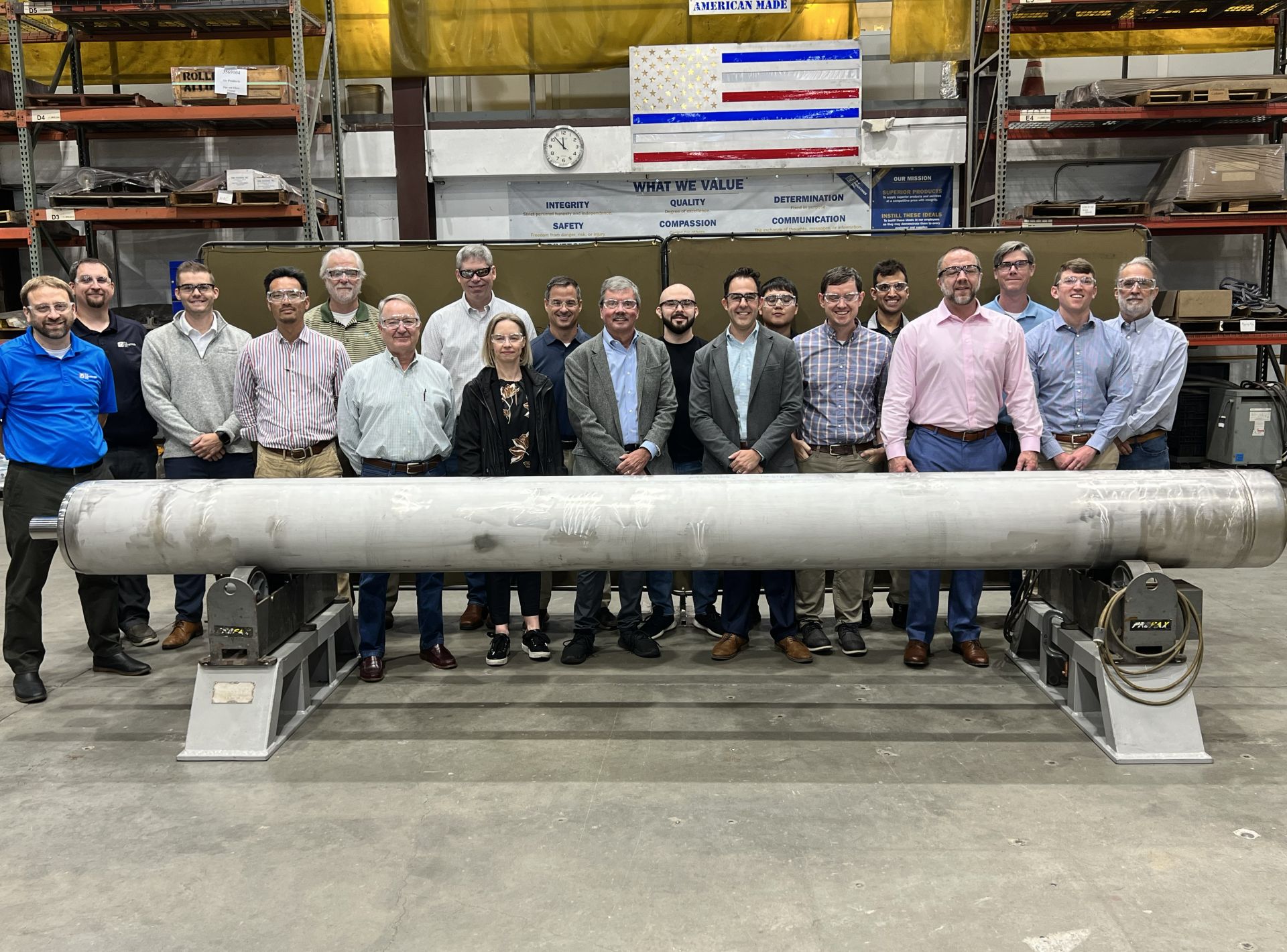
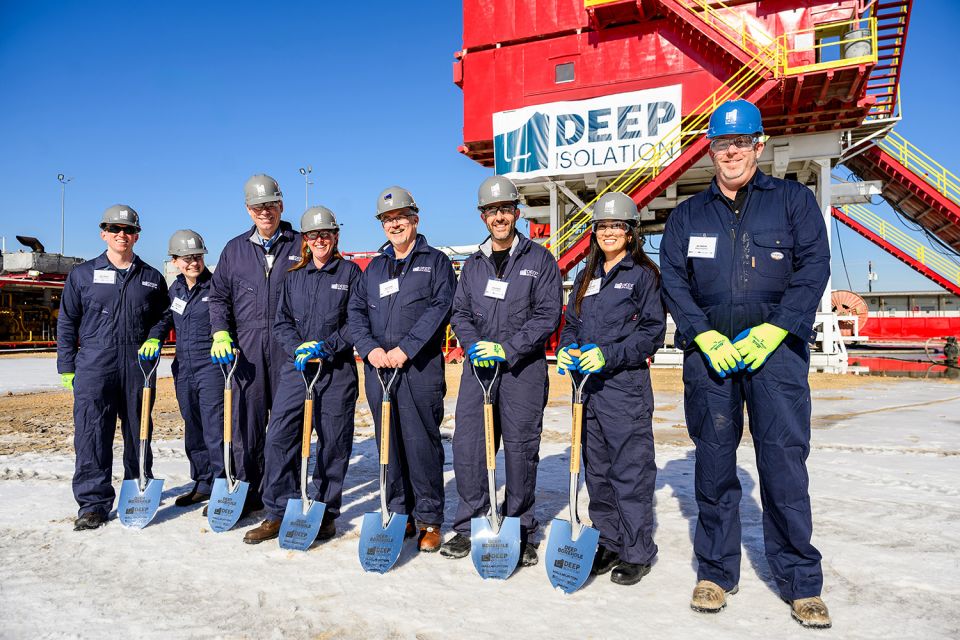
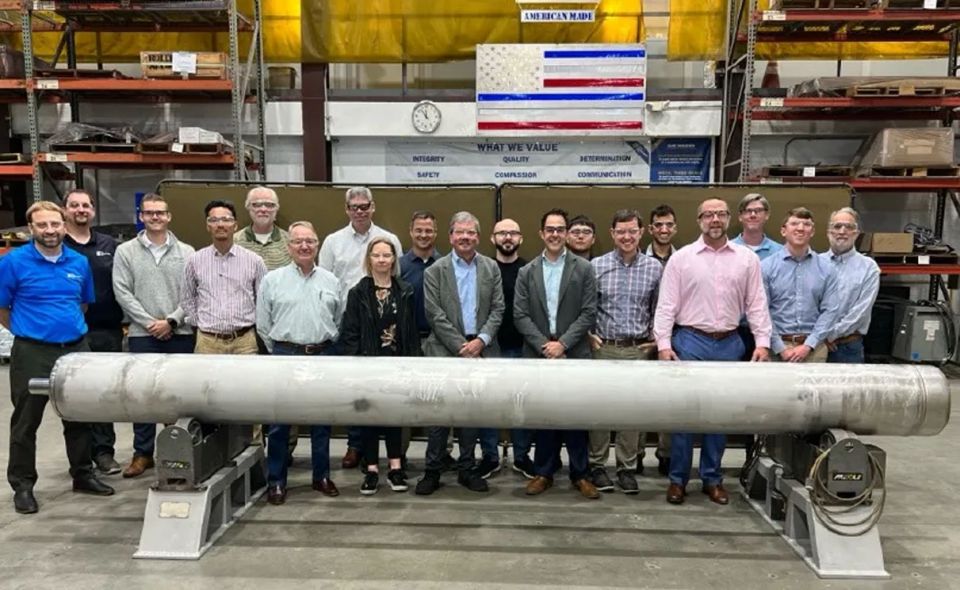
Technical advisory committee members in front of a full-scale UCS prototype developed through ARPA-E’s UPWARDS program.
Modeling repository behavior across three disposal concepts
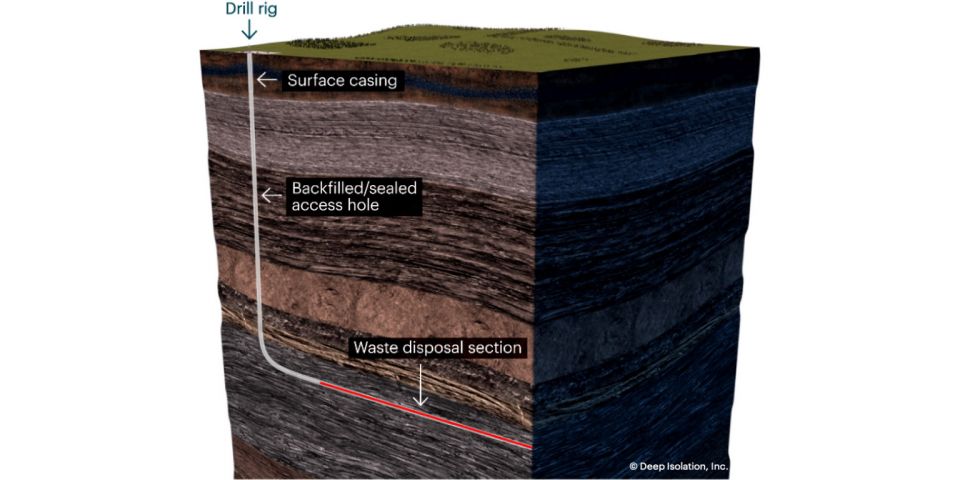
Understanding how canisters and waste behave underground over geologic timescales is just as important as designing them. Deep Isolation and LBNL developed safety and performance assessment screening models to evaluate UCS-packaged advanced reactor waste across three representative repository concepts: mined repositories, horizontal borehole repositories, and vertical borehole repositories. These concepts were evaluated in representative shale and fractured crystalline host formations to span the range of geologic environments relevant to potential disposal pathways.
These screening models were intentionally generic rather than site-specific and were designed to define an envelope of acceptable repository performance for the investigated waste forms across the representative disposal configurations. Using coupled thermal-hydrologic-chemical process modeling with the TOUGHREACT and iTOUGH2 platforms, the models simulated thermal evolution, groundwater flow, geochemical interactions, waste-form degradation, and radionuclide transport over long periods, providing the technical basis for subsequent development of generic WAC.
The models incorporated UCB’s experimentally derived waste-form parameters, NAC’s engineering evaluations of canister performance and design parameters, and repository conditions spanning realistic ranges of temperature, permeability, fluid chemistry, and mechanical behavior. The thousands of simulations run through UPWARDS provided two important outcomes: insight into system behavior and a clearer understanding of which parameters matter most.
Across the modeled scenarios, several consistent themes emerged. Waste-form durability, especially the performance of TRISO’s SiC barrier, played a significant role in limiting radionuclide release. Thermal response was strongly dependent on waste loading, heat output, and waste age, with bounding and outlier cases identified that defined limits on acceptable configurations. Collectively, these results demonstrate consistent performance trends across the evaluated repository concepts and provided the basis for defining generic WAC.
An important outcome of the UPWARDS modeling effort was recognition that WAC and site-selection considerations are inherently interdependent. The performance envelope used to define generic WAC was developed assuming representative ranges of repository conditions, including host rock properties, disposal geometry, and thermal constraints. As a result, generic WAC are best understood not as stand-alone limits, but as part of an integrated framework in which waste characteristics, canister design, and repository conditions are co-optimized to achieve acceptable long-term performance.
Distilling what matters: generic waste acceptance criteria grounded in science
With insights from waste-form experiments, canister engineering, and safety and performance modeling, the UPWARDS team developed a set of generic WAC for waste forms loaded into the UCS. These criteria are not regulatory limits, but rather a high-level framework identifying the parameters that most influence performance across storage, transport, and deep geologic disposal. These criteria were developed within a defined performance envelope established through screening-level modeling and are intended to guide waste acceptance decisions within representative ranges of repository conditions, rather than serve as universally applicable limits.
The WAC included two complementary categories of criteria: canister-related criteria, which establish baseline performance requirements independent of waste form; and waste form-repository pairing criteria, which reflect repository performance drivers and define acceptable waste configurations within a given disposal context. The canister-related criteria define the fundamental performance envelope of the UCS and ensure structural integrity, shielding performance, criticality safety, and corrosion resistance across handling, interim storage, transportation, and disposal. The waste form-repository pairing criteria are based on sensitivity analyses and screening models and are centered around the three waste-related parameters that consistently influenced long-term performance: waste loading (radionuclide inventory per canister), heat loading (decay heat at disposal), and waste age (cooling time prior to disposal).
These parameters together determine the thermal environment, radionuclide availability, and spatial configuration within a repository. Other attributes were evaluated, but within expected ranges for near-term advanced reactor systems, they exerted comparatively minor influence on long-term outcomes.
By identifying these key drivers, UPWARDS provided practical guidance for reactor developers and waste generators planning long-term management strategies. Decisions about cooling time, waste loading strategy, and canister class selection can now be informed by a scientifically grounded understanding of their influence on repository performance.
Implications for advanced reactors and national waste strategy
Advanced reactor developers face an increasingly complex landscape. Waste forms vary, deployment locations may differ from historic nuclear sites, and disposal pathways are not yet finalized. UPWARDS helps bring clarity to this evolving picture by introducing flexibility that helps bridge uncertainties around final disposition pathways for advanced reactor waste.
For developers, UPWARDS project results offer a framework for integrating waste considerations early in design. Understanding how waste loading, heat loading, and waste age shape disposal behavior enables more informed planning, reduces uncertainty, and guides feasibility assessments across disposal pathways. The existence of multiple UCS configurations—with opportunities to refine and optimize internal geometries or loading approaches to support an even broader set of waste forms—allows developers to consider waste packaging as part of the technology development process rather than a deferred challenge.
For utilities and waste owners, early emplacement of advanced reactor waste into the UCS offers meaningful life cycle economic advantage while preserving flexibility under policy uncertainty. Economic analyses of UCS deployment indicated that packaging waste into the UCS at the outset can substantially reduce total life cycle costs compared with conventional approaches that rely on interim storage followed by later repackaging for disposal. Additional savings may be realized where collocated deep borehole disposal pathways are available, reflecting reduced handling, transportation, and supporting infrastructure requirements. Equally important, early UCS emplacement preserves compatibility with mined repositories and deep borehole concepts without further conditioning, converting what would otherwise be a sequence of path-dependent future investments into a single, disposal-ready decision that reduces long-term cost and policy uncertainty.
For national disposal programs, UPWARDS demonstrates that a single integrated engineered system can support both mined and borehole disposal approaches, reducing long-term programmatic risk. Countries or utilities without access to large, mined repository programs may find borehole options attractive; conversely, larger programs may choose mined approaches. The UCS supports both.
Finally, UPWARDS aligns with the objectives of the ONWARDS program to reduce repository footprint, while also strengthening technical readiness for future disposal facilities and ensuring that waste management develops in parallel with reactor innovation. At a time when advanced reactors are increasingly gaining commercial and public attention, having a technically grounded, flexible, disposal-ready solution is not just beneficial, it is essential.
Advanced reactors promise innovation at the front end of nuclear technology. UPWARDS and the advent of the universal canister system ensure that innovation at the back end keeps pace, providing confidence that safe, flexible, and scientifically grounded disposal pathways will be ready when they are needed. ν
Jesse Sloane is the executive vice president of engineering for Deep Isolation.