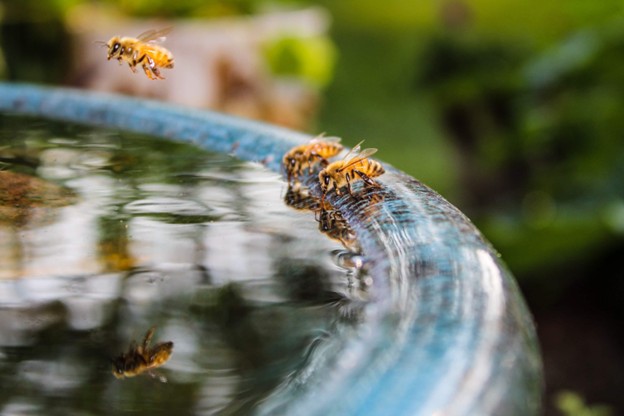
Honeybees drinking water. (Photo: Jackie Fabian)
Of the many and varied uses of nuclear science and technology, few may be aware of its applications in the detection of food adulteration. Also known as food fraud, food adulteration is the intentional altering of food products through dilution, substitution, mislabeling, or other fraudulent actions for financial gain.
To celebrate World Bee Day, the International Atomic Energy Agency highlighted in an article the use of nuclear technology in Chile, where the Joint FAO/IAEA Centre of Nuclear Techniques in Food and Agriculture is helping the beekeeping industry maintain the integrity and safety of its honey. Similar work has been successful in other countries, including Algeria and Thailand.
According to the article, the IAEA and Food and Agriculture Organization of the United Nations are collaborating with the Chilean Nuclear Energy Commission “to classify and catalog samples of local honey from around the country by establishing a national database for honey based on stable isotopic profiles.” CCHEN researcher Enrique Mejías is quoted as saying that the collaboration seeks “to strengthen the sector by providing scientific tools to certify the authenticity of their honeys, ensuring that the product’s value accurately reflects its quality and origin.”
Isotopic fingerprints: The IAEA is helping Chilean scientists develop a database of isotopic “fingerprints” for the honey in the country, indicating the origins of the flower nectar–derived substance and allowing for the identification of sugar additives in it. The analytical tools and methods for honey fraud detection and authentication are being applied in line with the standards and methodologies of the Codex Alimentarius international food standards and AOAC International, an analytical science organization based in Champaign, Ill.
The IAEA provided the necessary equipment for these analyses to scientists at CCHEN and the University of Chile, including an FTIR (Fourier transform infrared) spectrometer, which can detect added sugars, syrups, and other adulterants, and an ED-XRF (energy dispersive-X-ray fluorescence) spectrometer, which can measure trace element contamination and identify likely geographical origins.
Food system credibility: Dongxin Feng, director of the Joint FAO/IAEA Centre, is quoted in the IAEA article as saying that the development of scientific capacity “is at the core of enabling countries to address complex challenges such as food fraud. By equipping experts with advanced tools and aligning methodologies with international standards, we are fostering long-term resilience and credibility in food systems.”
The value of IAEA’s support for using nuclear technologies in the detection of food fraud in Chile was emphasized by Luis Longoria, director of the IAEA Technical Cooperation Division for Latin America and the Caribbean, who said, “The IAEA is supporting Chile in cultivating a skilled workforce of nuclear scientists who can help ensure the long-term success of the beekeeping industry and those who depend on it.”