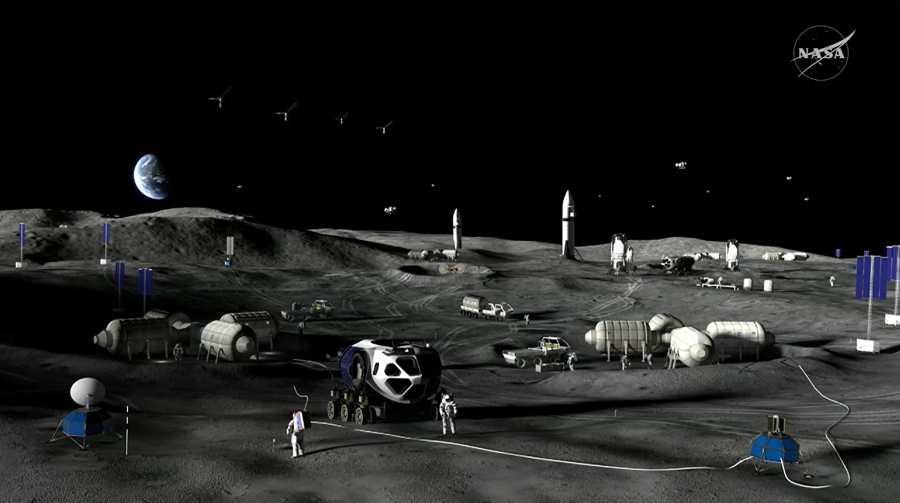
In the announcement, few details were given about what FSP would look like other than it being planned for the 2033–2036 phase of the program, with radioisotope heater units and thermal generators as power sources for earlier phases. According to the new memo, FSP may be on the moon as early as 2030.
Here’s how: The memo lays out the OSTP’s goal to ensure close coordination between NASA, the DOE, and the DOD across the range of design, development, training, and testing requirements needed to achieve space nuclear power on the intended timeline. It also instructs the agencies to leverage private industry resources where possible.
NASA and the DOD are directed to perform “parallel and mutually reinforcing” design competitions for low-power (1 kWe) to mid-power (20 kWe) space reactors in preparation to deploy high-power (100 kWe) reactors in the 2030s.
According to Space News, at the 41st Space Symposium, held earlier this week in Colorado Springs, Colo., OSTP Director Michael Kratsios said, “Nuclear power in space will give us the sustained electricity, heating, and propulsion essential to a permanent robotic and eventually human presence on the moon, on Mars and beyond . . . . For this to work, it has to be a collaboration between multiple government agencies.”
Propulsion and surface power: The memo directs NASA and the DOD to consider designs that are “optimized for in-space propulsion but can also serve FSP needs,” maximizing commonality between designs for the two applications while maintaining the flexibility to choose different options for the two purposes, “depending on cost-effectiveness and mission suitability.”
NASA should also prioritize integrated designs for mid-power FSP and NEP, the memo states, making use of common elements, including reactor hardware and nuclear fuel, and mature and demonstrated technologies to the extent reasonable for both applications.
Funding allocated for nuclear thermal propulsion (NTP) is to be focused on common NEP/NTP elements that can be used on Space Reactor-1 Freedom, the planned NEP demonstration rocket, according to the memo.
The longer-term goal of the space nuclear technology is Mars exploration, and the memo said NEP development should lay “the path toward NEP systems combining high power and high specific power appropriate for future crewed missions to Mars.”
The next few months: Within 30 days, NASA will initiate a program to develop a mid-power space reactor with a lunar FSP variant ready for launch by 2030 and an option for a space variant for a nuclear electric propulsion demonstration.
Within 60 days, the DOE will provide an assessment on the readiness of the U.S. nuclear reactor industrial base to produce up to four space reactors within five years, including reactor design, delivery of long-lead-time components, and fuel allocation or production, along with recommendations for addressing any gaps.
Within 90 days, the DOD will brief the OSTP, the Office of Management and Budget, and the National Safety Council on operationally relevant use cases and payloads for low-power, mid-power, and high-power space nuclear systems and provide an initial assessment of the best use of the 2031 mission. Also within 90 days, the OSTP will develop a road map for the initiatives laid out in the memo.