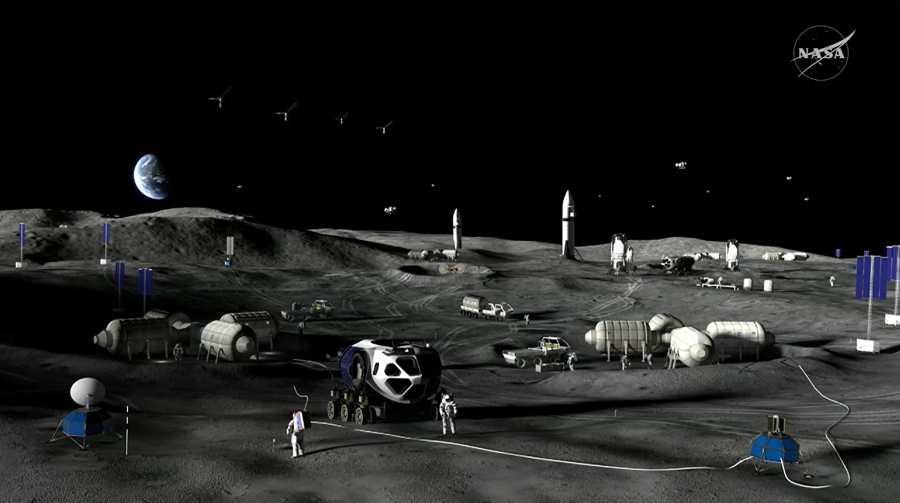
Artist’s concept of Phase 3 of NASA’s Moon Base. (Image: NASA)
A White House Office of Science and Technology Policy (OSTP) memorandum released on Tuesday guides NASA, the Department of Energy, and the Department of Defense on their roles in deploying near-term space nuclear power.
This follows a series of NASA announcements last month—driven by the executive order “Ensuring American Space Superiority,” issued by Trump in December—including an ambitious timeline for establishing a moon base, which would rely on fission surface power (FSP) to survive the long lunar night at the moon’s south pole, and plans for a nuclear electric propulsion (NEP) rocket to be launched in 2028.
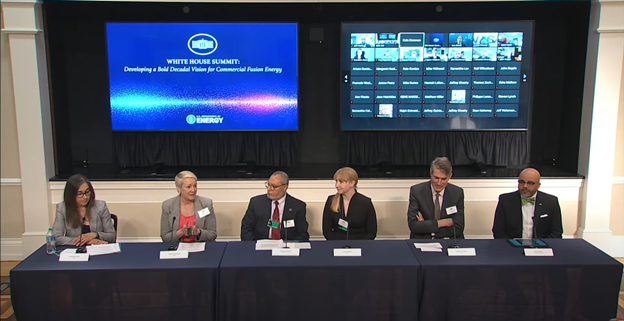
A panel on the status and benefits of fusion technology featured, from left, Kimberly Budil (moderator), of Lawrence Livermore National Laboratory; Kathy McCarthy, of Oak Ridge National Laboratory; Abdalla Darwish, of Dillard University; Anne White, of the Massachusetts Institute of Technology; Steven Cowley, of Princeton Plasma Physics Laboratory; and Mark Berry, of Southern Company.
The White House Office of Science and Technology Policy and the Department of Energy cohosted the White House Summit on Developing a Bold Decadal Vision for Commercial Fusion Energy on March 17. The livestreamed event brought together fusion leaders from government, industry, academia, and other stakeholder groups to showcase recent achievements in fusion research and discuss the administration’s strategy to support the development of commercial fusion energy. Energy Secretary Jennifer Granholm’s announcement of a new agency-wide fusion energy initiative and a funding opportunity worth $50 million for magnetic confinement fusion research made March 17 a lucky day indeed for the U.S. fusion energy community.