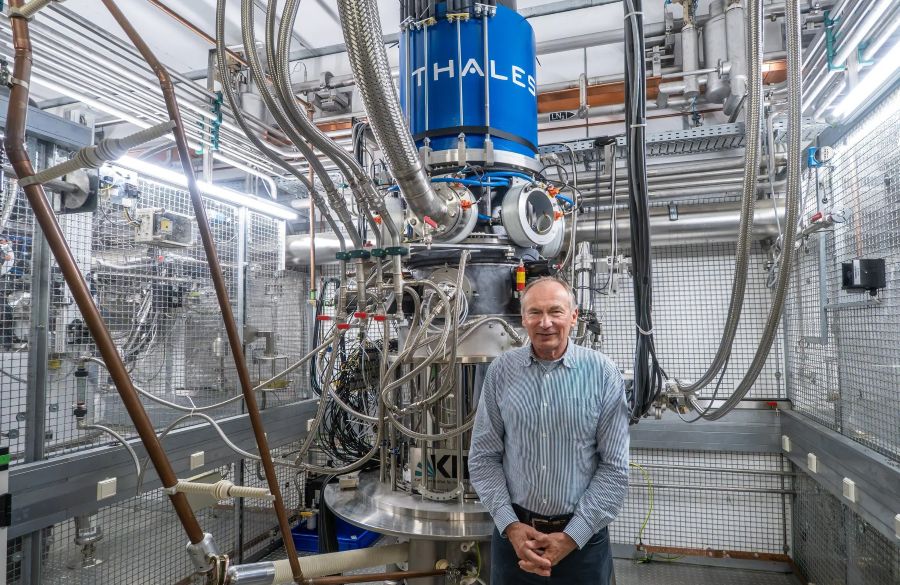
Heinrich Laqua, HiPMiB project manager, standing next to what is currently the world’s most powerful gyrotron. It can deliver a maximum of 1.3 MW. (Photo: Frank Fleschner/MPI for Plasma Physics)
The Max Planck Institute for Plasma Physics (IPP) announced yesterday that it is developing 2-MW gyrotrons to be used as the main plasma heating system of the Wendelstein 7-X (W7-X).
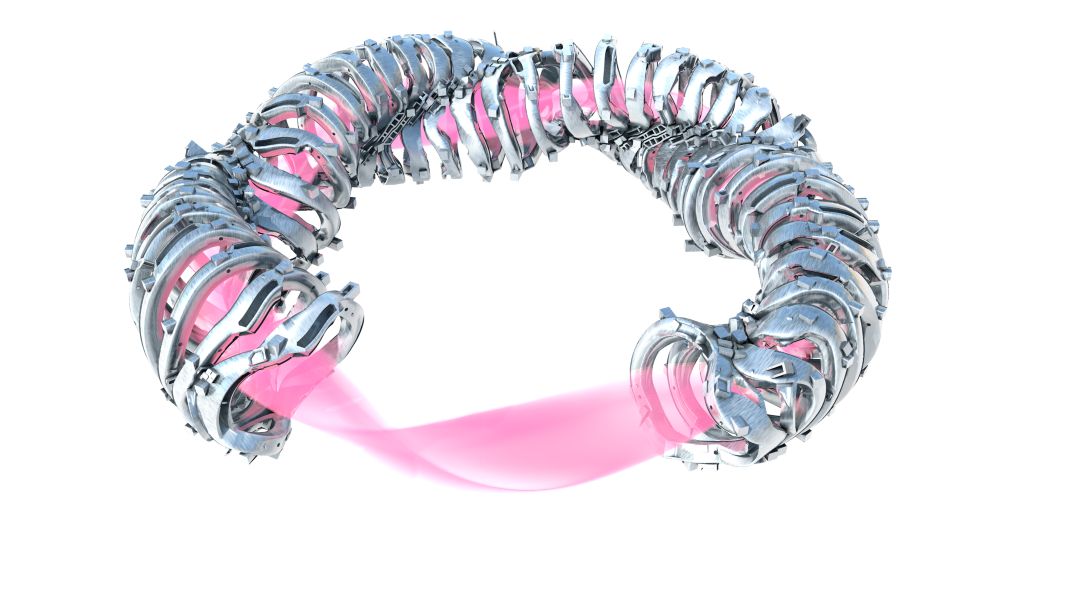
W7-X, located at IPP, is currently the largest superconducting stellarator facility in the world. The project conducts research aimed at filling key knowledge and technology gaps for developing a stellarator-based power plant.
An illustration depicting computer graphics of the plasma vessel (shown in pink) and superconducting magnet coils of the Wendelstein 7-X fusion device. (Image: IPP)
The Department of Energy announced a 10-year project agreement with the Max Planck Institute for Plasma Physics (IPP) to advance research on the Wendelstein 7-X stellarator.
“This agreement reflects our deep commitment to international partnerships that accelerate progress in fusion energy,” said Jean Paul Allain, director of the Office of Fusion at the DOE. “The collaboration between the United States and IPP on W7-X has been extraordinarily productive for more than 20 years already, and this agreement pushes us forward into the next decade and beyond.”
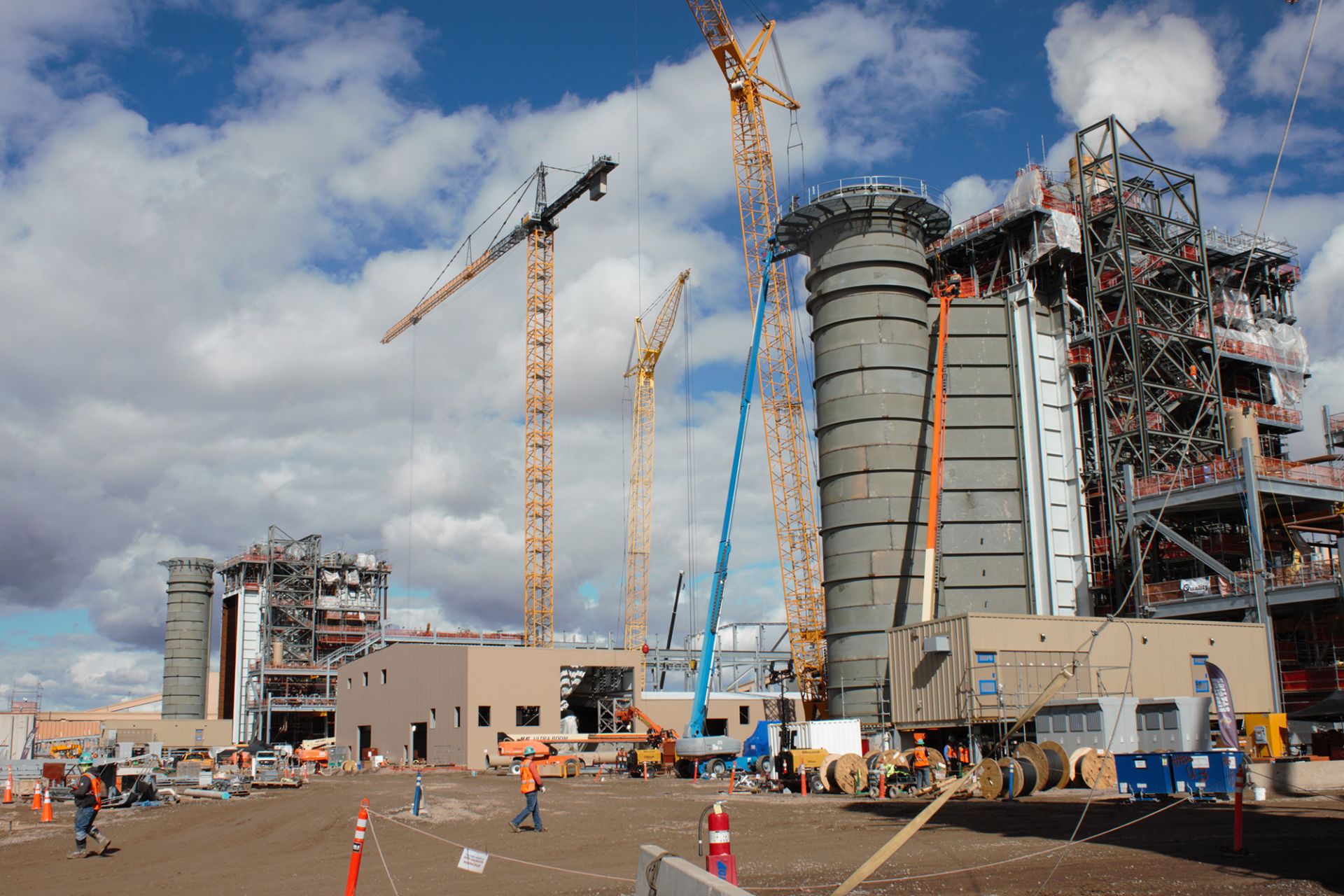
Gas-fired power units under construction at the IPP plant site in central Utah. (Photo: IPA)
Utah-based waste management company EnergySolutions announced that it has signed a memorandum of understating with the Intermountain Power Agency and the state of Utah to explore the development of advanced nuclear power generation at the Intermountain Power Project (IPP) site near Delta, Utah.
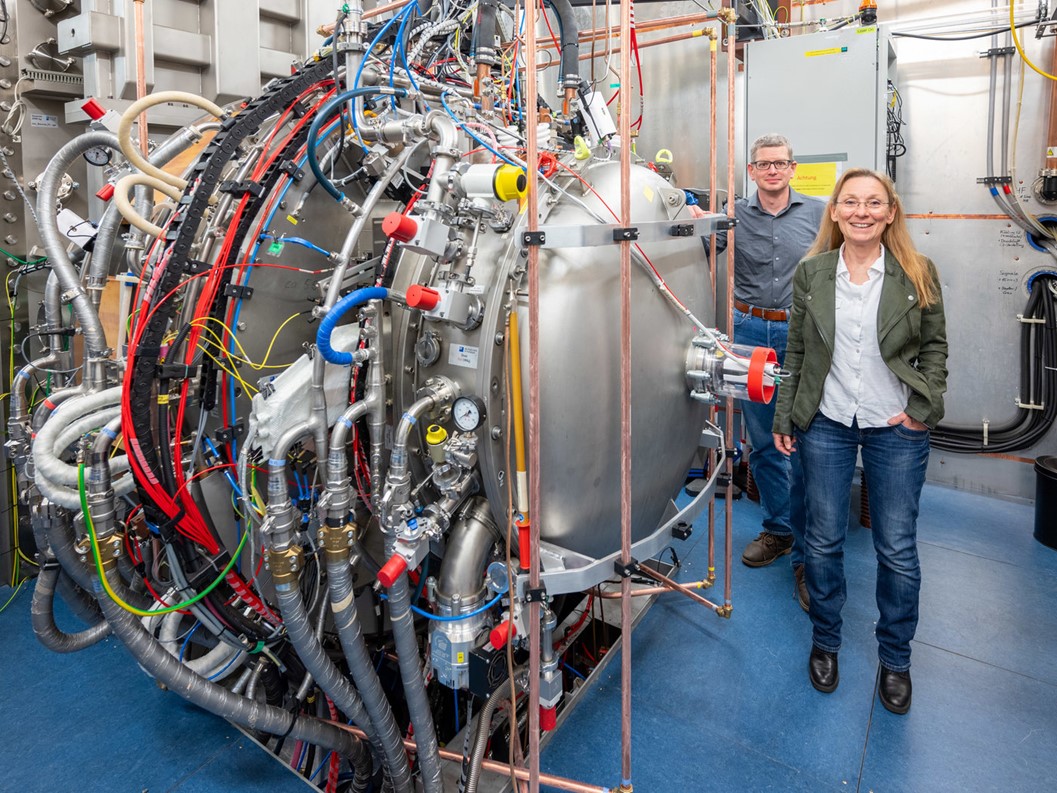
The IPP’s Dirk Wünderlich and Ursel Fantz at the experimental testing facility ELISE in Germany. (Photo: MPI for Plasma Physics/Frank Fleschner)
The Max Planck Institute for Plasma Physics (IPP) announced that it recently has achieved a new record for ion current density for neutral particle heating at its ELISE (Extraction from a Large Ion Source Experiment) experimental testing facility in Garching, Germany. ELISE is being used to test neutral beam injection (NBI) systems that will be used to heat the plasma of the ITER fusion experiment in France.