Five companies, five bases: The Army’s Janus Program takes shape
Between the Nuclear Lifecycle Innovation Campuses and Nuclear Energy Launch Pad programs, August has already been a busy month for federal partnerships with the nuclear industry.
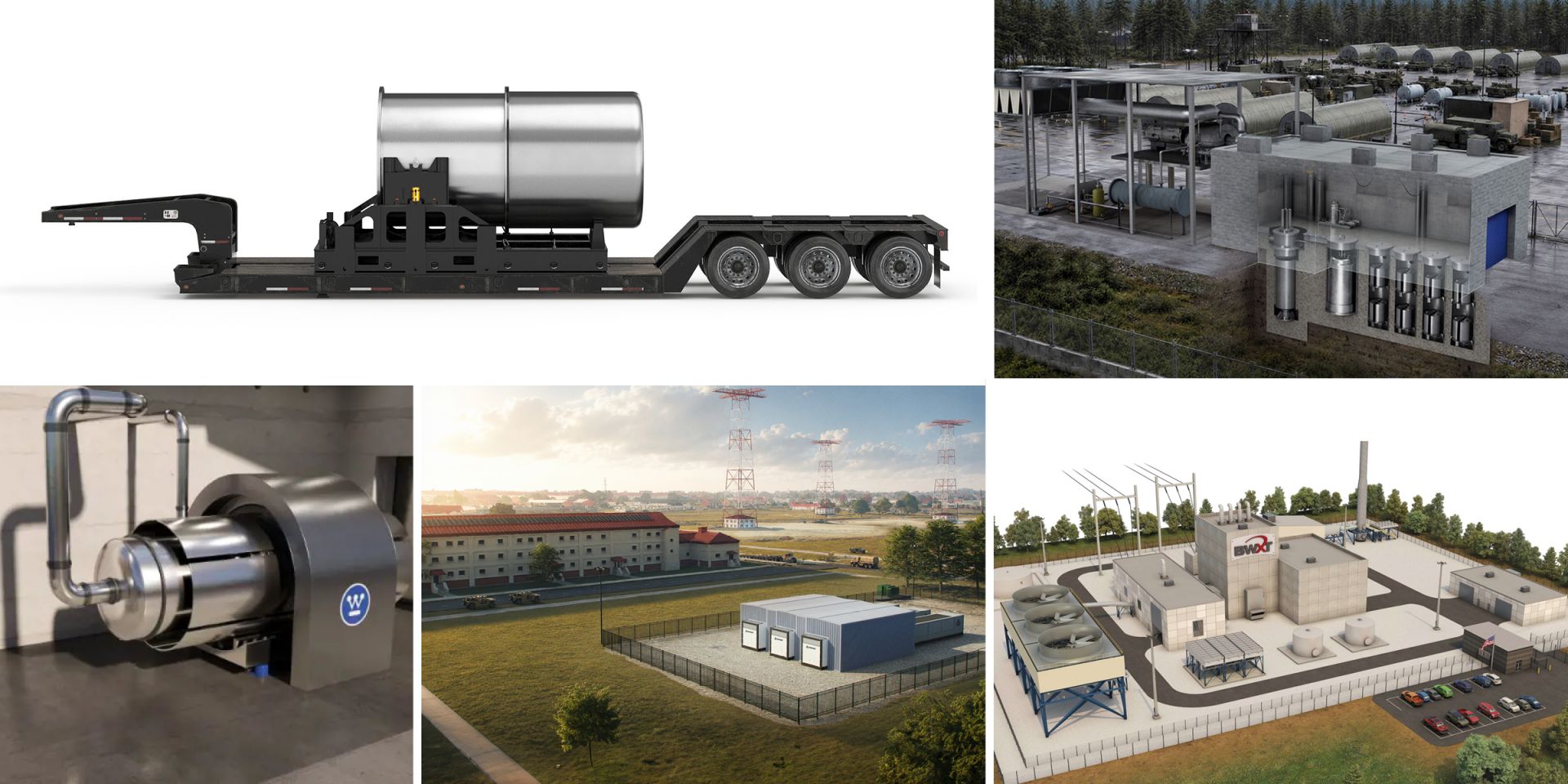
That trend continues: On Wednesday, the Department of the Army announced that it has selected five nuclear reactor developers—Antares Nuclear, BWXT Advanced Technologies, General Atomics Electromagnetic Systems, Radiant Industries, and Westinghouse Government Services—each paired with a different military installation, for its Janus Program.
This week, the nuclear community descended on Dallas, Texas, for the second annual Nuclear Energy Conference and Expo, the premier industry-focused nuclear conference cohosted by the American Nuclear Society and the Nuclear Energy Institute. Among the plenary panelists was Jeff Waksman, principal deputy assistant secretary of the Army for installations, energy, and environment. Waksman has been closely involved in the development of the Janus Program, and the morning before the program’s new selections were unveiled, he provided insights on its ultimate goals at NECX 2026.
The background
The Janus Program was first announced in October 2025 in direct response to Executive Order 14299, one of the four nuclear-related EOs signed by President Trump in May 2025. EO 14299, “Deploying Advanced Nuclear Reactor Technologies for National Security,” called for the Department of Defense to bring an Army-regulated reactor on line at a domestic military installation no later than September 30, 2028. In November 2025, the Defense Innovation Unit (DIU, a technology-focused DOD organization partnering with the Army on Janus) released a request to gauge the industry’s interest in the program.
This week, along with selecting its vendors, the Army also announced that it is “awarding up to a combined $2.2 billion” for the ownership, construction, and operation of the reactor projects. Between the support of these government dollars and expected private capital, the Army “expects more than 20 total nuclear microreactors will be built and operated” across DOD installations. For its part, the DOD will use a milestone-based payment model, wherein the involved partners will receive money only after successfully hitting specific technical goals.
The selected companies
The Army and its five partners have already unveiled significant details regarding the next chapter of the Janus Program. According to the Army, the industry awardees were selected by a panel of nuclear and technical experts drawn from the Department of Energy, national laboratories, and representatives across the services.
Antares Nuclear
North Carolina’s Fort Bragg was paired with Antares Nuclear. The Torrance, Calif.–based company is currently developing a sodium heat pipe–cooled, TRISO-fueled microreactor design. That design work is being boosted by two other major federal projects beyond the Janus Program.
On the DOE front, Antares made waves in June 2026 by becoming the first company to achieve criticality through the DOE’s Reactor Pilot Program (RPP). This achievement was especially notable considering the company—which had largely been quiet in the run-up to the milestone—crossed the finish line a full month before the target date imposed by EO 14301, “Reforming Nuclear Reactor Testing at the Department of Energy.” Antares achieved zero-power criticality at Idaho National Laboratory with its Mark-0 reactor, a forerunner to the R1, the company’s flagship design. The Mark-0 stands apart from the R1 as it is equipped with neither power conversion nor heat removal systems.
Antares has also been selected for another DOD initiative: the Advanced Nuclear Power for Installations program. ANPI is a collaboration between the Air Force, the Army, and the DIU that is aiming to bring at least one 3–10-MWe microreactor on line at a military installation by 2030. Through ANPI, Antares was selected to deploy a reactor at Joint Base San Antonio in Texas.
Along with its terrestrial ambitions, Antares hopes to bring its reactor technology to space. To that end, the company has been collaborating with the Space Force on several fronts. Jordan Bramble, Antares CEO, had this to say about the company’s multifaceted government engagement: “Between our contracts to deploy dozens of reactors under Janus for the Army, ANPI for the Air Force, and space nuclear for the Space Force, we now have a contract value on the order of $1 [billion] that is growing rapidly.”
BWXT Advanced Technologies
Kentucky’s Fort Campbell was paired with BWXT Advanced Technologies. There, the company will deploy its BWXT Advanced Nuclear Reactor (BANR), a 20-MWe high-temperature, gas-cooled, TRISO-fueled reactor. Notably, this is one of two terrestrial reactor designs BWX Technologies is pursuing with the DOD. In 2020, the company was one of three selected to design a mobile microreactor for Project Pele; in 2022 BWXT won a contract to build and deliver its design. The DOD broke ground at INL for the project in 2024, and BWXT began manufacturing a 1.5-MWe reactor core in August 2025. The Janus Program aims to directly build on the lessons learned from Project Pele.
However, Project Pele and the Janus Programs are not the only military nuclear programs with which BWXT is involved. The company is perhaps best known for its deep ties to the Navy, for which it has served as the major aircraft carrier and submarine reactor supplier since the 1950s. According to BWXT, it has delivered more than 420 reactor cores to the Naval Nuclear Propulsion Program over those decades.
Rex D. Geveden, BWXT CEO, said that the company’s “long-standing strengths in reactor engineering innovation, TRISO fuel development, and advanced nuclear manufacturing are the foundation of our BANR technology.” The company added that it is “targeting ground breaking for site construction in late 2028 with reactor operations commencing in the early 2030s.”
General Atomics Electromagnetic Systems
Texas’s Fort Hood was paired with General Atomics Electromagnetic Systems. There, the company will deploy the General Atomics Tactical Energy System (GA-TES), a 5–20-MWe HALEU-fueled, liquid metal–cooled reactor.
Of the five companies selected, GA is a relatively unique case; it is the only one that was not already involved in a major, ongoing federal-private reactor partnership program. The company explained in its announcement that GA-TES builds on the operating record of its global TRIGA reactor fleet, which comprises some 66 reactor units deployed across 24 countries. (TRIGA is short for Training, Research, Isotopes, General Atomics.) Those 66 pool-type, water-cooled and -moderated reactors range from 20 kW to 16 MW, and they are powered by a GA-developed uranium-zirconium-hydride (UZrH) fuel.
The GA-TES leverages the UZrH experience gained through the TRIGA fleet (albeit at a higher level of enrichment) but otherwise significantly departs from the TRIGA design. Christina Back, vice president of General Atomics Electromagnetic Systems Nuclear Technologies and Materials said about the reactor, “Passive safety and operational simplicity are fundamental to our Tactical Energy System design. Self-protecting UZrH fuel and pump-free natural-circulation cooling reduce reliance on active systems and operator intervention while provid[ing] flexibility to meet evolving defense energy requirements.”
Radiant Industries
Georgia’s Fort Benning was paired with Radiant Industries. The company announced that it has entered into a binding agreement totaling up to $750 million to develop and deploy 15 of its 1-MWe helium-cooled, TRISO-fueled Kaleidos microreactors through the Janus Program.
Like Antares, Radiant is involved in both ANPI and the RPP. Through ANPI, the company is planning to deploy Kaleidos at Buckley Space Force Base in Colorado. Its DOE partnership, meanwhile, is more complicated. Radiant is not one of the five DOE-authorized companies that have so far achieved criticality through the RPP or the related Nuclear Energy Launch Pad. (In order of criticality, those companies are Antares, Valar Atomics, Deployable Energy, Aalo Atomics, and Oklo.)
Instead, the company has ostensibly ignored the target criticality date set by the RPP, sticking to its previous plan to reach criticality with a full-power demonstration unit via testing at INL’s Demonstration of Microreactor Experiments (DOME) test bed. On August 20, the Kaleidos Demonstration Unit (better known as KDU) arrived at DOME. There, it will cycle through more than six months of powered testing.
Mike Starrett, chief commercial officer at Radiant, set a definitive goal for the company’s next steps: “Through Janus, Radiant will deploy 15 reactors by 2030, identical in design to the units serving our commercial customers. Operating on military installations first gives us the reliability track record to unlock commercial deployments, and the resulting, much larger commercial volume drives down costs, letting the government buy at scale for less.”
Westinghouse Government Services
New York’s Fort Drum was paired with Westinghouse Government Services. There, the company will deploy its 5-MWe heat pipe–cooled, TRISO-fueled eVinci reactor. An eVinci test reactor—a one-fifth-scale representation of the commercial design—achieved cold criticality at the National Criticality Experiments Research Center earlier this week. Like Antares and Radiant, Westinghouse previously was selected for ANPI, and the company plans to deploy its eVinci at Malmstrom Air Force Base in Montana. Both NASA and Penn State University have also expressed interest in the reactor, which makes use of a closed Brayton cycle system for power generation. After Radiant, Westinghouse is next in line at DOME for the testing of eVinci.
With two companies from the RPP, one from Project Pele, and all three from ANPI now involved in Janus, it’s clear that the DOD is aiming to roll the momentum and experience from ongoing federal projects into broader reactor deployment.
The NECX connection
At NECX 2026 earlier this week, Jeff Waksman joined a panel titled “Advanced Reactors: Setting the Path for Delivery.”
When it comes to delivering on the goals of the Janus Program, Waksman called the September 30, 2028, deadline set by President Trump aggressive but doable and characterized these newest announcements as a significant step forward.
“I'm a bit cynical about MOUs and LOIs and companies deploying thousands of reactors in some hypothetical future. We’re going to announce something we haven’t seen from a Pentagon nuclear press release before, which is a dollar sign.” For Waksman, that $2.2 billion commitment from the DOD separates this announcement from the grandiose and difficult-to-believe claims arising from industry—it lays out a meaningful resource base to fuel real plans.
When asked about the biggest difficulties the Army has seen as it works to bring new reactors on line, Waksman said, “The challenge in building a reactor [is] all the thousand little things that you don't think about, right?” He explained that “sometimes people try to optimize their reactor core and spend a million hours trying to make that perfect,” but that the real challenge is getting to a commercial product with multiple deployments.
Later in the conversation, when asked how he is measuring success for the program, Waksman explained, “Our consideration of success is that we have an actual commercial product on the back end of this that people can buy. This is why I named the program Janus. Janus is not an acronym; it stands for nothing. I hate acronyms. Janus is the Roman god of transitions, that’s why the first month of the year is January.”
What then, is the Janus Program seeking to move away from? As he put it, “We’re transitioning from one-off experiments—prototypes—to actual commercial reactors. If these are still experimental one-offs, then we have failed.”
When asked which partnership is the most critical to the DOD in seeing the Janus Program through, Waksman said that “it’s a holistic thing.” Between utilities, private industry, and the government, every piece is important. However, in particular, “the unity of the federal government right now is pretty amazing,” he said.
Broad nuclear support is coming from the White House, Congress, the Nuclear Regulatory Commission, and the DOE, providing a massive boon to the Janus Program. However, Waksman cautioned, “I've been doing this long enough in D.C. to know that it's not usually like this. So, we have to succeed now. We will never get another opportunity like this.”