INL opens molten salt testing facility
Idaho National Laboratory has announced that the National Reactor Innovation Center’s Molten Salt Thermophysical Examination Capability (MSTEC) facility will begin operations in March 2026.
Providing testing capabilities for molten salts, including fuel salts, MSTEC extends INL’s abilities to advance molten salt reactor technology and provide data needed for safe reactor deployment.
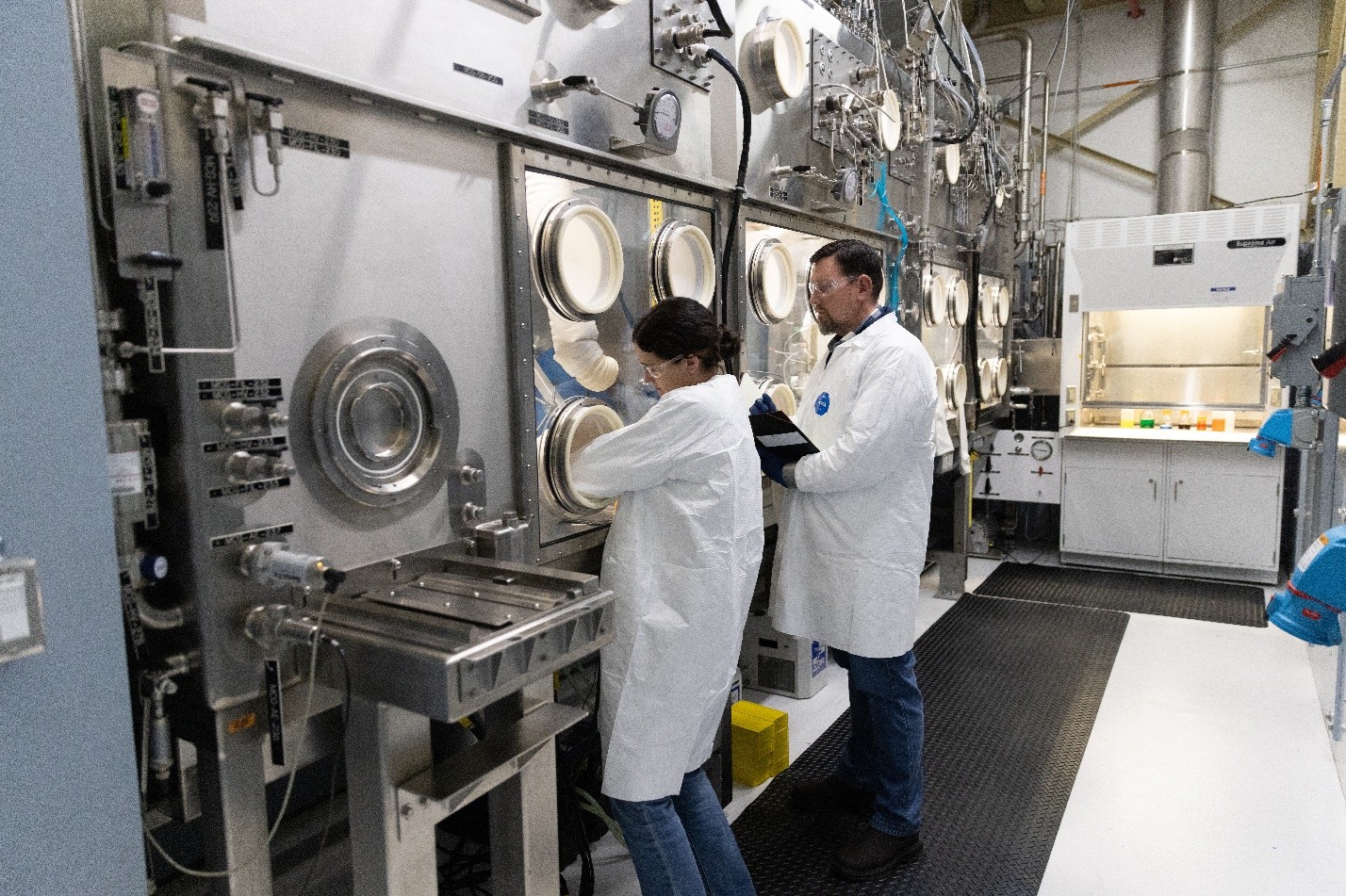
MSTEC is a shielded argon glove box furnished with remotely operated equipment for thermophysical property characterization and other sample testing, including a rheometer, gas displacement pycnometer, densitometer, universal furnace, simultaneous thermal analyzer, and differential scanning calorimeter.
“The instrumentation and space will also be utilized to support fuel cycle [research], specifically lab-scale pyrochemistry demonstrations on U/TRU [uranium/transuranic] fuels and salt. When designing MSTEC, the team tried to be forward thinking and installed extra feedthroughs such as fiber optics and USB to support testing of new and novel equipment on irradiated nuclear materials, offering more experimental flexibility than a traditional hot cell,” said Toni Karlsson, a senior molten salt researcher at INL.
Making inroads: With Oak Ridge National Laboratory leading the way with the Molten Salt Reactor Experiment
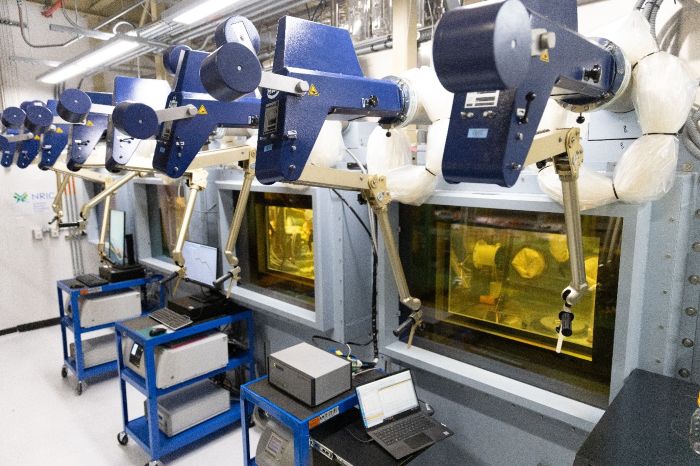
Manipulator arms for remote handling at MSTEC. (Photo: INL)
starting in 1965, INL has continued to develop its molten salt testing capabilities through the development of facilities such as the Neutron Radiography Reactor, Advanced Test Reactor, and Analytical Research Laboratories, which collectively provide capabilities for irradiating salts and providing precise isotopic and elemental analysis.
MSTEC will extend these capabilities, offering equipment for fuel cycle research and development, material accountancy and mass tracking for nuclear safeguard–related research, and the ability to synthesize novel and difficult-to-acquire salts.
According to INL, MSTEC can handle irradiated and nonirradiated chlorides; fluorides; beryllium; actinides, including plutonium and other minor actinides; gases such as hydrogen, chlorine, and fluorine; and more.
Next steps: INL says there is room and time available for research in MSTEC. According to Karlsson, the facility so far is slated to handle postirradiation examinations for fuel salt irradiation experiments at the Advanced Test Reactor starting in 2027. Other upcoming projects include fuel salt fabrication, analysis, and irradiation for Saltfoss Energy (formerly Seaborg Technologies) from Denmark; the Molten Chloride Reactor Experiment with INL and Southern Company; and characterizing fuel salt for the Korean Atomic Energy Research Institute.
“The establishment of MSTEC marks a major achievement in our quest to advance next-generation nuclear reactor technologies,” said Brad Tomer, director of NRIC. “By offering the essential experimental infrastructure and expertise to industry, MSTEC will be pivotal in addressing our national energy objectives and propelling the future of nuclear power.”