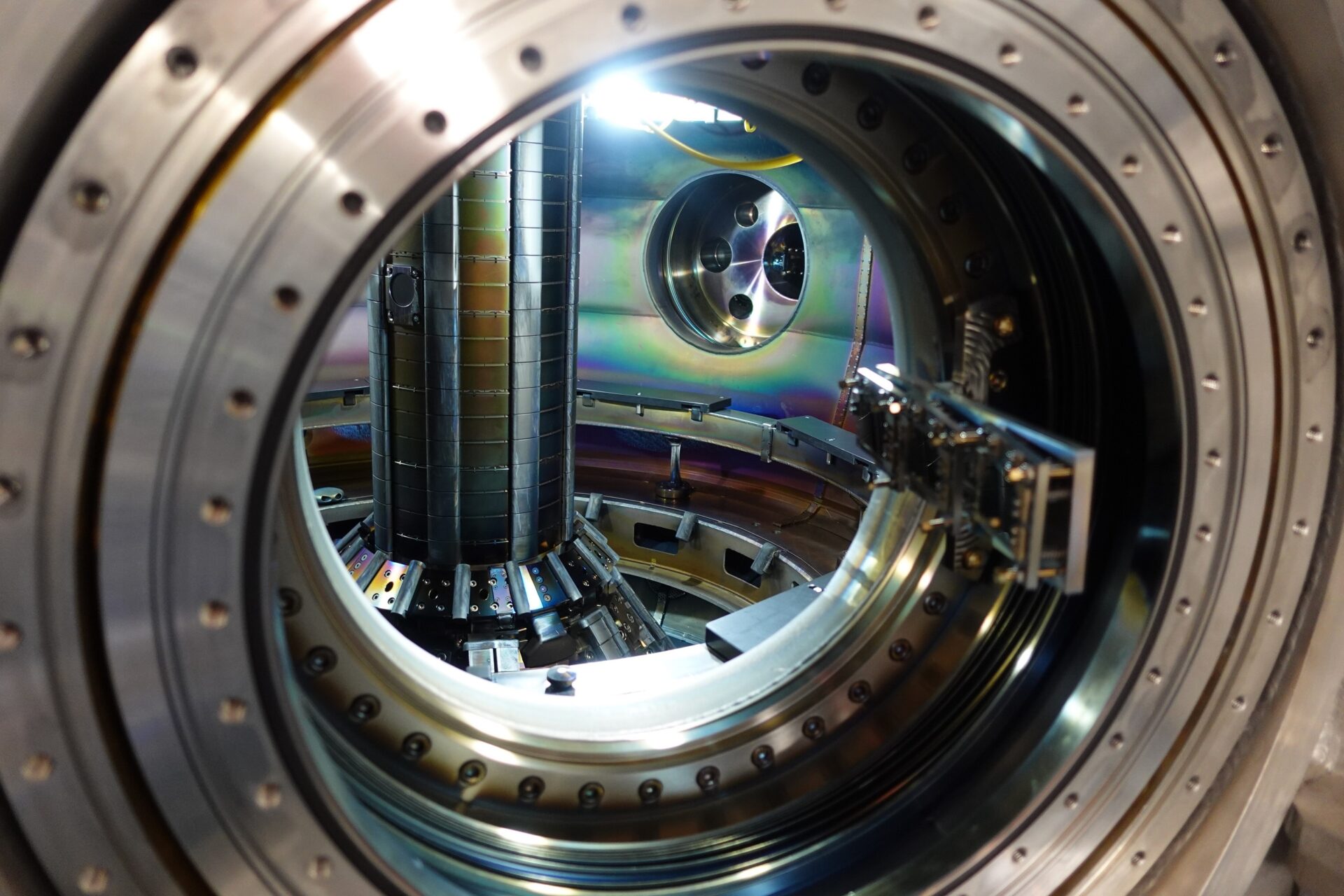
Tokamak Energy’s ST40. (Photo: Tokamak Energy)
Tokamak Energy’s ST40 experimental fusion facility will receive a $52 million upgrade under a joint public-private effort with the U.S. Department of Energy and the U.K. Department of Energy Security and Net Zero (DESNZ) aimed at advancing the fusion science and technology needed to deliver a future pilot plant.
The Realta Fusion and ARPA-E team at the WHAM facilities in 2023. (Photo: DOE/ARPA-E)
TitletownTech, a venture capital firm formed out of a partnership between Microsoft and the Green Bay Packers, has invested in Realta Fusion, a private fusion startup company that was spun out of an ARPA-E-funded fusion project at the University of Wisconsin–Madison in 2022. Realta is developing modular, compact, magnetic mirror fusion energy generators as an economic, zero-carbon solution to power AI-driven infrastructure and other industrial applications. TitletownTech did not disclose the details of its investment.
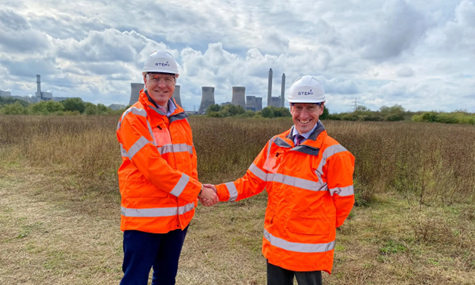
Chapman (left) and Methven at the West Burton power station. (Photo: UKIFS)
Leadership of the United Kingdom’s STEP (Spherical Tokamak for Energy Production) fusion program has transitioned to U.K. Industrial Fusion Solutions Ltd. (UKIFS), a wholly owned subsidiary of the U.K. Atomic Energy Authority (UKAEA). UKIFS was established in February 2023 to lead a public-private partnership that will design, build, and operate the STEP prototype fusion energy plant in Nottinghamshire in England’s East Midlands region.
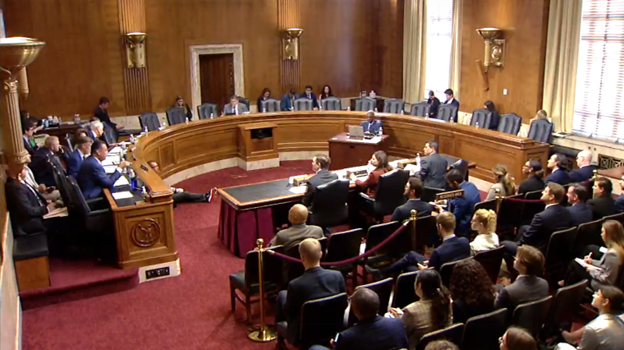
A still shot from the Senate ENR Hearing to Examine Fusion Energy Technology Development.
Hours before the Senate Committee on Environment and Natural Resources (ENR) opened a scheduled September 19 hearing on fusion energy technology development, CNN published an article titled “The US led on nuclear fusion for decades. Now China is in a position to win the race.” The article was entered into the hearing record, but senators had already gotten the message.
A screengrab from a video released by the STEP program on July 23 illustrating the future home of the prototype fusion power plant. (Image: UKAEA/STEP)
Japan’s recent moves to boost fusion power in the nation’s energy plan and accelerate the timeline for a prototype fusion power plant come in response to increased global attention on fusion energy. Even as ITER faces delays, more than 40 private fusion developers are pursuing different technologies and competing for attention. And so are other countries, including the United Kingdom, which announced its plans for a fusion pilot plant back in 2019. Fusion companies and nations alike are responding to a growing sense that there is a race—or at least collective momentum—to commercialize fusion energy.
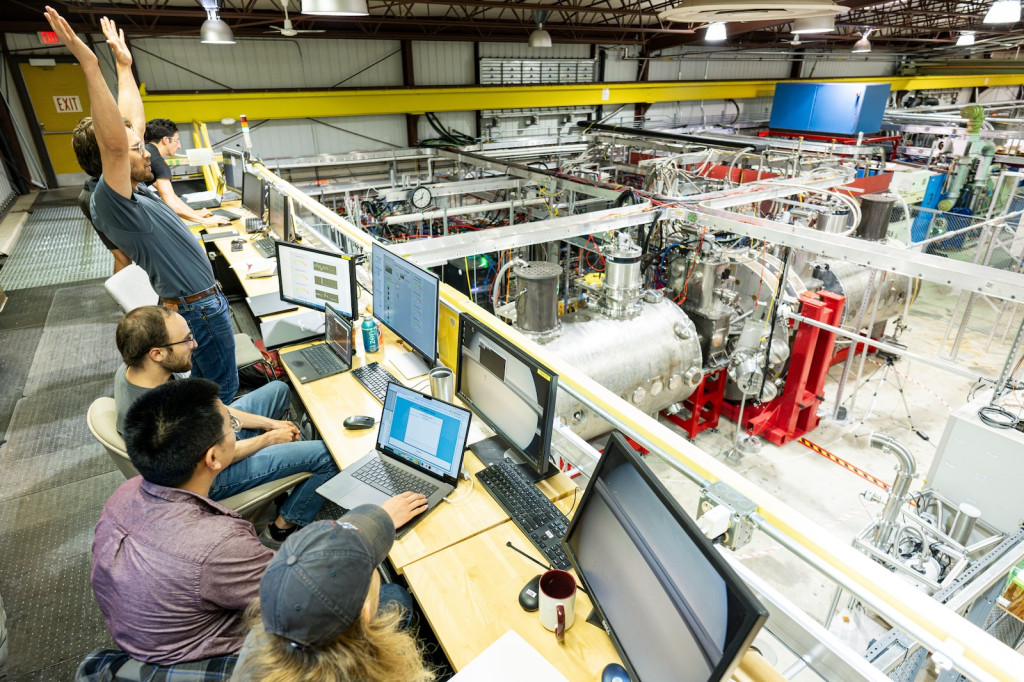
Elliot Claveau, honorary fellow in the UW–Madison Department of Physics and experimental scientist at Realta Fusion, raises his arms in celebration of achieving a plasma in WHAM at the Wisconsin Plasma Physics Laboratory. The device is seen on the floor of the lab. (Photo: Bryce Richter/UW–Madison)
The magnetic mirror fusion concept dates to the early 1950s, but decades ago it was sidelined by technical difficulties and researchers turned to tokamak fusion in their quest for confinement. Now it’s getting another look—with significantly more powerful technology—through WHAM, the Wisconsin HTS Axisymmetric Mirror, an experiment in partnership between startup Realta Fusion and the University of Wisconsin–Madison.
Xcimer Energy’s headquarters in Denver, Colo. (Photo: Xcimer Energy)
Xcimer Energy announced June 4 that it has raised $100 million in Series A financing for a new facility in Denver, Colo., that will host a prototype laser system with “the world’s largest nonlinear optical pulse compression system.” As a private fusion developer, Xcimer wants to “extend the proven science of inertial fusion to industrial scale” with the help of that laser system and “key technologies and innovations from multiple fields.”
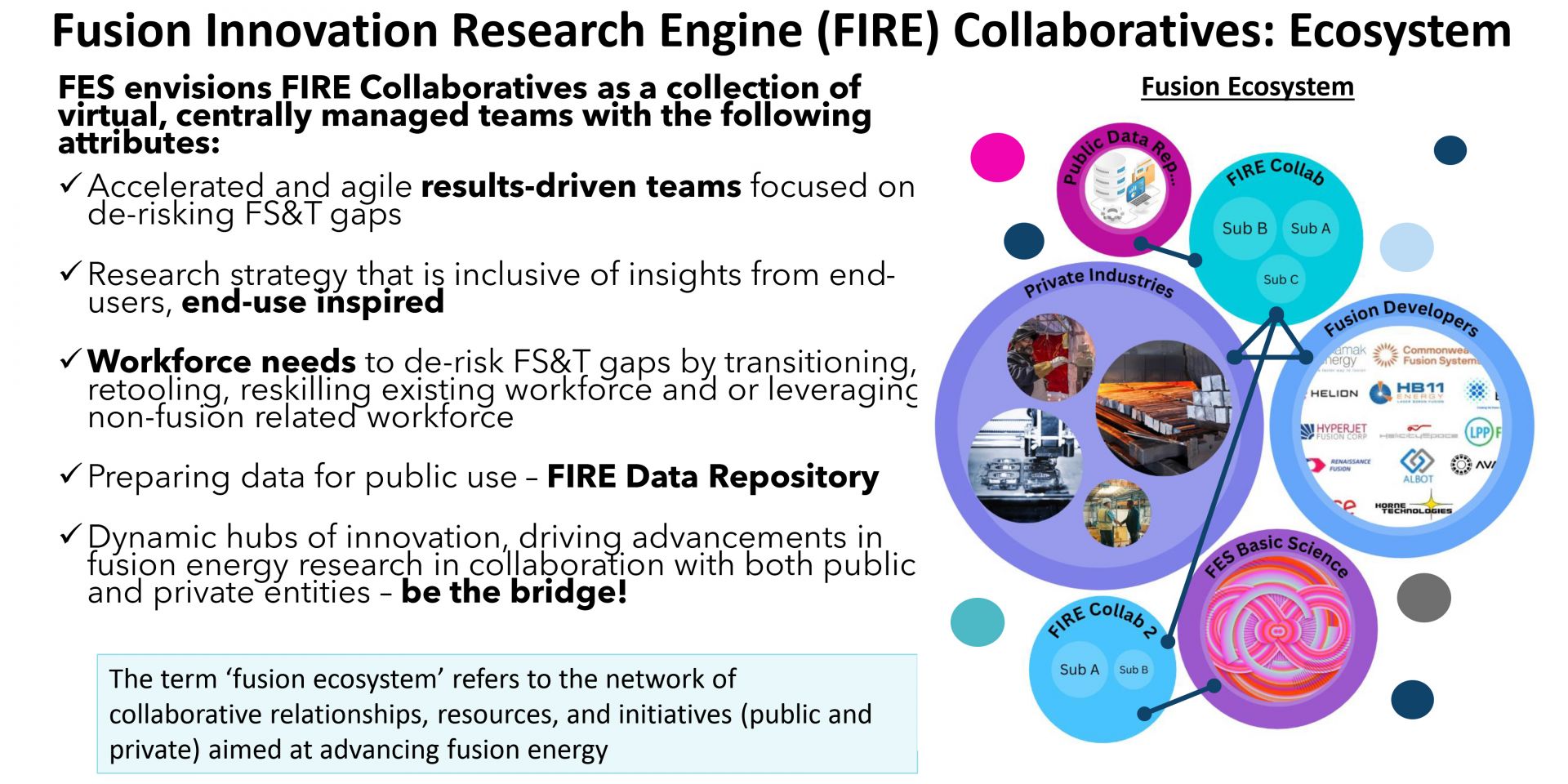
A slide on the FIRE collaboratives presented during a recent FES webinar. (Graphic: FES)
The Department of Energy’s Office of Fusion Energy Sciences (FES) wants Fusion Innovation Research Engine (FIRE) collaboratives to be a bridge between FES’s basic science research programs and the growing fusion industry. A funding opportunity announcement released May 22 explains that FIRE will be a “transformative initiative aimed at creating a fusion innovation ecosystem” with virtual, centrally managed collaboratives working on “end-use inspired” fusion science and technology R&D.
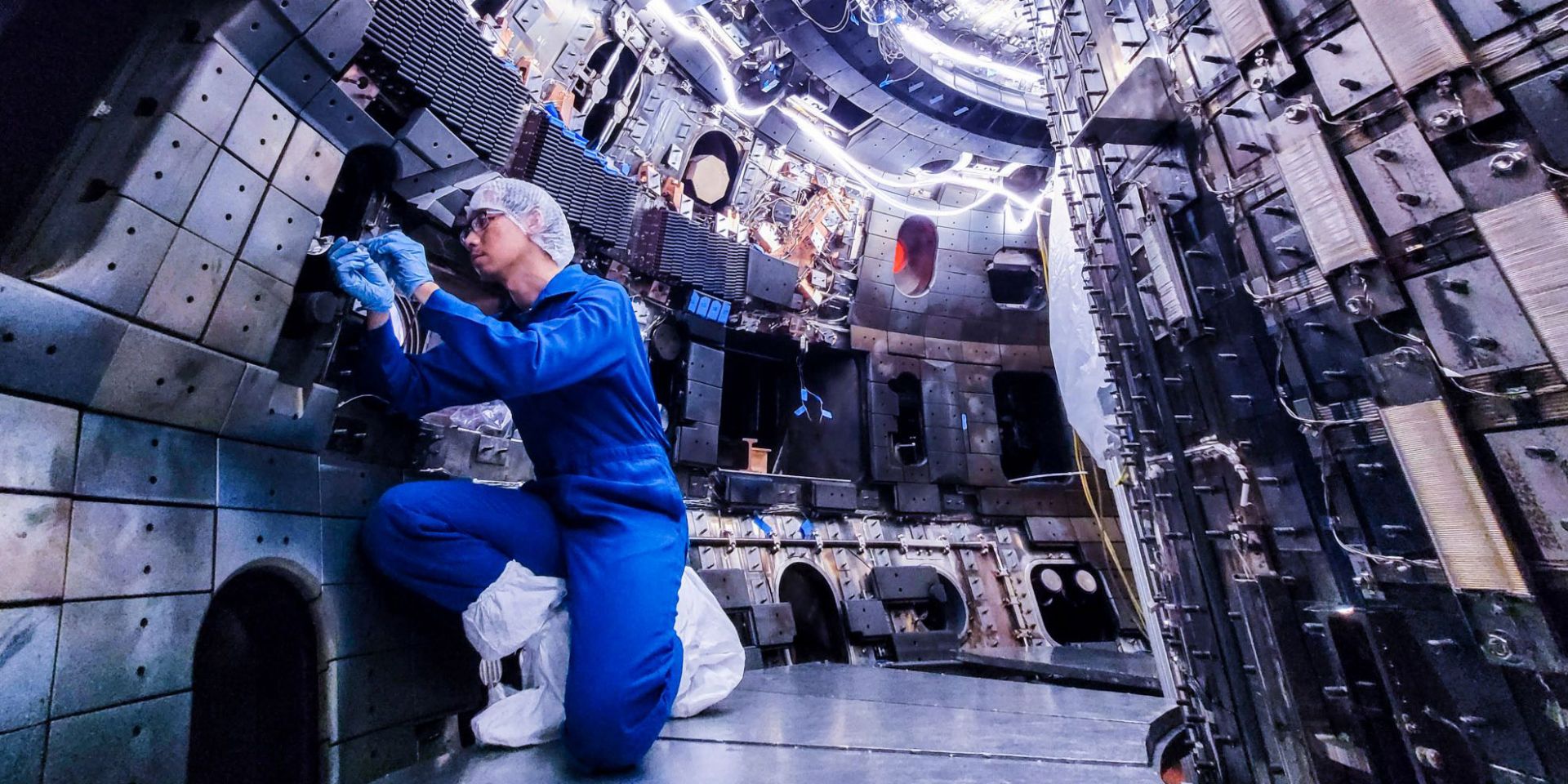
An engineer adjusts mirrors while installing new diagnostic equipment inside the DIII-D tokamak. (Photo: General Atomics)
The DIII-D National Fusion Facility is starting up after an eight-month experimental hiatus, equipped with new and improved plasma control and diagnostic systems. The upgrades will help researchers from around the nation and the world resolve key physics questions to bridge the gap between current magnetic confinement fusion research and the first fusion power pilot plants. General Atomics, which operates DIII-D for the Department of Energy, announced the completion of upgrades on May 8.
Illustration by Ana Kova for U.S. Fusion Outreach
Fusion is riding a surge of attention that began in December 2022 when researchers at Lawrence Livermore National Laboratory’s National Ignition Facility achieved fusion ignition. The organizers of Fusion Energy Week—a group called the U.S. Fusion Outreach Team—on the other hand, trace fusion development back 100 years to the doctoral research of Cecilia Payne-Gaposchkin, who discovered that stars, including our Sun, are mostly made of hydrogen and helium, which in turn led to the understanding that those elements are the “fuel” of potential fusion energy systems on Earth. In recognition of Payne-Gaposchkin’s birthday—May 10—the U.S. Fusion Outreach Team plans to hold a “grassroots celebration of fusion energy” May 6–10, 2024, and annually during the second week of May.
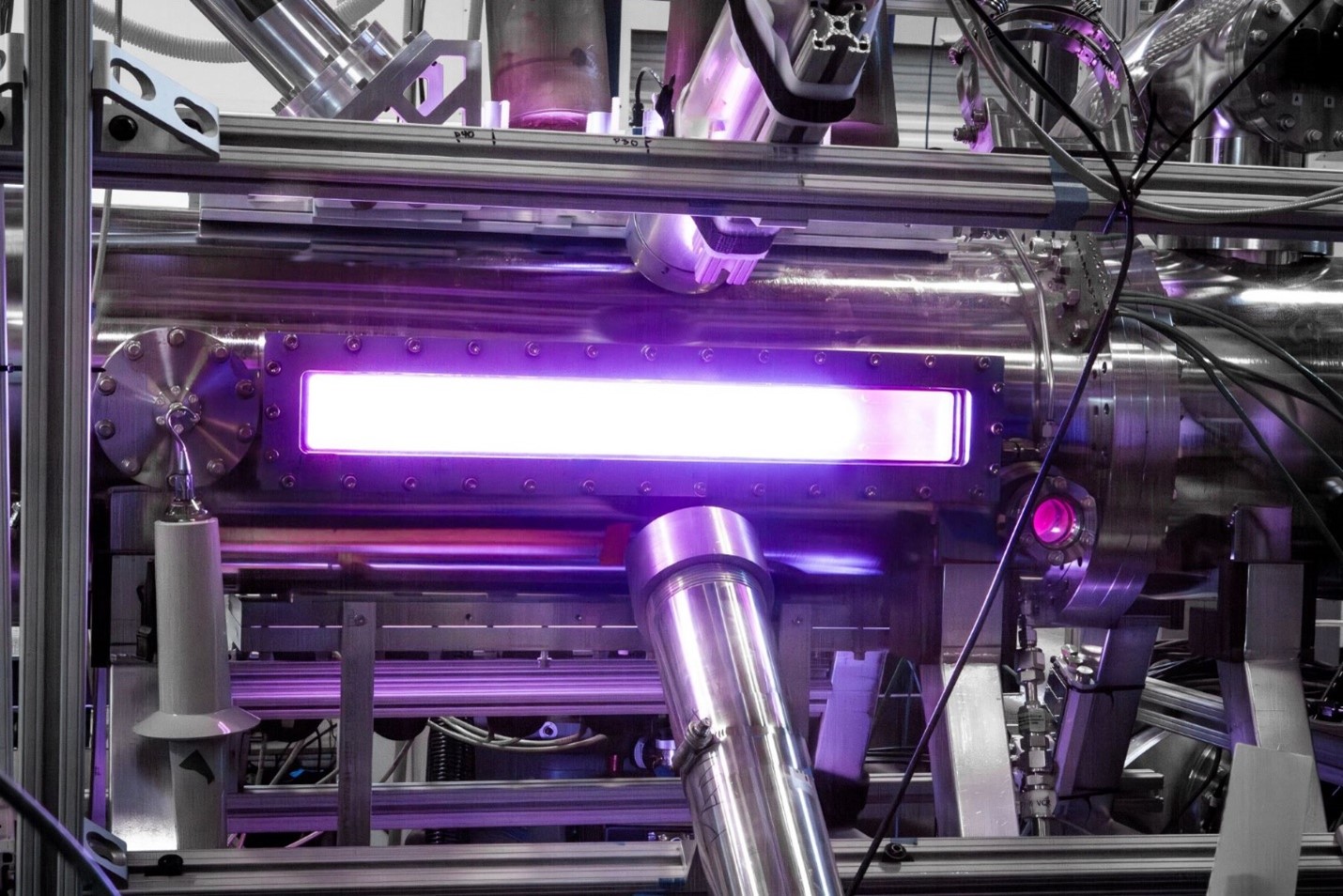
A bright flash of light from a FuZE (Fusion Z-pinch Experiment) plasma. (Photo: Zap Energy)
Zap Energy announced April 23 that it has reached 1-3 keV plasma electron temperatures—roughly the equivalent of 11 to 37 million degrees Celsius—using its sheared-flow-stabilized Z-pinch approach to fusion. Reaching temperatures above that of the sun’s core (which is 10 million degrees Celsius temperature) is just one hurdle required before any fusion confinement concept can realistically pursue net gain and fusion energy.
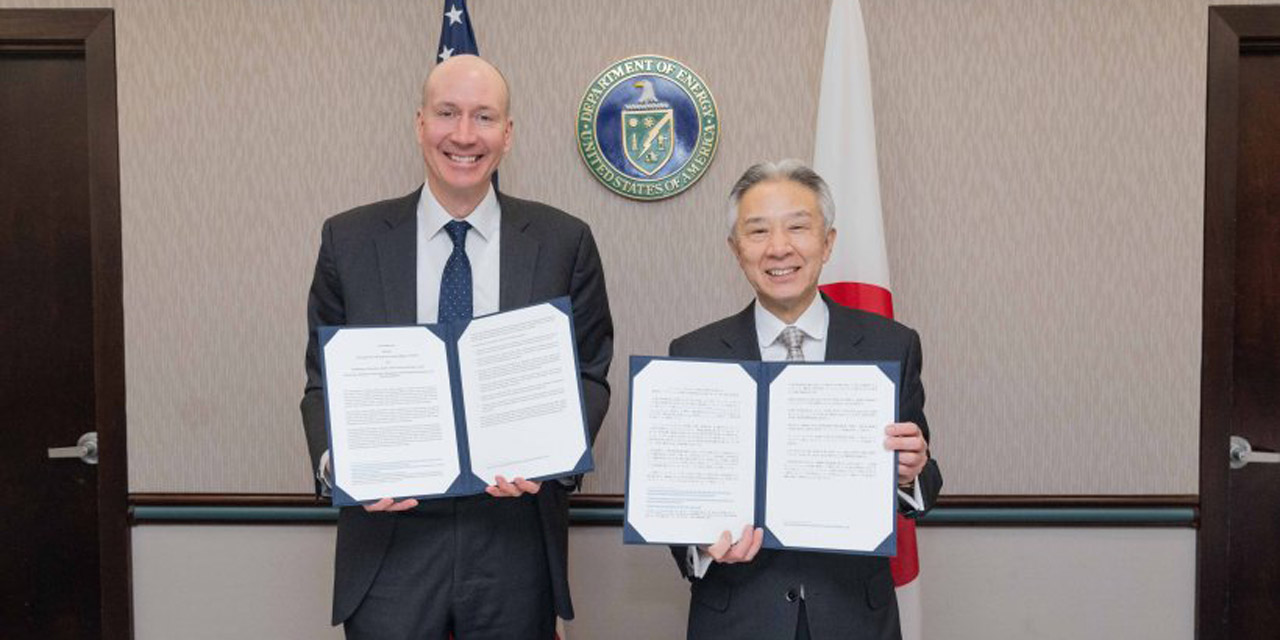
U.S. deputy secretary of energy David M. Turk (left) and Japan’s minister of education, sports, science, and technology Masahito Moriyama, in Washington, D.C. (Photo: DOE)
During a state visit to the White House by Japanese prime minister Fumio Kishida on April 10, the Department of Energy announced that U.S. and Japanese agencies had cooperated to remove all high-enriched uranium (HEU) from the Japan Materials Testing Reactor Critical Assembly (JMTRC) of the Japan Atomic Energy Agency (JAEA) two years ahead of schedule.

-3 2x1.jpg)



 Following new federal funding and programs announced