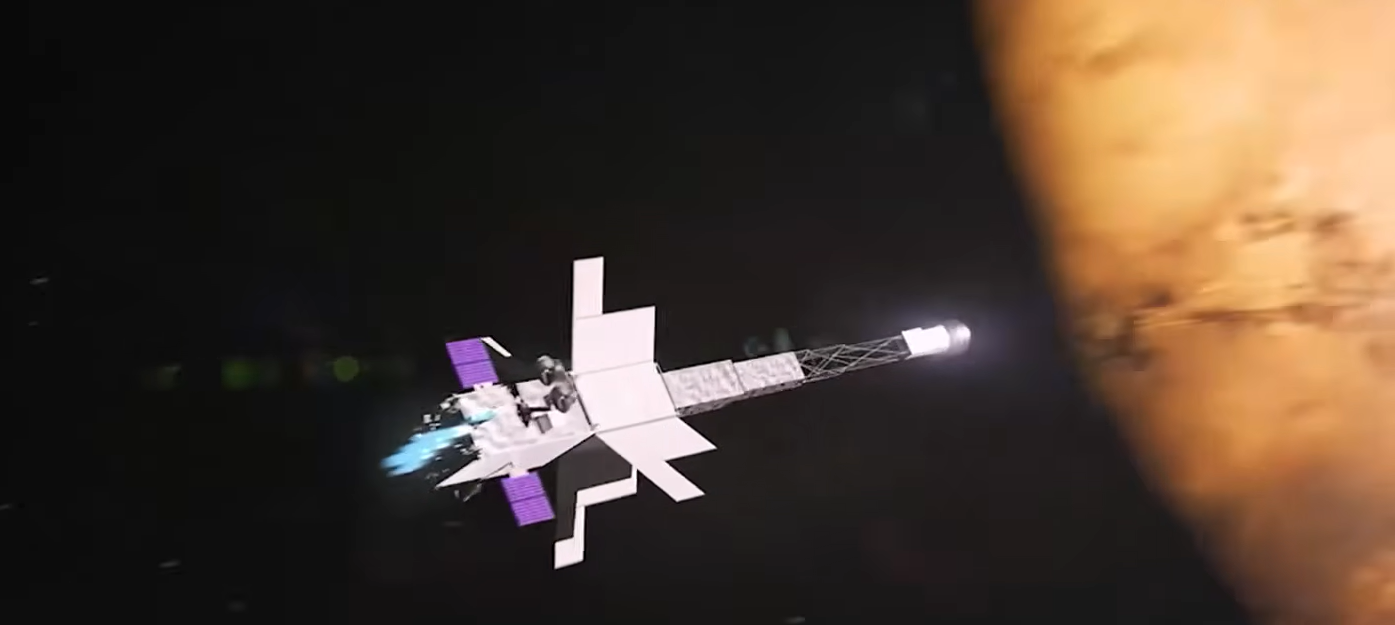
A still from a NASA video illustrating Space Reactor-1 Freedom. (Image: NASA)
Yesterday NASA announced a series of initiatives, including plans to launch a nuclear electric propulsion spacecraft to Mars in December 2028 and a three-phase plan to establish a lunar base incorporating nuclear-driven heat and power.
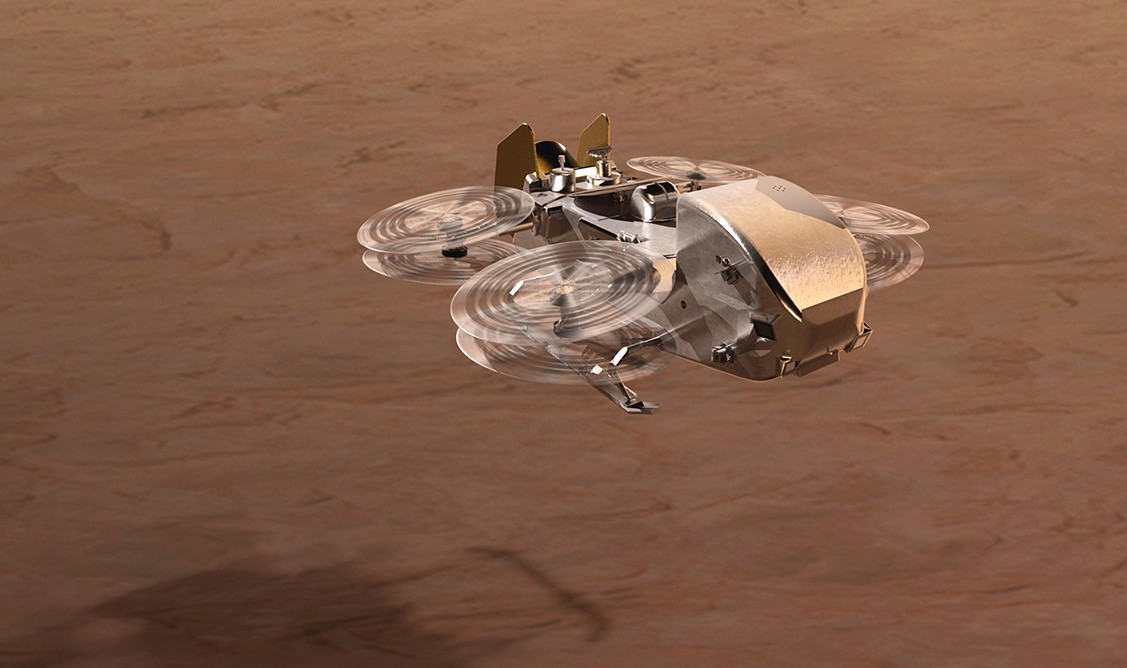
Artist’s impression of NASA’s Dragonfly approaching a landing site on Saturn’s moon Titan. Essentially a flying chemistry lab, along with cameras and other science instrumentation, Dragonfly will travel between dozens of landing sites on Titan’s surface to investigate the chemical origins of life. (Image: NASA/Johns Hopkins APL/Steve Gribben)
Curiosity landed on Mars sporting a radioisotope thermoelectric generator (RTG) in 2012, and a second NASA rover, Perseverance, landed in 2021. Both are still rolling across the red planet in the name of science. Another exploratory craft with a similar plutonium-238–fueled RTG but a very different mission—to fly between multiple test sites on Titan, Saturn’s largest moon—recently got one step closer to deployment.
On April 25, NASA and the Johns Hopkins University Applied Physics Laboratory (APL) announced that the Dragonfly mission to Saturn’s icy moon passed its critical design review. “Passing this mission milestone means that Dragonfly’s mission design, fabrication, integration, and test plans are all approved, and the mission can now turn its attention to the construction of the spacecraft itself,” according to NASA.