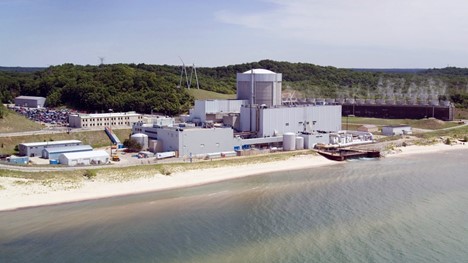
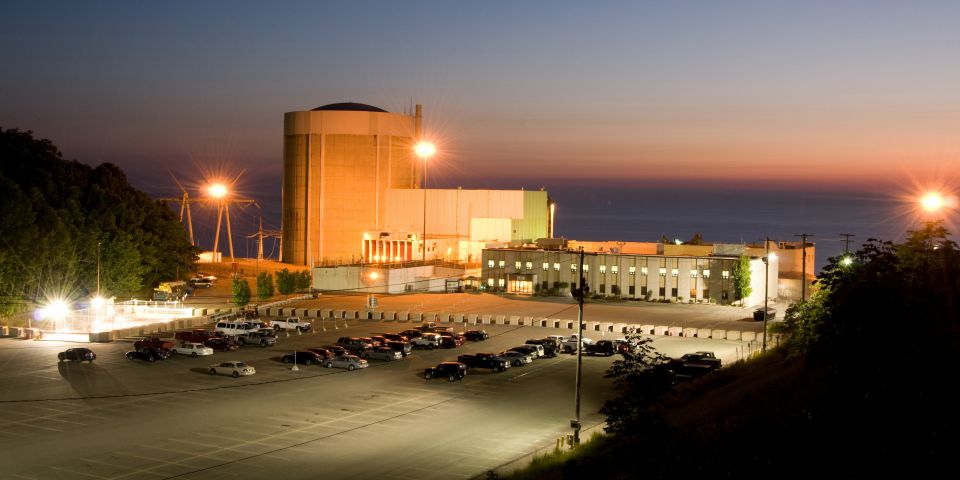
Oyster Creek update: A 625-MWe boiling water reactor, Oyster Creek operated from December 1969 to September 2018. In 2019, the NRC approved the transfer of the plant’s license from Exelon to Holtec International. Since then, Holtec has been working on the decommissioning and dismantlement of the site.
Before a commercial reactor can terminate its license, the NRC requires the submittal of an LTP. This document, which must be submitted at least two years before the proposed license termination date, contains a thorough accounting of the license holder’s plans for site characterization and remediation, remaining dismantlement activities, an estimate of forthcoming decommissioning costs, and much more. Holtec submitted its 469-page LTP in August 2024.
At the end of July, about two years after Holtec’s initial submittal, the NRC approved the company’s LTP. According to Holtec, decommissioning and dismantlement of the site is currently more than halfway complete. In its LTP, Holtec stated it plans to have all work completed at the site by 2029, though that date is not explicitly reiterated in the company’s latest announcement about its progress.
Oyster Creek site vice president Jeff Dostal said that the approved LTP “provides the road map for the final phase of decommissioning and site restoration. We will continue to execute the remaining work with the same discipline, professionalism, and focus on safety that have guided the project to date.”
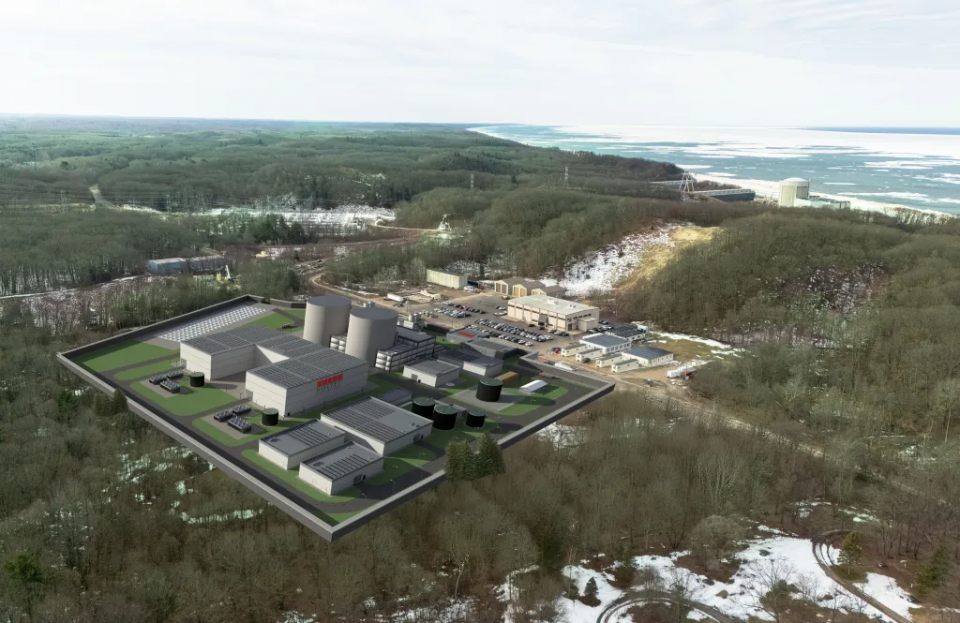
Potential project: Holtec also said that it is still planning to deploy four of its SMR-300 units at the Oyster Creek site, crediting recent legislative momentum in New Jersey as a significant tailwind for the project. (In recent months, new laws in the state have kicked off a nuclear energy procurement program and eliminated a longstanding de facto nuclear moratorium.)
The public has been aware of Holtec’s plans for new nuclear capacity at Oyster Creek since 2021, when reports first emerged that the company was considering deploying its SMR-160 at the site. Since then, Holtec has upsized plans at Oyster Creek and across its whole planned fleet to the SMR-300. Both designs are pressurized water reactors, though the 340-MWe SMR-300 is scaled up from the original 160-MWe SMR-160 design and uses pumped (rather than passive) circulation. The company has yet to publicly announce any timeline or tentative dates for the project.
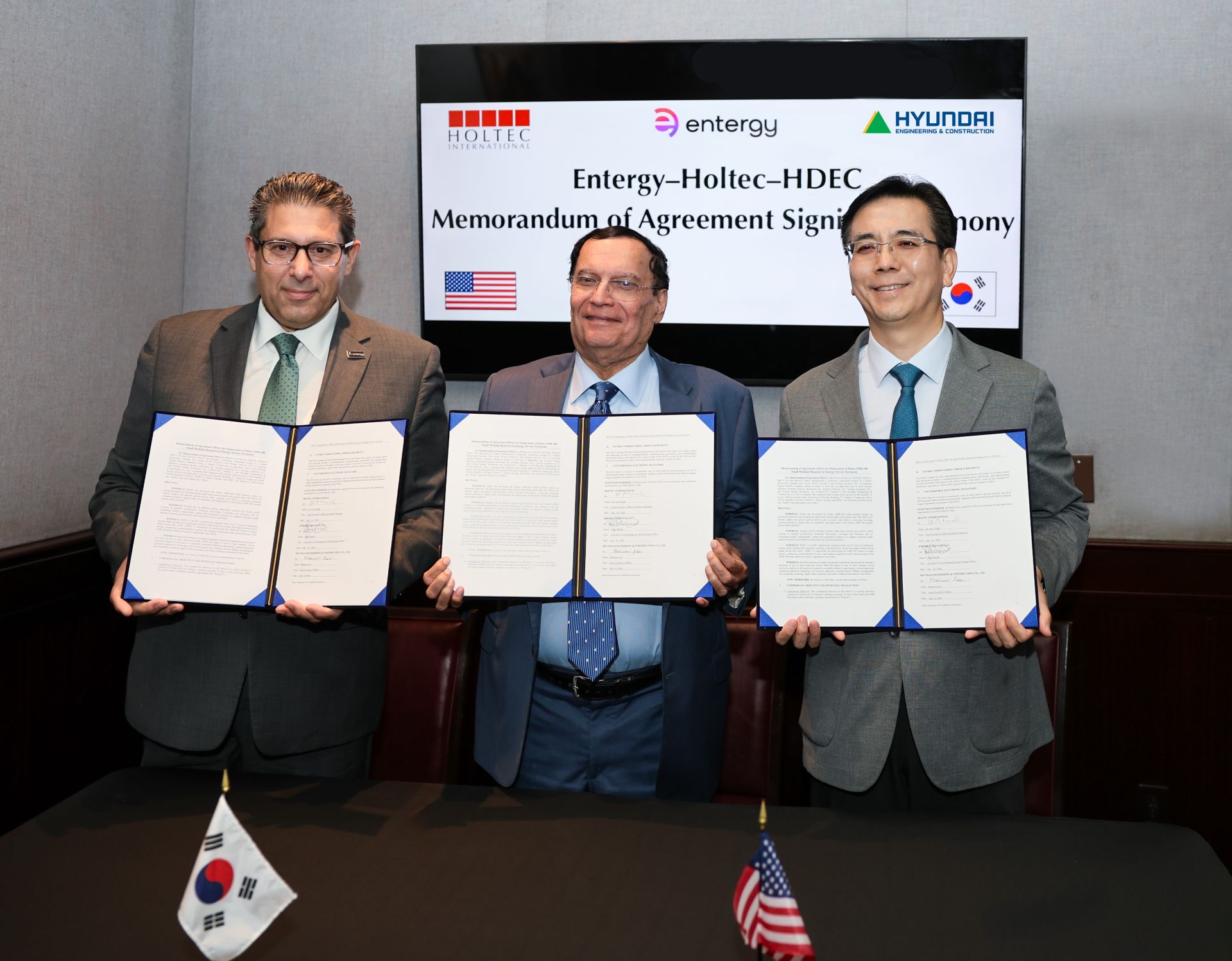
Entergy and Hyundai: On August 4, Holtec announced that it has signed a memorandum of agreement with utility Entergy and engineering and construction firm Hyundai Engineering and Construction. That nonbinding MOA establishes a framework in which the companies will jointly evaluate possible sites, demand, and commercial structures for potential dual-unit SMR-300 projects in Entergy’s service region, which includes much of Arkansas, Mississippi, and Louisiana, along with a smaller (but still sizeable) swathe of Texas.
If any projects are ultimately pursued, Holtec would lead on reactor technology, nuclear systems, manufacturing, and nuclear procurement, while Hyundai would lead on balance-of-plant engineering, procurement, and construction. This MOA represents an extension of the companies’ preexisting partnership to deploy two SMR-300s at the Palisades site and a broader 10 GW fleet.
This is also not the first time Holtec has partnered with Entergy. In 2022, the two companies entered into an MOA to evaluate deploying its now-replaced SMR-160 at existing Entergy power reactor sites like Arkansas Nuclear One, Grand Gulf, River Bend, or Waterford. This newest announcement made no reference to that now four-year-old MOA.