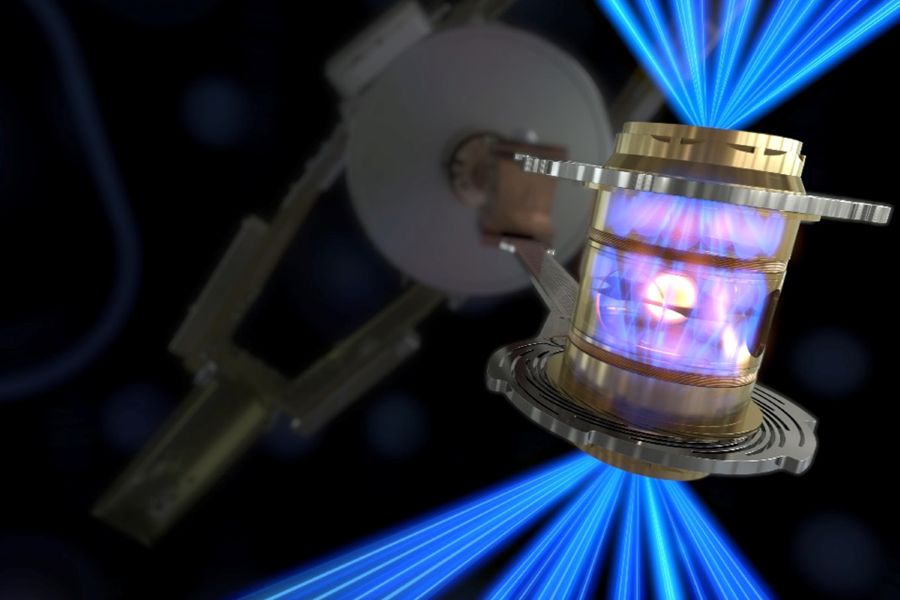
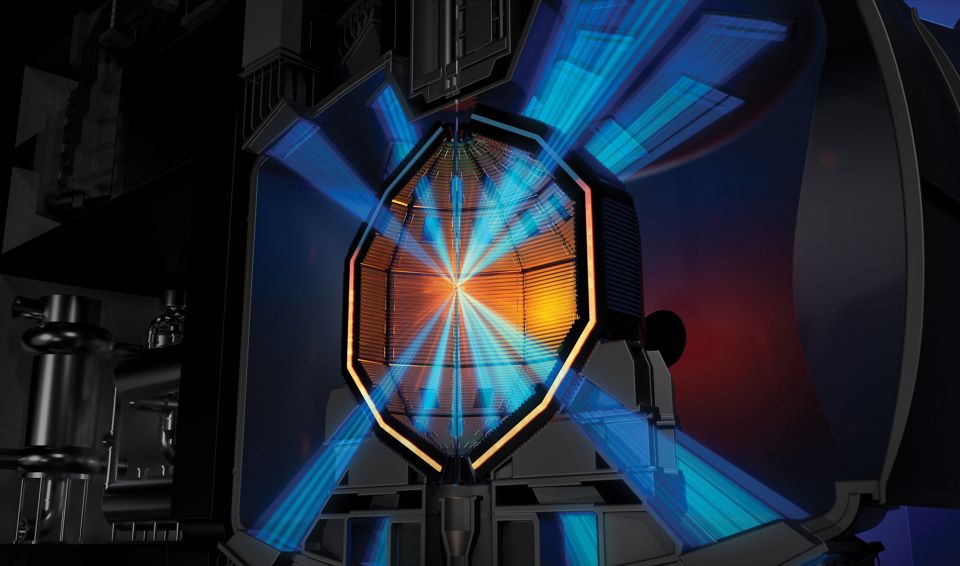
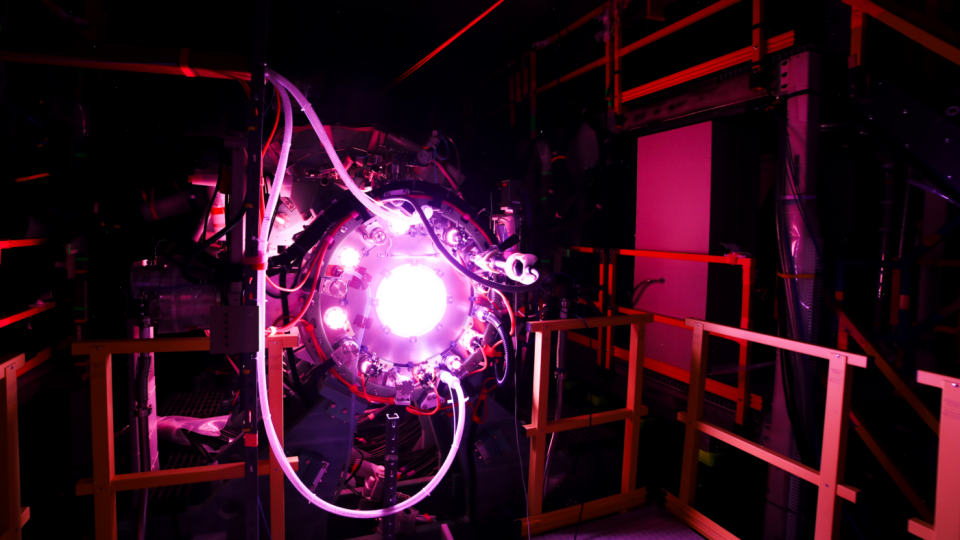
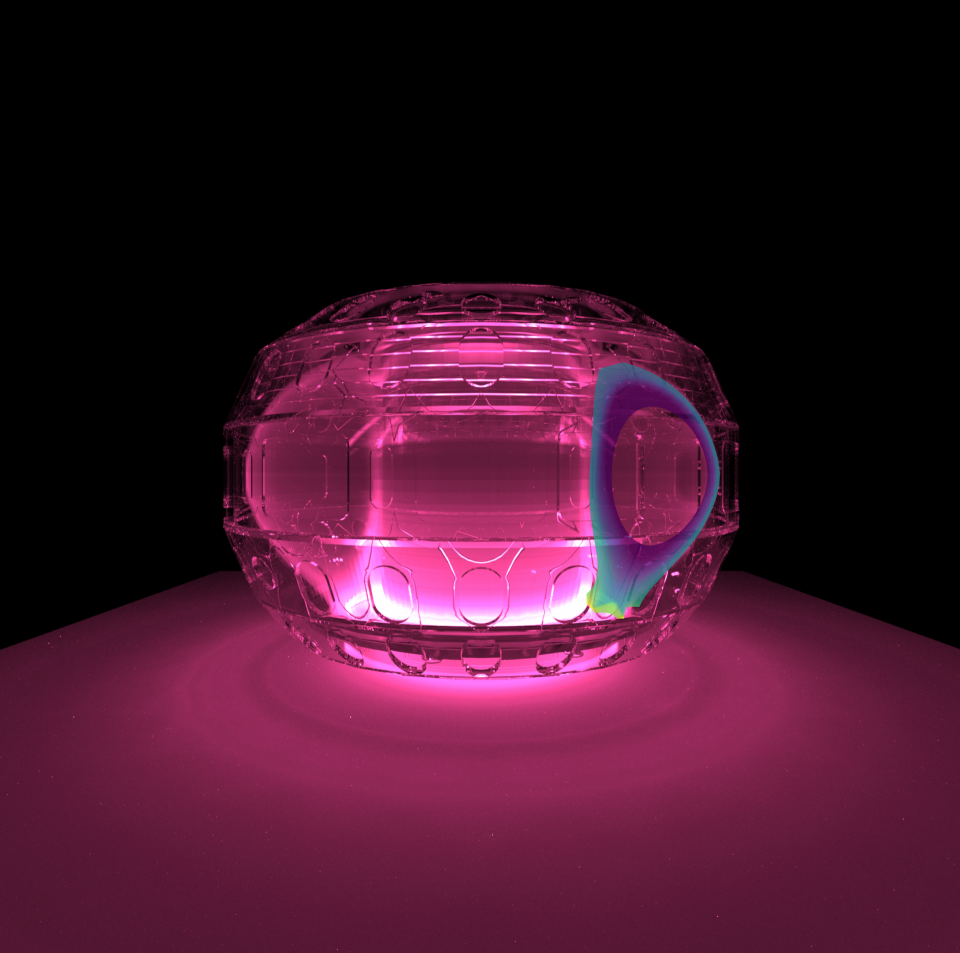
NIF achieves inertial confinement fusion (ICF) by focusing 192 lasers into two 3-millimeter holes on the top and bottom of a tiny canister called a hohlraum, which contains a fuel capsule that creates a plasma in the implosion. Inevitably, during this process, some of the laser energy is scattered away from the direction of the beam, sometimes hitting the machine’s optics.
“The consequences for the shot operations can be quite severe, depending on how many optics get damaged during a shot and how many spare optics are available at that time,” said Pierre Michel, an LLNL physicist.
Michel is the lead author on a new study published in Physics of Plasma, which found that changing the laser’s polarization may reduce the amount of backscatter.
The study explored crossed-beam energy transfer (CBET), an effect where the beams intersect inside the plasma and exchange energy. According to the paper, the study found that the initial laser polarization leads to “significant beam-to-beam variations in CBET,” and the beams that end up amplified can trigger backscatter instabilities.
These new calculations found that linear polarization gives a minimum and maximum CBET rate, increasing variation, whereas circular polarization gives an intermediate transfer rate.
While this would be expected to reduce backscatter, understanding the size of the effect is not straightforward.
“We don’t have a good predictive capability for backscatter; despite decades of work, laser-plasma interactions remains one of the most complicated areas of ICF,” said Michel.
Backscatter changes nonlinearly with laser intensity. At low intensities, the level of backscatter is very sensitive to changes in intensity, whereas at high intensity backscatter can become saturated, making it less sensitive to laser intensity.
Optics damage due to backscatter is also nonlinear.
“To first order, there’s a damage threshold fluence (backscatter energy per area on the optics) below which nothing happens, and above which the optics is severely damaged and requires immediate replacement,” said Michel.
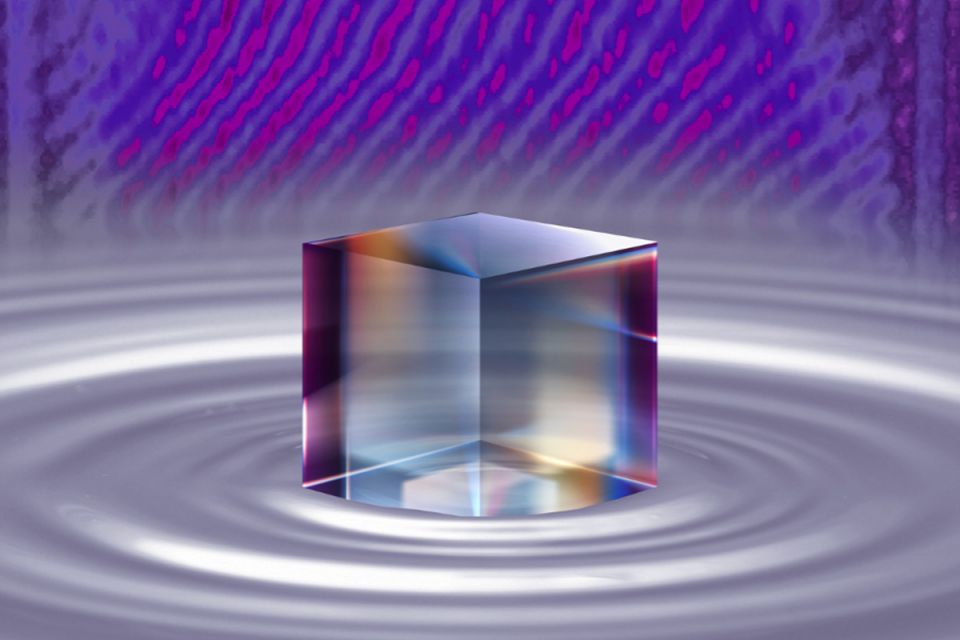
Beyond this, there is work that would need to be done to make circularly polarized lasers at NIF a reality. A “specialized waveplate element” would be required to create the circular polarization.
“As of today, there is no known straightforward path to manufacture such a device (a quarter waveplate) at the aperture size and requirements needed for NIF. We’re currently investigating potential fabrication methods including through our patented metasurface technology,” said Jean-Michel Di Nicola, chief laser systems engineer at NIF.