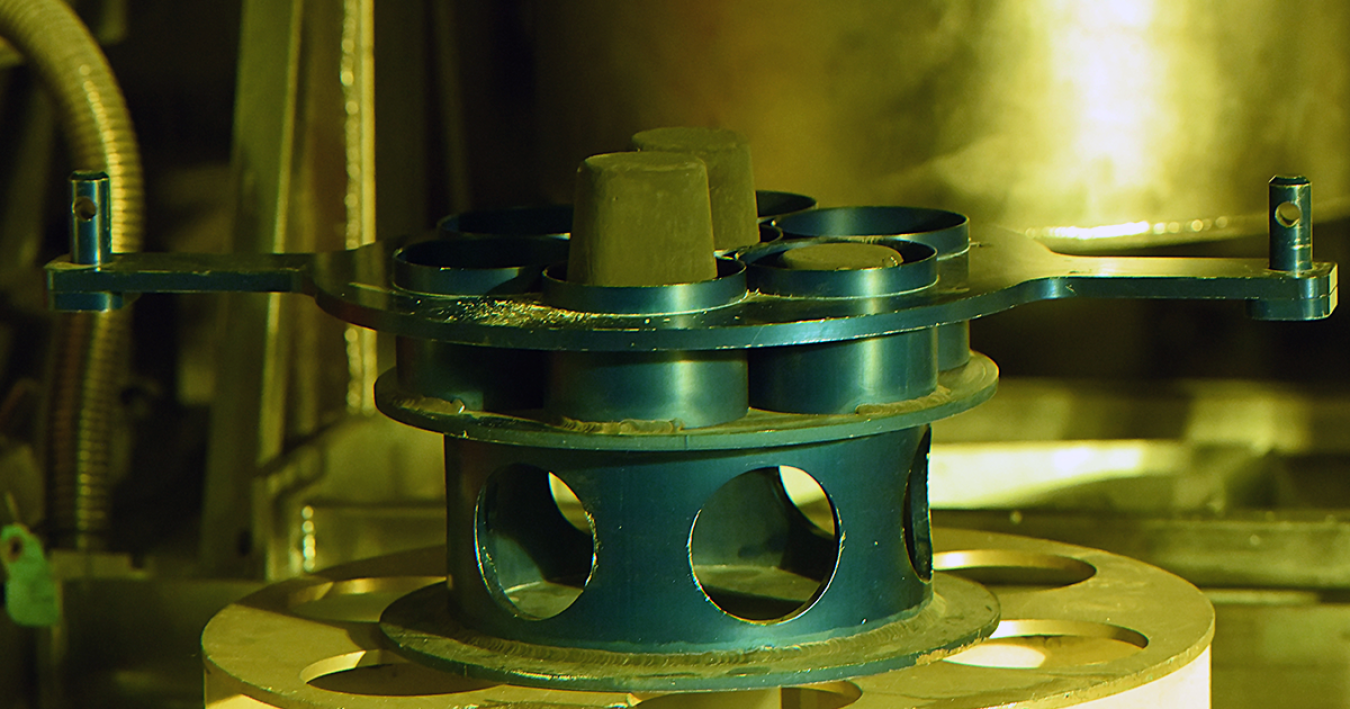
HALEU reguli fabricated from downblended high-enriched uranium recovered from legacy EBR-II fuel at Idaho National Laboratory. (Photo: DOE)
Five companies are the recipients of Department of Energy awards to support the development, modification, and licensing of transportation packages for high-assay low-enriched uranium (HALEU) fuel. HALEU, which is enriched between 5 percent and 20 percent, is the type of fuel required for the operation of many of the small advanced nuclear reactors that are being designed and developed by U.S. companies.
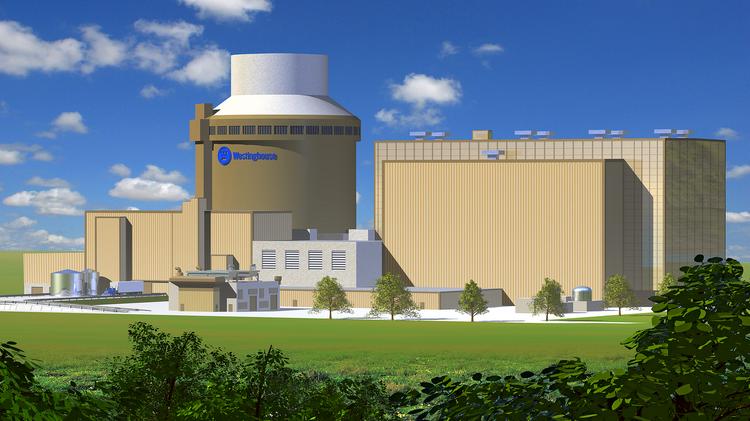
Artist’s rendering of the Westinghouse Electric AP1000 modular reactor. (Image: Westinghouse)
New and immersive internship and development opportunities are being offered through a partnership of Westinghouse Electric Company and the Ukrainian nuclear energy utility Energoatom. Beginning this autumn, more than 60 opportunities will be available for Ukrainian nuclear energy professionals and graduate-level students.
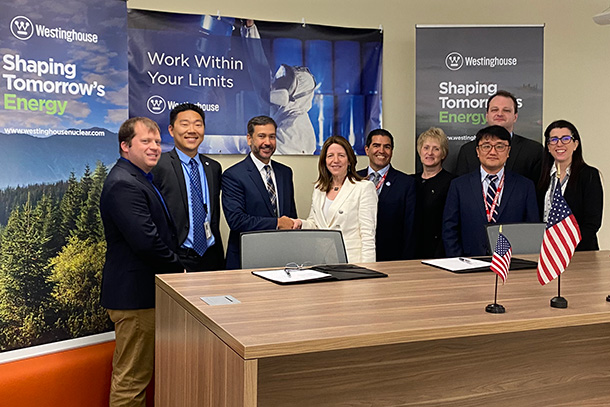
Representatives from Westinghouse and Penn State met at Westinghouse headquarters to sign a memorandum of understanding and enter a partnership focused on researching and developing microreactors. From left: Jason Beebe, director of the global transformation office at Westinghouse; Michael Valore, senior director of advance reactor commercialization, Westinghouse; Mike Shaqqo, senior vice president of advanced reactors, Westinghouse; Lora Weiss, senior vice president for research at Penn State; Jean Paul Allain, head of the Ken and Mary Alice Lindquist Department of Nuclear Engineering at Penn State; Geanie Umberger, associate vice president for research and director of industry research collaborations at Penn State; Saya Lee, assistant professor of nuclear engineering; Elia Merzari (back), associate professor of nuclear engineering; and Hilary Ruby, director of transformation for the Americas Operating Plant Services Business Unit at Westinghouse. (Photo: Westinghouse)