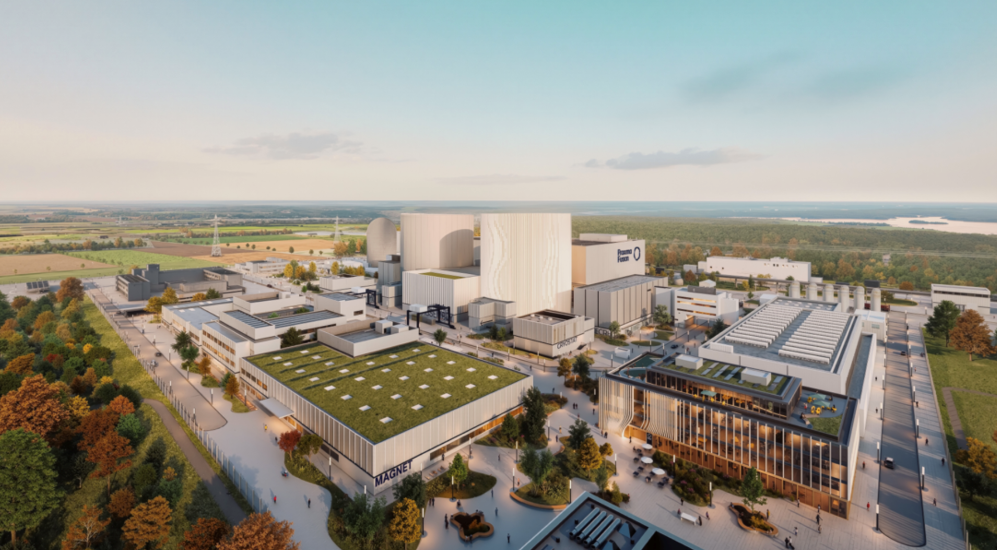
Artistic rendering of the future site of Proxima’s commercial stellarator fusion power plant Stellaris, in Gundremmingen, Germany. (Image: Proxima Fusion)
Proxima Fusion has signed a memorandum of understanding with the Free State of Bavaria, German electric company RWE, and Max Planck Institute for Plasma Physics (IPP) to build a commercial stellarator fusion power plant in Europe. Based in Munich, Proxima was spun out of IPP in 2023.
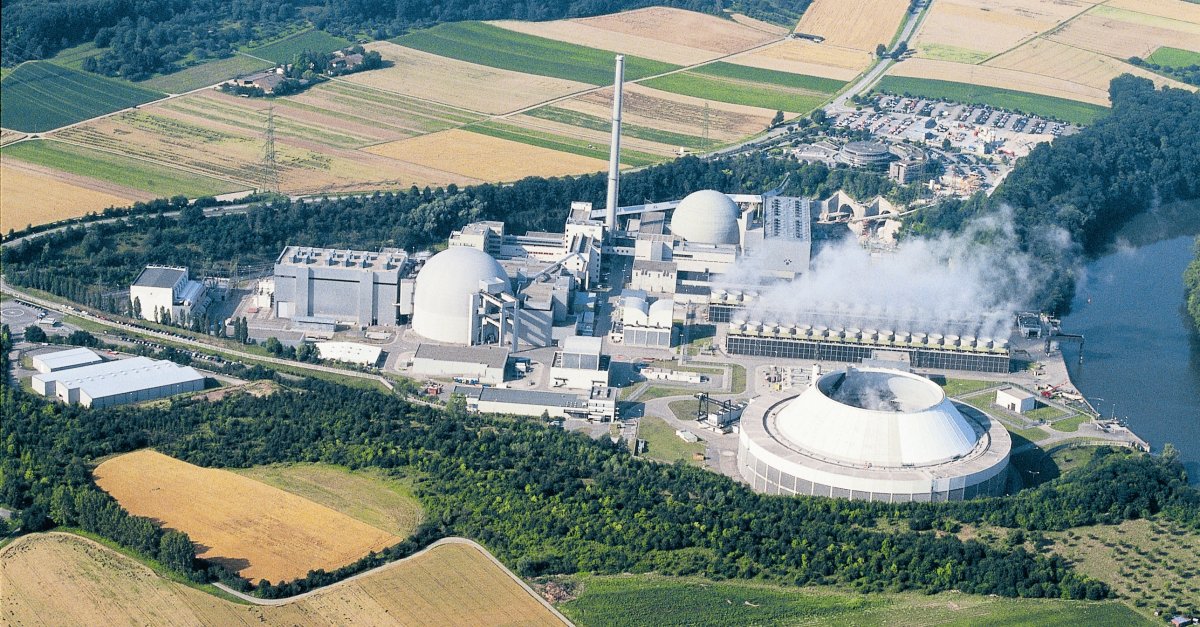
The Neckarwestheim nuclear power plant in Germany.
Ignoring a last-minute plea from a long list of scientific luminaries (including Nobel laureate Steven Chu and climate scientist James Hansen) to reconsider, as well as recent polls showing pronuclear sentiment among a majority of its population, Germany shut down its last three operating nuclear power plants late Saturday, ending 60-plus years of electricity generation from fission. (Germany’s first nuclear power plant, Kahl, was commissioned in 1961 and closed in 1985.)
The Neckarwestheim nuclear power plant in Germany. (Photo: EnBW)
German chancellor Olaf Scholz has provided what appears to be the final word on the fate of his country’s three remaining operating nuclear power plants.
Via an October 17 letter, Scholz informed economy and energy minister Robert Habeck, environment minister Steffi Lemke, and finance minister Christian Lindner of his decision to keep all three facilities operating “beyond 31 December 2022 until 15 April 2023 at the latest.” The order ends months of argument between Scholz’s two coalition partners—the stridently antinuclear Greens and the center-right Free Democrats (FDP)—regarding the plants’ continued operation. (Habeck and Lemke are Green Party members, while Lindner is with the FDP.)
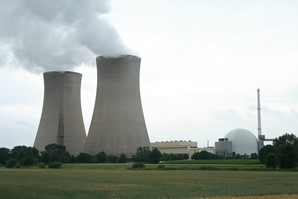
E.ON subsidiary Preussen Elektra’s Grohnde nuclear plant, located near the town of Hameln in Lower Saxony, on the banks of the Weser River. (Wikimedia/Heinz-Josef Lücking)

-3 2x1.jpg)