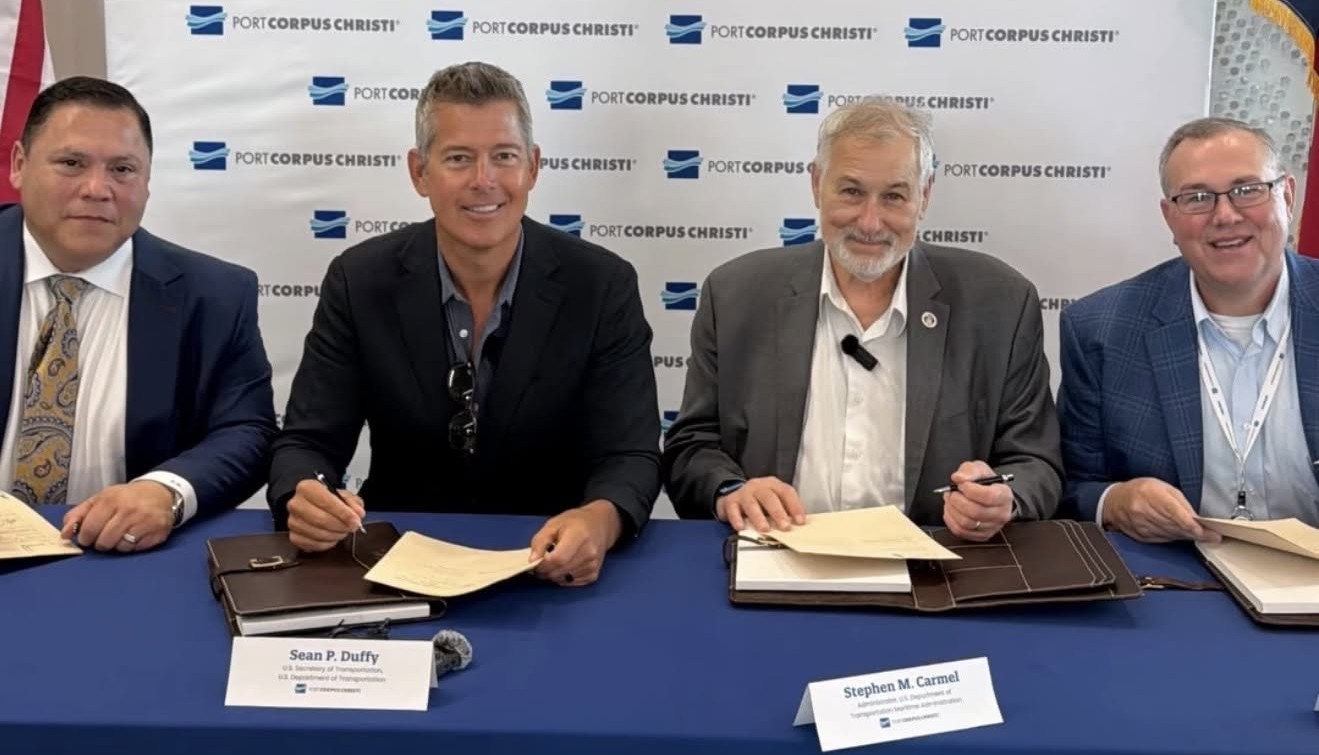
Federal and port officials sign an MOC to explore maritime nuclear opportunities in the Port of Corpus Christi in Texas. (Photo: MARAD)
The Department of Transportation’s Maritime Administration (MARAD) has signed its second memorandum of cooperation with a U.S. seaport to advance the development of small modular reactors to power commercial vessels, ports, and other maritime assets—this time, shifting its attention to the Gulf coast.
The MOC pairs the Port of Corpus Christi in Texas with MARAD to explore SMRs, microgrids, and advanced vessel propulsion systems for maritime applications. Last week, Secretary of Transportation Sean Duffy, MARAD Administrator Stephen Carmel, Port of Corpus Christi CEO Kent Britton, and Port of Corpus Christi Commission Chair Gabe Guerra signed the MOC at a ceremony.
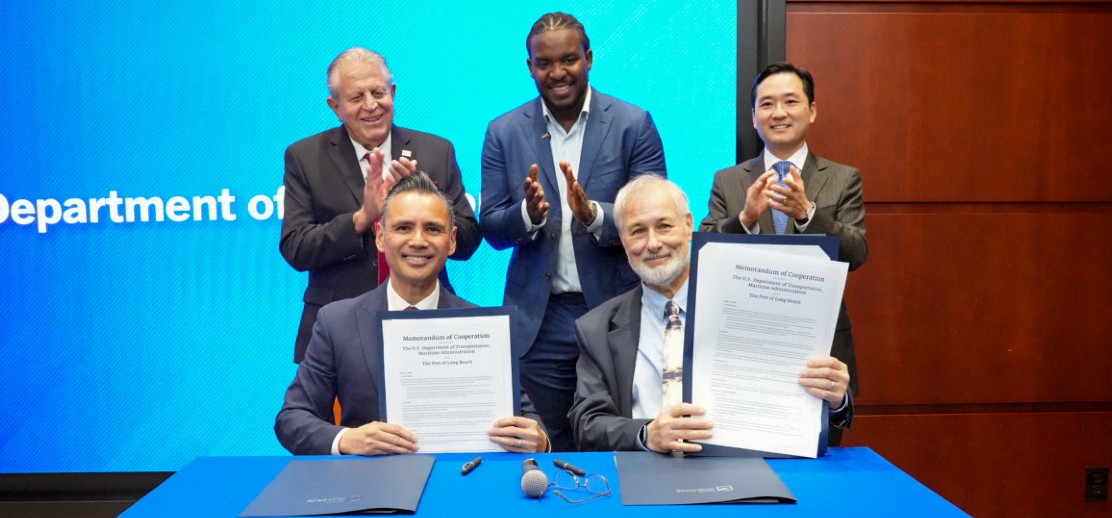
The MARAD–Port of Long Beach MOC is displayed by Port of Long Beach CEO Noel Hacegaba (seated, left) and MARAD Administrator Stephen Carmel (seated, right). Standing behind, from the left, are Long Beach Board of Harbor Commissioners president Frank Colonna, BlueCore Energy CEO Kofi Asante, and American Association of Port Authorities president and CEO Sang Yi. (Photo: Port of Long Beach)
The Department of Transportation’s Maritime Administration has signed a first-of-a-kind memorandum of cooperation (MOC) with the Port of Long Beach, in southern California, to advance the development of small modular reactors for powering commercial vessels, ports, and other maritime assets. With the signing, Long Beach became the first U.S. seaport to form a partnership with MARAD on commercial nuclear-powered maritime vessels. The federal maritime agency had issued a request for information in May seeking industry input on the development of domestic, scalable, commercially viable reactors for U.S. marine transportation.
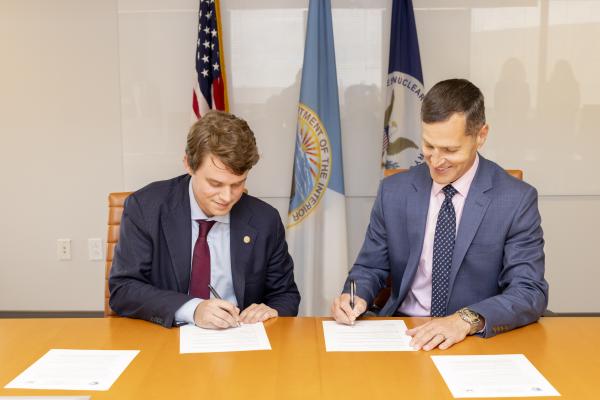
Matt Giacona (left), MMA acting director, and Jeremy Bowen, NRC Office of Advanced Reactors director, sign an MOU on July 21. (Photo: Bureau of Ocean Energy Management)
Within the past month, the Nuclear Regulatory Commission has signed memorandums of understanding to increase its cooperation with two U.S. maritime organizations. In late June, the NRC signed an MOU with the U.S. Coast Guard to strengthen coordination on civilian maritime nuclear projects, including floating nuclear power plants and civilian nuclear propulsion. On July 21, the NRC signed an MOU with the newly formed Marine Minerals Administration (MMA) to improve cooperation regarding potential future nuclear projects on the Outer Continental Shelf.
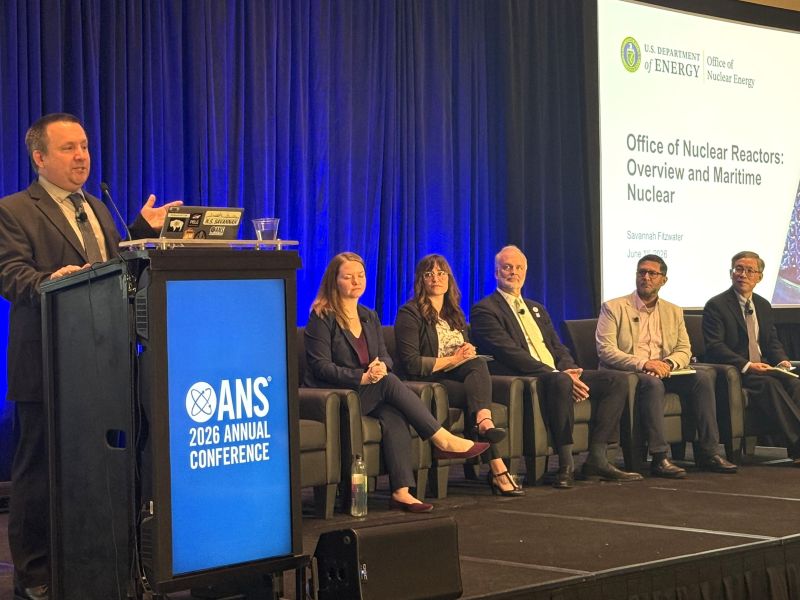
BWXT’s Jonathan Stephens moderated the “Advancing Nuclear Powered Maritime Shipping” session, featuring, from left, Savannah Fitzwater of the DOE, Meg Albrecht of Lloyd’s Register, Scott Edwards of Core Power, Sanjay Mukhi of Deployable Energy, and Xiaodong Sun of the University of Michigan.
At the American Nuclear Society’s Annual Conference on June 1, an executive session covered the increasingly prominent subject of nuclear applications in the civilian maritime industry.
Panelists who presented during “Advancing Nuclear Powered Maritime Shipping” highlighted the fact that the commercial shipping industry, the nuclear industry, and government agencies are looking at nuclear power as a solution for reducing greenhouse gas emissions, 3 percent of which are attributed to commercial shipping.
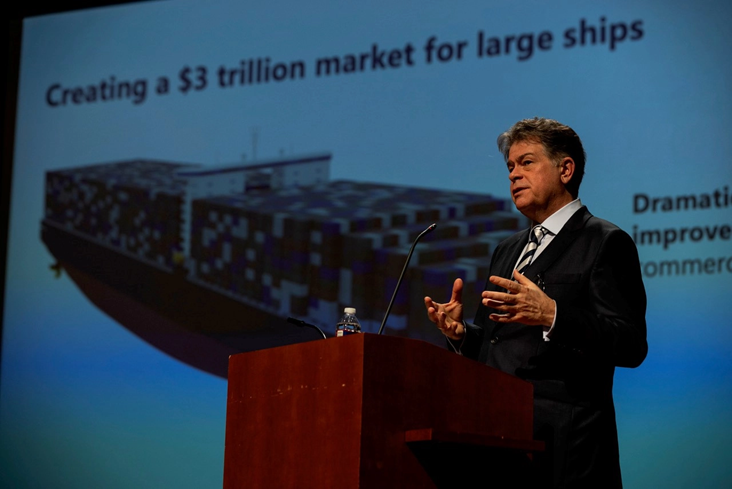
Core Power CEO Mikal Bøe addresses a Houston, Texas, summit. (Photo: Nina Rangoy)
U.K.-based Core Power has announced that it intends to develop a maritime civil nuclear program anchored in the United States with the goal of bringing floating nuclear power to market by the mid-2030s. The program, called Liberty, is to encompass the modular construction of advanced reactor technology and create the regulatory and supply chain frameworks needed to begin the mass production of floating nuclear power plants (FNPPs) on a global scale.
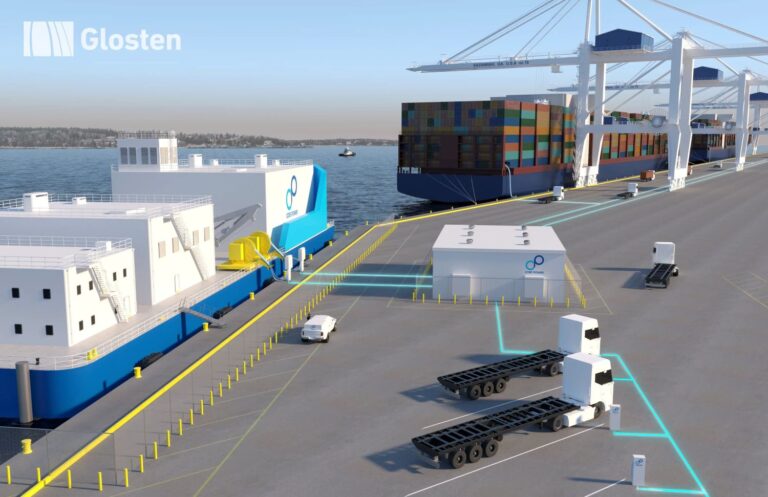
Concept art showing a FNPP design. (Image: Glosten)
A team of innovative companies has plans to bring floating nuclear power plants to U.S. ports.
Core Power, a maritime and nuclear technology company, announced in January a new partnership in with naval architecture company Glosten. The pair is working on a design for a floating nuclear power plant (FNPP) that could generate up to 175 gigawatt-hours of clean electricity annually and provide clean power to ships, equipment, and port vehicles, Offshore Energy reported.
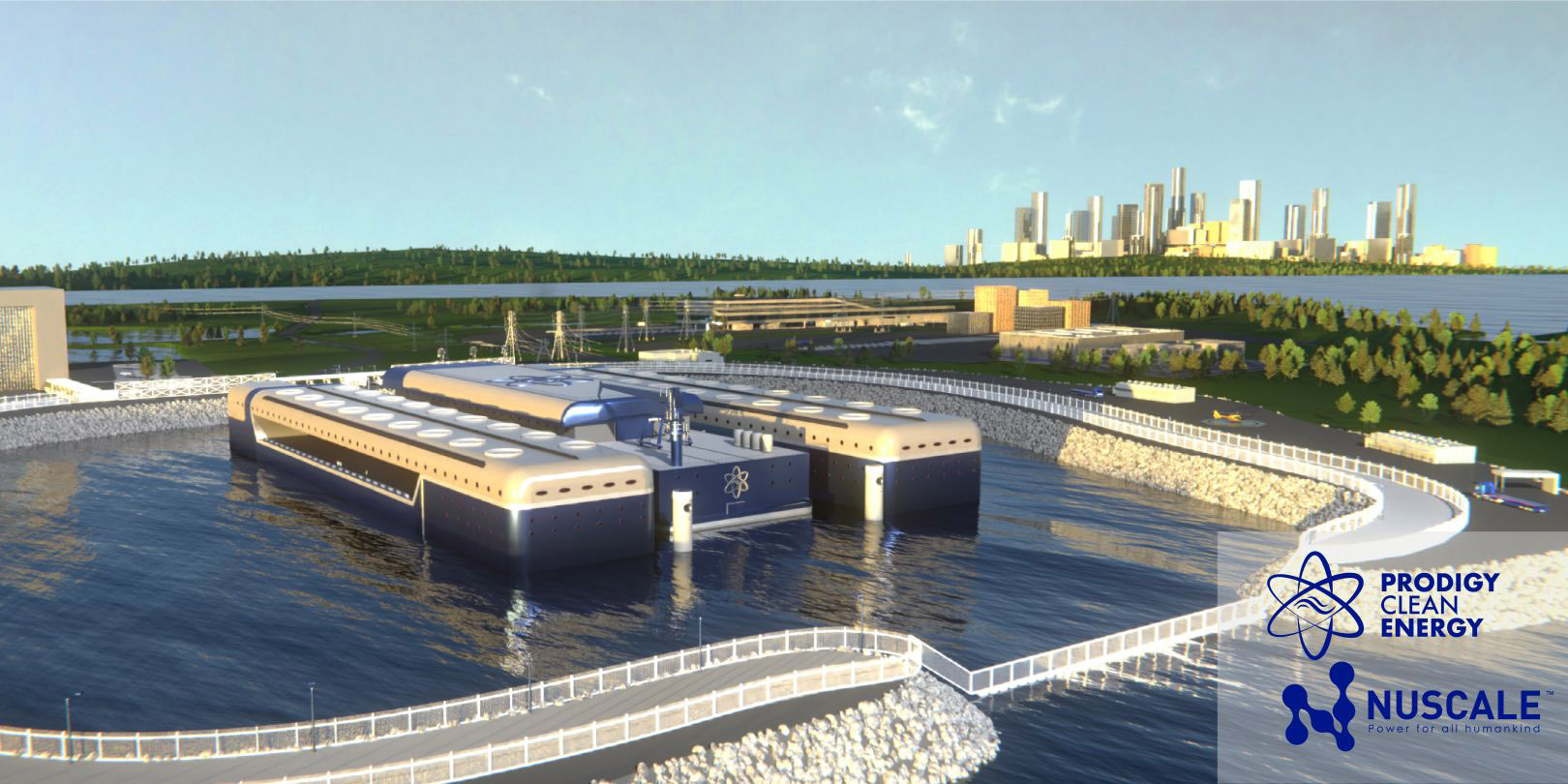
Conceptual layout and deployment of a Prodigy SMR Marine Power Station with 12 NuScale Power Modules. (Graphic: Business Wire)
NuScale Power and Prodigy Clean Energy announced on October 26 that they have developed a conceptual design for a transportable, marine-based small modular reactor. The companies plan to present the design to utilities, regulators, and shipyard manufacturers. Prodigy, a Canadian company “specializing in the development of transportable nuclear power plants,” and NuScale signed a memorandum of understanding in 2018 agreeing to pursue the development of an SMR marine facility.