
-3 2x1.jpg)
The oil spill: Nuclear, take note
January 13, 2011, 7:00AMANS Nuclear Cafe
A few months ago, I had the honor of leading a class of future engineering leaders at Iowa State University. The dean, Dr. Jonathan Wickert, occasionally asks alums and others who have done interesting things with their engineering degrees to come in and lead the class in a case study. Events in the Gulf of Mexico that started in April 2010 with the Macondo oil spill provided an excellent opportunity to talk about crisis management and communications, with the added benefit of current technology relevance. This is an area that the nuclear industry also needs to study and understand.
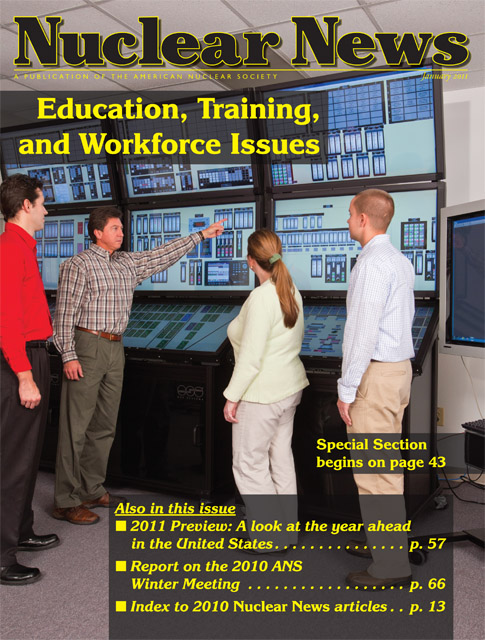 The January issue of Nuclear News has been published and mailed to American Nuclear Society members, and is
  The
The 
 The
The  Let's talk about food irradiation, which has made some in the general public fearful simply because a form of the word "radiation" is involved. Irradiation is used to destroy harmful bacteria and parasites that might be inadvertently present in some food matter. Irradiation makes the food safer for human consumption and, at low levels, it extends food's shelf life and can be used to control insects.
 American Nuclear Society scholarship applications for the 2011-2012 academic year are now online! Since ANS was established in 1954, it has promoted the awareness and understanding of nuclear science and technology (NS&T). To further that mission, ANS administers scholarships each year that support the development and education of those who will research and implement future applications of NS&T.
 It's not too late to go nuclear for the holidays.
  The
The  The
The