Sandia enters into SPP with Elemental
On August 11, Elemental Nuclear announced that the Department of Energy, through Sandia National Laboratories, approved its entrance into a Strategic Partnership Project. The SPP will support the development of Elemental’s supercritical carbon dioxide (sCO₂)–based Brayton cycle generator systems.
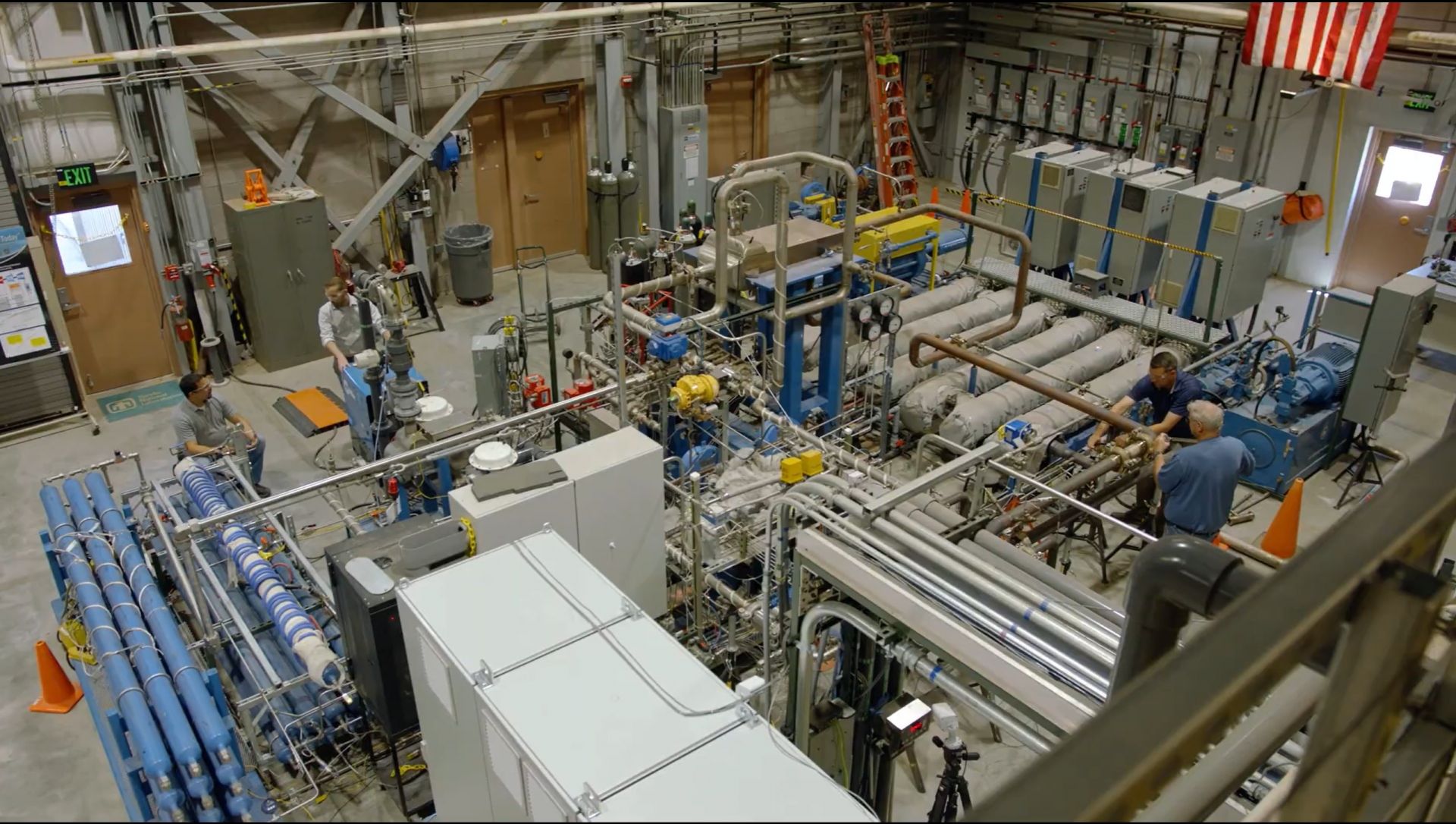
The background: As Elemental noted in its announcement, Sandia is “internationally recognized as a leader in closed-loop, recompression Brayton cycle systems and components, and operates one of the world’s foremost sCO₂ test facilities.” That recognition comes from a collection of projects the lab has been developing in the Brayton cycle space over the past two decades.
Sandia installed a first-of-a-kind, closed-loop recompression closed Brayton cycle in 2012. After several years of experimentation, in 2017, Sandia announced that it had entered into three cooperative research and development agreements (CRADAs) with private industry to commercialize the technology. At the time, the lab described that technology as a “power generation system that could yield thermal-to-electric conversion efficiency as much as 50 percent greater than conventional steam technology.”
Conventional steam technology boils water with heat from a source like a power reactor or natural gas combustion. The resulting steam is then expanded through a turbine to generate electricity. The efficiency of this process is about 33 percent, meaning one-third of the thermal energy is ultimately converted to electricity. A significant amount of usable energy is lost when steam cools and condenses into water.
A Brayton cycle cuts out the water, applying the heat source directly to (in this case) sCO₂, which is then expanded through a turbine. After exiting the turbine, the gas is cooled before returning to a compressor, after which it can be heated once again.
Removing water-cooling-related energy losses is not the only way Sandia’s Brayton cycle design increases energy efficiency; sCO₂ itself offers further efficiency gains. sCO₂ is a fluid state of carbon dioxide in which the temperature and pressure are held above their critical points. This fluid has a liquid-like density but otherwise behaves like a gas. The increased density allows for more heat to be moved with less pumping power, compared with traditional steam.
In 2022, Sandia successfully demonstrated electricity delivery to the Sandia-Kirtland Air Force Base electrical grid using its Brayton cycle technology.
Explaining SPPs: Between CRADAs, SPPs, MOUs, SBIRs, and a whole range of public-private programs, there are many avenues—and abbreviations—of partnership available to the industry when looking to partner with the DOE, each of which differ in ways ranging from minor to major.
SPPs are coordinated by the Office of Enterprise Planning and Analysis within the DOE’s National Nuclear Security Administration. These agreements provide a company access to highly specialized and unique NNSA facilities, services, equipment, and expertise. While the specifics and scope of each SPP naturally varies, the pathway broadly allows a company to outsource specific research and/or development tasks to an NNSA facility.
Agreement details: Elemental (not to be confused with Elementl, another nuclear start-up) will work with Sandia on the development of its own sCO₂-based Brayton cycle generator systems. Specifically, they will collaborate on the design, construction, and demonstration of two power-generating technologies. The first is a “1-MWe natural-gas-and-waste-heat-fired power and cooling system targeted for use in small modular data centers and remote military installations.”
The second is a scaled-up 10-MWe system designed to operate with a range of heat sources, including Elemental’s reactor design. That reactor, which Elemental calls the ISTR Power System, is sodium-cooled and uranium zirconium hydride–fueled (a standard fuel for TRIGA-type research reactors).
Elemental plans to have its first system operational next year and is aiming for commercial deployments of its Brayton cycle technology in 2028.