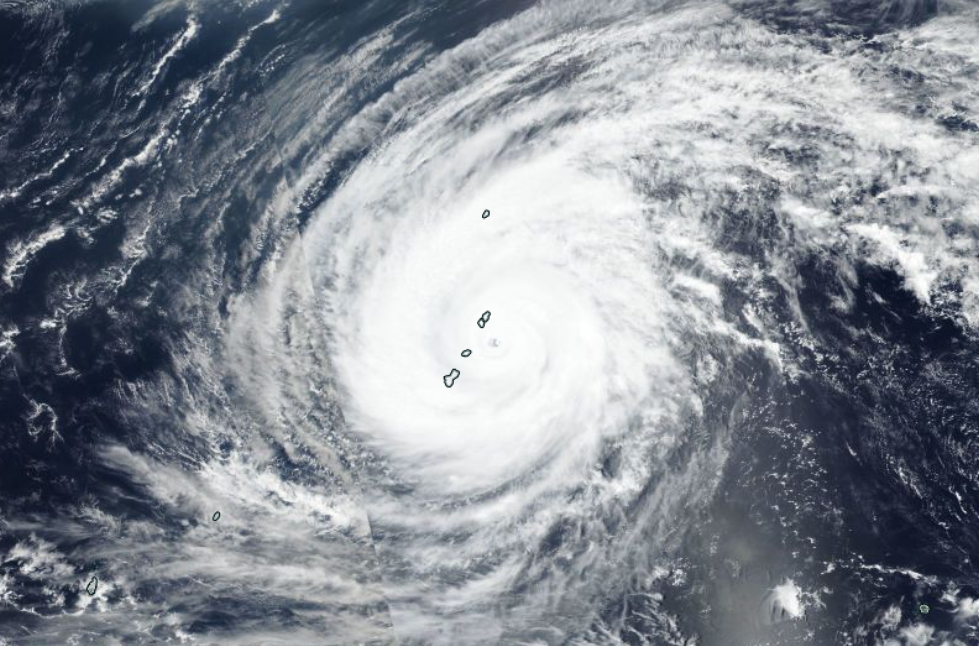
This photo of Typhoon Sinlaku over the Mariana Islands is an example of a tropical cyclone—a warm-core, low-pressure system with no attached front and an organized circulation that develops over tropical or subtropical waters. (Photo: NASA)
Scientists at Argonne National Laboratory have published a study evaluating the risk of flooding caused by tropical cyclones on coastal infrastructure, including nuclear power plants. The study, published in npj Natural Hazards, used advanced computer simulations of thousands of cyclone scenarios to make projections of potential damage of extreme storm tides in coastal areas—a threat that is expected to increase as a result of climate change. The researchers stated that their projections could be used to make siting decisions and design more resilient systems for nuclear power plants, hospitals, and other crucial infrastructure.
Low frequency events: Coleman P. Blakely, William J. Pringle, and V.R. Kotamarthi, who conducted the study, based their simulations on historical data and physics principles, and used Argonne’s Laboratory Computing Resource Center to create them. Their objective was to show how possible changes in cyclone strength and paths could affect risks from storm surges and floods. They verified the accuracy of their models using data from recent cyclones. Their evaluations focused on coastline of the Bay of Bengal in India.
Argonne senior scientist V. R. Kotamarthi said, “We wanted to understand how to evaluate the risk of building critical infrastructure in a hydrologically complex coastal area. We wanted to estimate the changes in low-frequency events [which extreme storm tides are considered] as would be necessary for siting nuclear reactors.”
India and Bangladesh: The researchers found that their simulations indicated variable risk in the Bay of Bengal region. The computer models showed a 78 percent elevated risk from low frequency events, compared with high-frequency events, along India’s eastern coast, where the proposed Kovvada Atomic Power Project is sited. The study noted that water accumulation caused by wave action and tide-surge interactions is especially significant in this area. By contrast, the models indicated a relatively lower risk in the Ganges-Brahmaputra-Meghna delta region of Bangladesh, though extreme flooding events are still possible there.
Update safety rules: The authors recommended certain actions to reduce flood risks, including improving safety protocols for existing infrastructure and conducting detailed flood risk assessments for new infrastructure.
Kotamarthi, who is working with the International Atomic Energy Agency on applying hydrological and meteorological hazard information to nuclear sites, said, “Since we are building more power plants in different locations, we need to do a more thorough analysis. There’s more to consider than just elevation. Even existing plants likely will need to update safety rules to account for the estimated risks from these types of hazards.”
Make predictions more reliable: Although this study focused on the Bay of Bengal, its methods “can be used for any coastal region where storm-tide risk assessments are needed,” Argonne noted in a press release about the research. “The study highlights opportunities to expand this research to other vulnerable coastal regions worldwide.”