Realta Fusion makes electricity, but not through heat conversion
Realta Fusion announced it has achieved direct energy conversion at the Wisconsin HTS Axisymmetric Mirror (WHAM), powering a lightbulb using electricity extracted from charged particles emitted by the plasma.
This process, called direct energy conversion (DEC), was theorized by Richard Post, a physicist at Lawrence Livermore National Laboratory, and has been demonstrated experimentally a few times, the earliest being the “Venetian blind” converter in the 1970s.
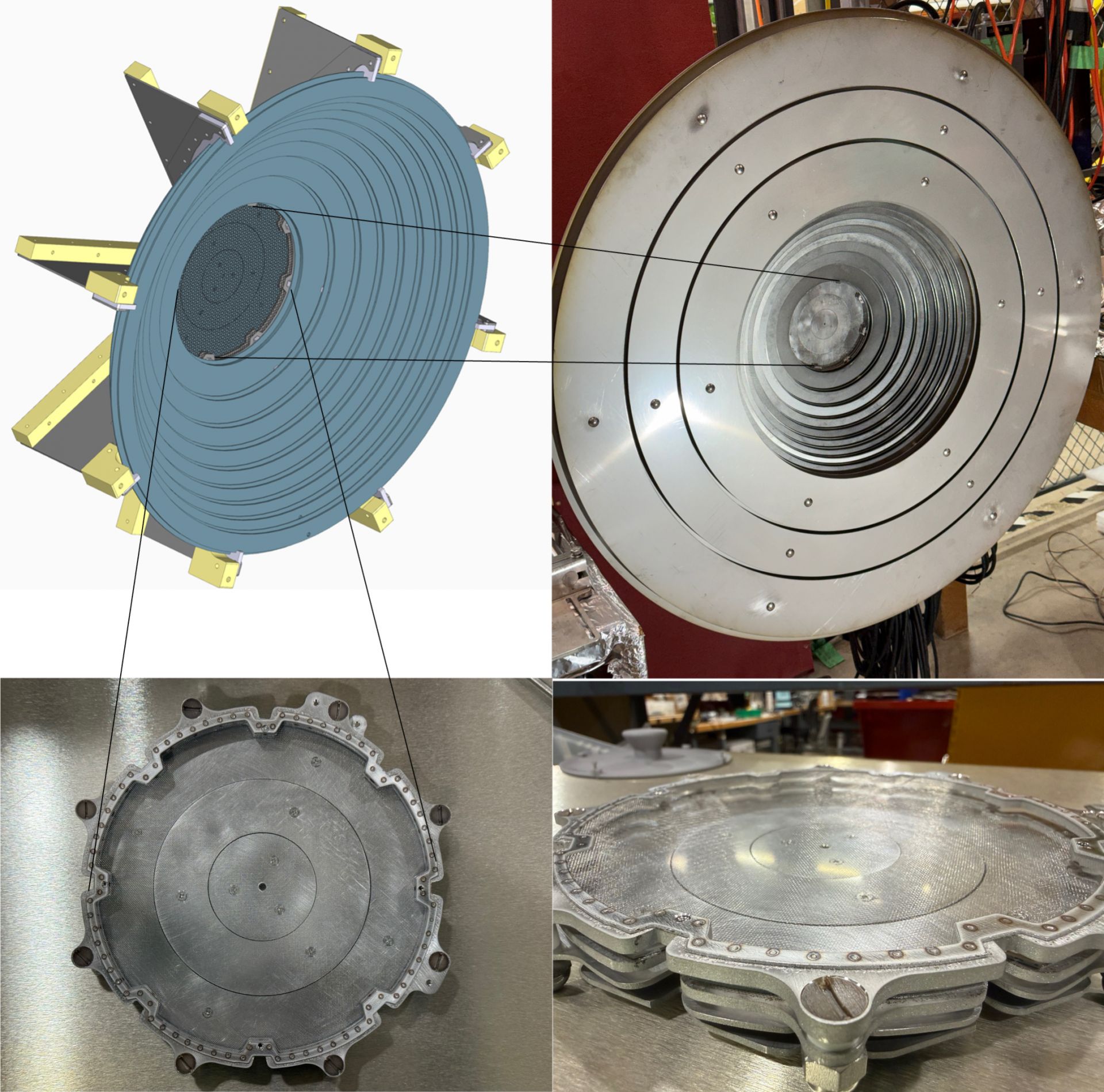
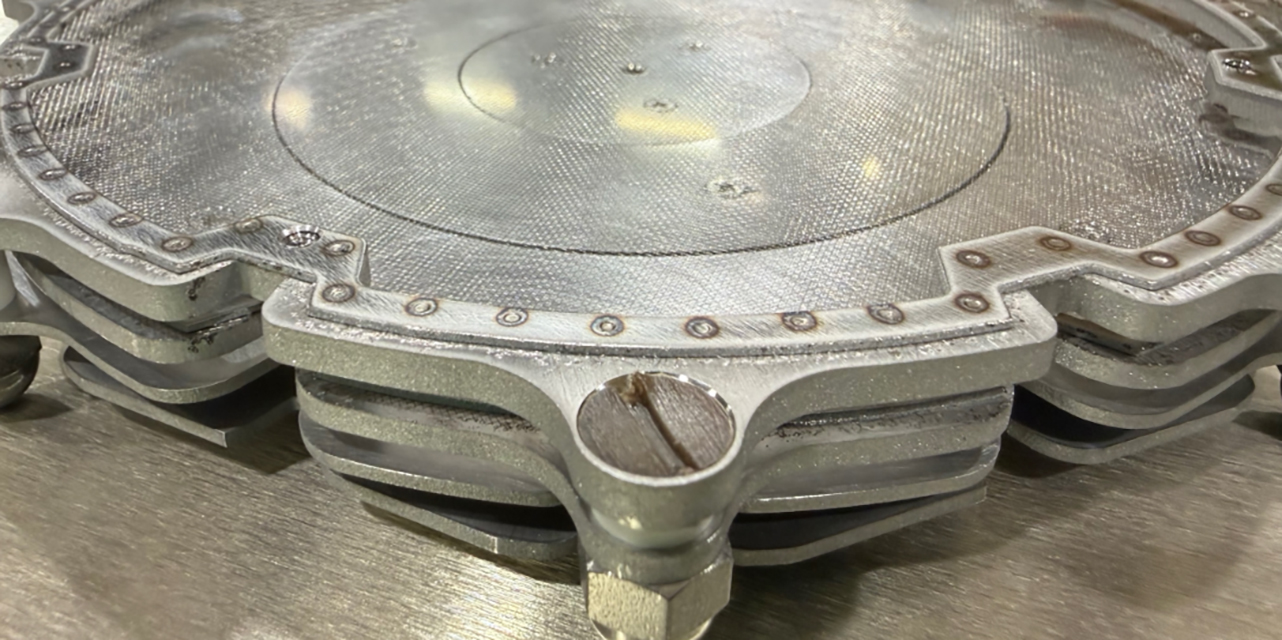
Single-stage direct energy converter on WHAM. Upper left: Direct energy converter installed in the center of the end-ring in CAD. Upper right: Assembled system ready for installation on WHAM. Lower left and right: Zoomed-in photos of the direct energy converter assembly head on and at an angle showing the three-layer grids used for this first prototype. (Image: Realta, with credit to Dmitry Yakovlev and Tucker Peterson of UW-Madison and Ty Omark of Realta)
Derek Sutherland, Realta's chief scientific officer, said, “The novelty here is that we have done this now as a private company in a meaningful way and intend to scale it rapidly for commercial fusion power applications in the coming few years. . . . This is neither a demonstration of net-electricity production nor large-scale conversion of fusion-born power directly into electricity.”
DEC is not the process that first comes to mind when discussing fusion power: using neutrons emitted from fusion reactions to drive a thermal cycle. It is a supplemental form of energy extraction, and current methods are more suited to open-ended magnetic fusion machine concepts, like the magnetic mirror approach used by WHAM, than they are to closed systems such as tokamaks and stellarators.
Sutherland said embracing DEC allows the company to “consider the leakiness of magnetic mirrors as a compelling feature rather than a hurdle.”
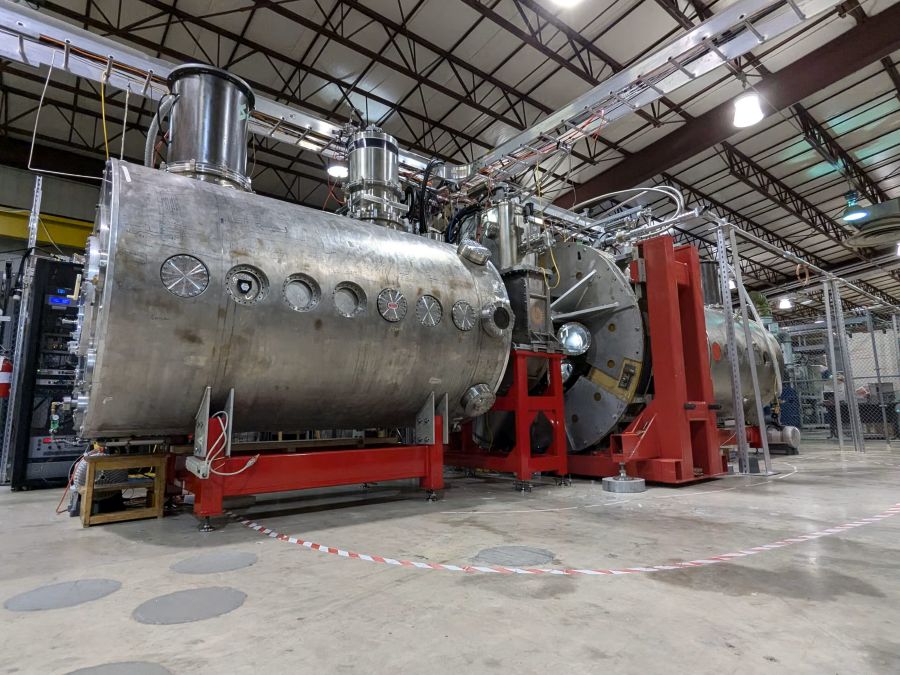
WHAM: WHAM is a prototype magnetic mirror fusion device housed on the University of Wisconsin–Madison campus. It started as a publicly funded project with UW-Madison, the Massachusetts Institute of Technology, and Commonwealth Fusion Systems. Realta is a spinoff company from the project, and WHAM now operates as a public-private partnership, with the company contributing most of its funding.
How it works: What Sutherland refers to as the “leakiness” of magnetic mirror confinement is charged particles that scatter into a loss cone. Realta’s design minimizes its loss cone using high-temperature superconducting magnets to increase the magnetic field strength, improving plasma confinement. But while the feature remains, Sutherland argues that it can be used as a strength.
The loss cone acts as a natural exhaust, keeping the fusion plasma clean, and energy from the charged particles in the loss cone can be captured with high efficiency through DEC. Most of the energy produced in a power plant version of this concept would still be from capturing neutron energy as heat in a moderating blanket, but adding on DEC increases the efficiency of the overall system.
“You can think of a [deuterium-tritium] fusion power plant with DEC like a hybrid powertrain in a vehicle—it generates heat to push pistons (or in our case, spin turbines) for most of the power but with an electric component to improve efficiency,” said Sutherland.
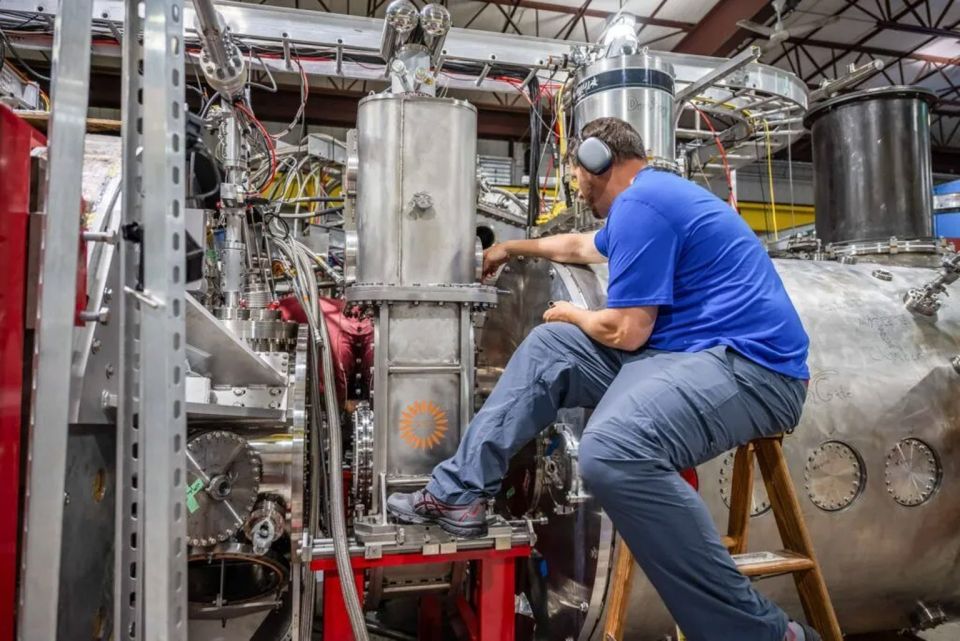
Realta’s DEC test: Realta installed a direct energy converter in WHAM’s end-ring assembly. It used an electrostatic approach to DEC, slowing down charged particles as they exited through the loss cone using an electrostatic potential, converting the captured kinetic energy directly into electricity.
According to Sutherland, the converter used in this test had three finely meshed grids, “an electrically grounded grid, an electron repulsion grid, and an ion collector grid.” This first test was to make sure the concept works, producing power levels in the hundreds of watts. Next steps would involve a converter with more coverage and more stages, able to capture more energy.
He said that in this test, “most of the directly converted energy is of the input power we are supplying the mirror plasma to heat and sustain it,” but that at the power plant scale, more of the converted power would be coming directly from fusion.
Sutherland said that the company found setting up DEC at WHAM to be “relatively straightforward.” According to the company’s announcement, Realta installed the converter on June 19, less than two weeks before announcing it had drawn electricity.
Scaling up: Like many aspects of fusion technology, it remains to be seen how—or if—the concept scales up to power plant–applicable levels. Sutherland said Realta is working on new end-ring assembly designs that could increase the amount of electricity produced but that the maximum it could scale to on WHAM is around 1 MW.
“It’s now on us to scale what we’ve done on WHAM to multi-kilowatt and ultimately multi-megawatt capability in our future devices,” he said. “But, even with this first demo, our path to commercial [deuterium-tritium] mirror fusion power plants just got clearer.”
Sutherland said the company will be making more measurements, testing operations at higher voltages and seeking to understand the impact of using the convertor on plasma conditions. According to Realta, it expects to operate DEC at over 90 percent efficiency in a fusion power plant, though the company is not yet releasing efficiency numbers from this test.
“We’re planning on running dedicated campaigns to better determine these numbers soon,” Sutherland said. “We believe we can generate enough electricity using DEC in our design points to completely cover the input power requirement of the system for continuous operation, leaving the heat component for either direct use or the generation of electricity for customers.”
That would require scaling the DEC system to tens or even hundreds of megawatts. According to the company, it would translate to lowering the cost per kilowatt-hour by at least 10–20 percent.
Fuel implications: Sutherland said using DEC also opens an avenue for using catalyzed deuterium-deuterium or deuterium-helium-3 fuels.
“By using DEC with advanced fuels, we could potentially rely less on a thermal cycle to generate electricity and sidestep the need for large-scale tritium breeding—both could result in additional cost savings for our future fusion power devices geared on generating electricity,” said Sutherland.
Who’s using DEC? Realta is not the only commercial fusion company pursuing this option. Helion Energy’s magneto-inertial fusion concept is also suited to DEC, and the company has widely discussed using an induction-based method of DEC as a pillar of their approach.
"People have been talking a big game about DEC for years, so we just went out and did it," said Kieran Furlong, CEO of Realta. "We’re the first private fusion company to achieve DEC of plasma kinetic energy into electricity on a real fusion machine."
The Defense Advanced Research Projects Agency has been investing in projects that could expand the possibilities of direct energy conversion. DARPA’s Rads to Watts program, launched in 2025, recently funded seven projects with innovative concepts for directly converting energy from various types of radiation to electric power. If a direct energy conversion method were developed for neutrons, it could lead to a major efficiency boost for both nuclear fission and fusion.