
DOE, INL, Kairos talk nuclear energy at Senate committee hearing
It has been 10 months since President Trump signed several executive orders that have reshaped the nuclear energy industry and set lofty goals for initiatives like the development and deployment of new nuclear technology.
One such initiative, the DOE’s Nuclear Reactor Pilot Program, calls for at least 3 of the 11 reactors in the program to achieve criticality by July 4, 2026. Some have questioned whether this target is feasible.
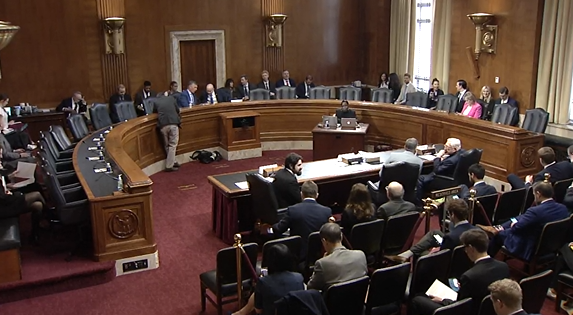
Department of Energy Assistant Secretary for Nuclear Energy Theodore Garrish and Idaho National Laboratory Director John Wagner, however, told the U.S. Senate Energy and Natural Resources (ENR) Committee at a hearing on Thursday that three will achieve criticality by Independence Day. Other reactors should hit the milestone later in the year.
“When I first saw the executive order . . . I couldn’t imagine how that was going to be possible,” Garrish said. “We sent out requests for applicants and received 11. And out of that 11, it appears at least three or four will be able to meet that deadline.”
The ENR Committee had a chance to gauge the progress of the pilot program and other efforts associated with the executive orders at Thursday’s hearing. Garrish, Wagner, and Kairos Power CEO Mike Laufer were on hand to provide updates and answer questions from the senators on topics like advanced reactors, cost overruns, domestic enrichment investments, and fuel recycling.
Reactor updates: Throughout the hearing, the three speakers noted multiple encouraging developments:
- Aalo Atomics and Oklo breaking ground on their sites at INL.
- The introduction of the DOE Nuclear Energy Launch Pad.
- TerraPower’s receipt of a construction permit for its Natrium reactor in Wyoming.
- Progress on the Microreactor Applications Research Validation and Evaluation (MARVEL) test reactor.
- Kairos Power’s ongoing progress with its Hermes reactors.
In less than a decade, Kairos has matured to a point where it can see a pathway to provide “affordable, reliable, secure” power to the United States, said Laufer. For instance, its power purchase agreements with Google and the Tennessee Valley Authority are significant milestones for advanced reactors, utilities, and big tech. He argued that Kairos’s approach has also led to cost certainty, a topic that still triggers concern for potential stakeholders.
“We utilize an iterative design, build, and test approach that mitigates the risks that have hindered past nuclear builds,” he said.
Cost overruns discussion: Any first-of-a-kind (FOAK) technology will be more expensive, Wagner argued. One runs into unexpected issues or delays with new technology that may not emerge in future iterations. The cost of two Westinghouse AP1000 reactors at the Vogtle nuclear plant in Georgia ballooned from an estimated $14 billion to more than $30 billion.
One issue facing new nuclear projects is that there are practically no incentives for developers to keep projects on budget and on time, both Wagner and Garrish said.
Sens. James Risch (R., Idaho) and Ruben Gallego (D., Ariz.) mentioned the Accelerating Reliable Capacity (ARC) Act, which they reintroduced earlier this year. The bill would create a federal risk-reduction program to protect companies against unforeseen cost overruns in FOAK reactor designs.
“Overruns are the one issue that we need to really resolve, and we appreciate your efforts to look at the legislative fixes to that,” Garrish added.
Updating nuclear waste policy: Wagner not only used his time to tout the work being done at INL but to urge senators to update the Nuclear Waste Policy Act. The law established a legislative, economic, and social framework for the commercial and government management of used fuel and high-level waste in the United States, and it prioritized establishing mined geologic repositories for the disposal of the material.
Now more than 40 years old, Wagner said the 1982 law is outdated, provides no incentives for fuel recycling, and does not align with the Nuclear Lifecycle Innovation Campuses the DOE has launched, seeking support from interested states.
“I would hope the requests for information responses from this activity the [DOE] is doing would be useful info to inform how exactly the Nuclear Waste Policy Act should be modified,” he said. “I feel strongly modifications are required. We need to move quickly, but we also need to be thoughtful on what needs to be changed.”
Sen. Catherine Cortez Masto (D., Nev.) said addressing where to dispose of nuclear waste created by existing and advanced reactors remains a top priority for her.
“I can't stress this enough: To me, this is the issue we deal with first—how we address waste—so we don't end up where we are today with an old policy from the ’80s and still addressing the waste in this country,” she said. “This is a priority for us to move forward with nuclear technology.”
Domestic enrichment priorities: The DOE announced in January a $2.7 billion investment to strengthen domestic enrichment services over the next 10 years. The ultimate objective of these funds is to strengthen the domestic nuclear fuel supply chain and reduce the dependence on foreign fuel suppliers.
Garrish called this domestic shift a top priority.
“I believe the question of enrichment is one of the most important ones that we have faced,” he said. “We are right now in the process of doing the milestones for enrichment. When that gets done over the next several months, we will begin the process to build domestic enrichment facilities.”
Senators speak: As Gallego put it, there is a “real bipartisan want” to elevate and expand nuclear power, especially as the energy demands of areas like artificial intelligence and advanced manufacturing continue to grow.
Senators from both sides of the aisle were largely supportive of the work and progress shared by the three speakers.
“To put it bluntly: energy will determine the global balance of power for the next generation. If we hesitate now, we will not just fall behind, we will operate inside a system defined by others dependent on supply chains and standards we didn’t write,” said Sen. Mike Lee (R., Utah), the committee chair.


 2x1.jpg)